This is the third installment in an ongoing series, “Powerless,” from Public Health Watch that examines how rising temperatures and skyrocketing electricity costs are placing Texans in danger.
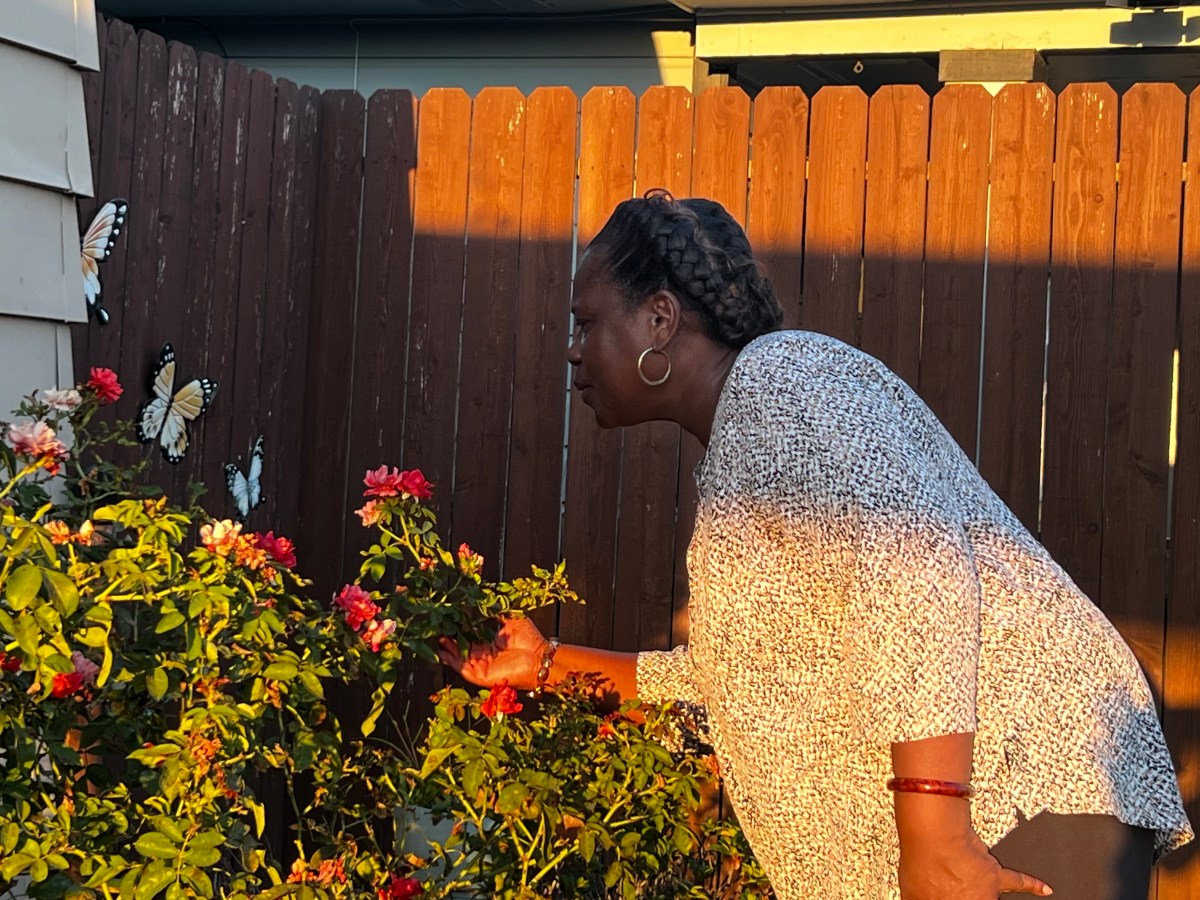
GALVESTON — The green house on M Avenue ½ bears little resemblance to what it was when her great-grandfather purchased it in the early 1920s. But Sherman Boyer sees its history in its wide windows, the doorknobs and lofty entryways between rooms.
Over time, the house was extended, renovated, raised and restored after coastal floodwaters ran through the first floor. The house, Boyer said, is a museum, a relic of Galveston.
But while her home is full of history, it lacked air conditioning until recently.
About ‘Powerless’
An ongoing series about what’s driving the relentless rise in Texas energy costs. Read more.
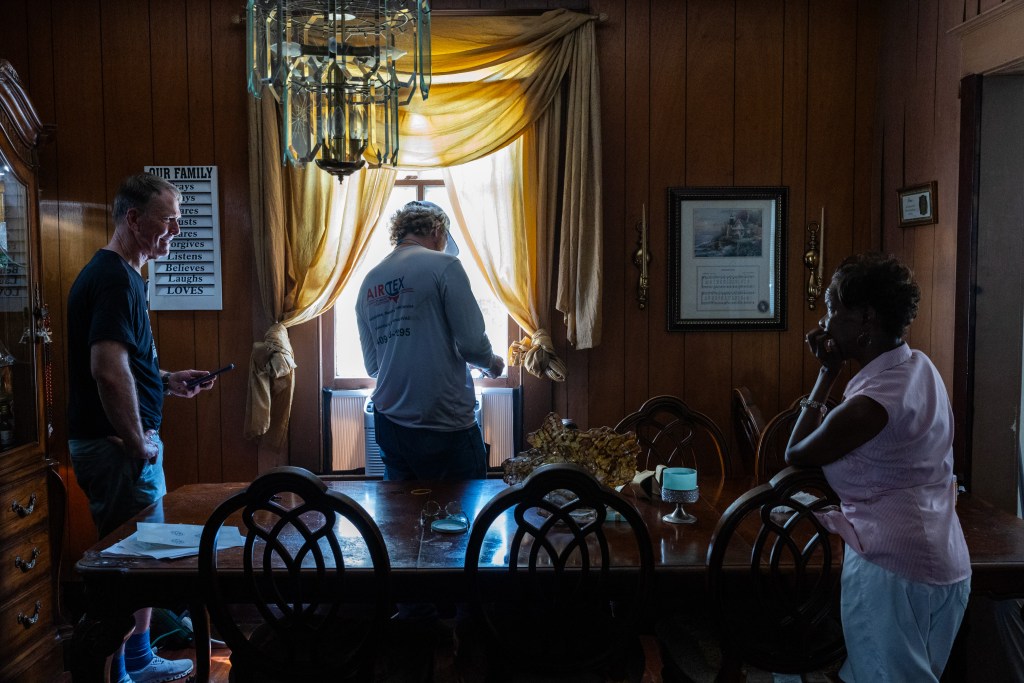
Temperatures in coastal Texas can rise well above 100 degrees for weeks during the summer. Years ago, her mother would open all the windows wide, letting the Gulf breeze cool the house. But times changed. Today, most of Boyer’s windows are boarded up against extreme heat and cold, with curtains drawn tight. She’s tried to compartmentalize the heat, closing off the kitchen with a thick collection of blankets hanging from the doorway.
She abandoned the second floor of her home entirely. Because of summer’s oppressive heat, Boyer lives boxed up in darkened rooms and still owes hundreds of dollars in electric bills.
“This heat now is a different heat,” said Boyer, 87. “It’s hard to keep up with it.”
Boyer is one of many in Galveston struggling with access to air conditioning or the expense of running it. A 2023 U.S. Census Bureau report found that nearly 600 homes in the city, about 2.6%, lack access to any kind of air conditioning, with the majority living in the city’s historically Black neighborhoods. No city ordinance requires landlords to install cooling systems in rental units, and buying air conditioning can be unaffordable for homeowners and renters alike.
Electricity costs have risen an average of 30% in Texas since 2020, the sharpest increase in the United States. This can be a particular struggle in Galveston, where a fifth of housing stock was built before 1939, meaning less insulation to keep homes cool, according to the census.
Extreme heat threatens everyone’s health, but it is especially dangerous for elderly residents, infants, and those with chronic health conditions. From April to September this year, Galveston County had 238 heat-related emergency department visits, according to data compiled by the Houston Health Department, which tracks regional health statistics.
Days with dangerously high heat — meaning over 100 degrees in Galveston County — have more than doubled in the 30 years from 1993 to 2023, according to data from FirstStreet, a firm that researches climate risk for public and private institutions. The number of dangerously hot days is expected to nearly double again in the next 30 years.
Nonprofit organizations in Galveston County work to provide both air conditioning units and electric bill assistance to those in need, including Boyer. However, the groups say the need far outweighs what they can provide. The current system, they say, is not sustainable.
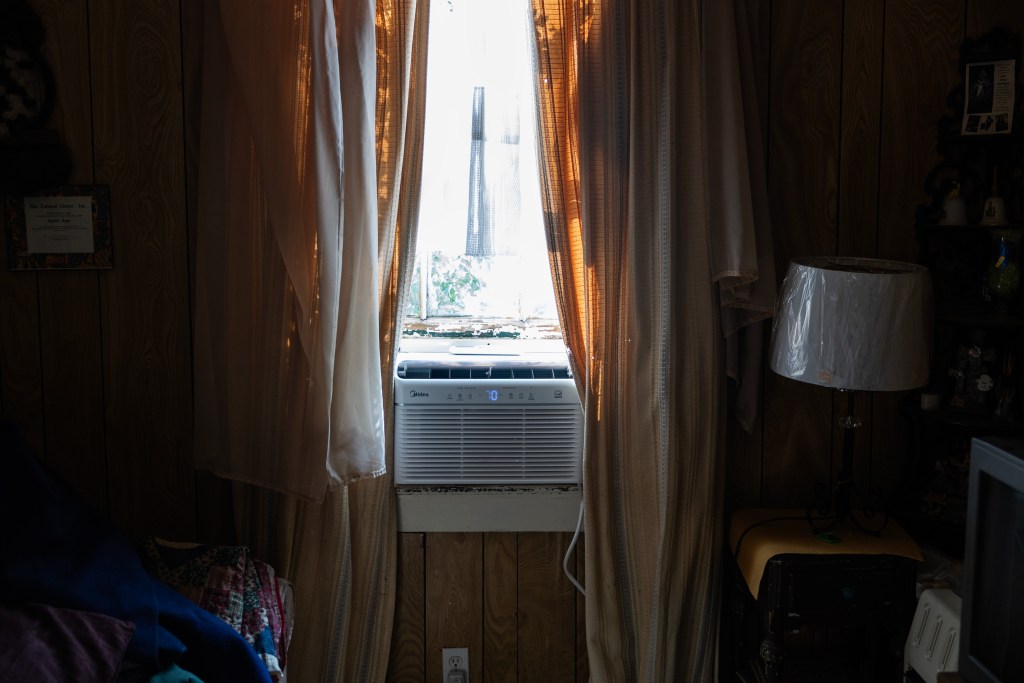
Before getting help, Boyer’s two working air-conditioning window units — in the two first-floor bedrooms — drove her summer monthly electric bill to more than $400, about a fourth of her monthly $1,500 income from her deceased ex-husband’s pension payments.
In the evening, she would stand at the stove, cooking in the heat that built up over the day. She says she’s used to it.
“It’s been like this for a long time,” she said. “No one else can handle it, but I can. I have to.”
Meeting the need one home at a time
Earlier in the summer, Boyer received help paying her electric and gas bills from the federal Low Income Home Energy Assistance Program, or LIHEAP. Community action agencies across the country distribute the funding nationwide. One such agency, the nonprofit BakerRipley, aids residents in Galveston, Harris and Brazoria counties.
The assistance helped Boyer with her electric and gas bills, which went as high as $550 in the summer and $800 in the winter.
Boyer is one of the few lucky people to receive assistance. As energy costs increase, available funding is stretched thin. In 2024, the most recent data available, less than 3% of eligible Texas households received support.
Like Project Fat Cat, BakerRipley is overwhelmed with demand.
BakerRipley receives 22,000 to 25,000 applications a year from all three counties, and this year, the organization expects to help about 1,250 residents in Galveston County.
BakerRipley can give as much as $1,800 for residents in need, but that can only go so far these days, according to Glynniece Herron, program director for BakerRipley’s Utility Assistance.
“It’s been most helpful if the allowable amount we give is larger, so that we’re able to help for a longer period of time,” Herron said. “Because energy costs have gone up, the number of months of assistance that a neighbor receives seems as if it’s decreasing, because they’re paying more and more each month.”
For example, Herron said, someone who is eligible for $1,200 could have stretched that money to cover seven to eight months of bills in 2020. This year, that amount may cover only four to five months.
LIHEAP funding has not grown to meet the demand. In 2021, during the COVID-19 pandemic, the budget reached $8.2 billion. However, funding now lands closer to $4 billion. President Donald Trump has proposed ending the program six times. Congress blocked those efforts.
“What we’d like to see is the allowable assistance amount to be increased,” Herron said. “It costs more now to live. You’re trying to have your medications paid for, your food paid for, your house paid for, your car paid for, and every single one of those areas is costing you more today than it did a year ago.”
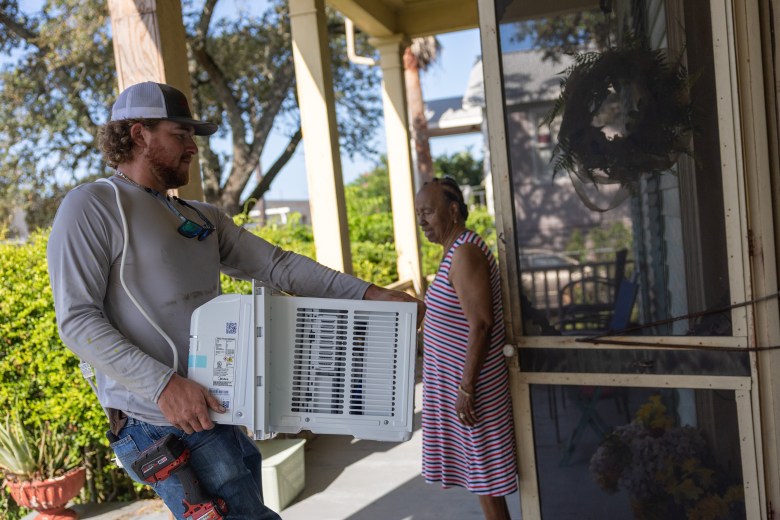
Steven Creitz is the project manager for Project Fat Cat, an initiative by Build Galveston, a nonprofit community development corporation. Since 2025, Creitz has given out free energy-efficient window units to city of Galveston households in need through a $150,000 grant from the CenterPoint Energy Foundation.
This year, he organized the installation of 58 air conditioners. He has given them out to elderly residents, families with young children and residents with disabilities — all in homes with little to no air conditioning.
People can nominate Galveston residents, including themselves, using a form. After a needs assessment, CenterPoint Agencies in Action reviews applications. Creitz then connects with people in need, purchases the units, schedules a local installer and follows up after installation.
About 10 residents are waiting for air conditioners and the list is growing, so he is seeking another $300,000 in funding from the foundation.
“There’s so much more we need,” Creitz said. “It would be amazing if we could harness all that money, because I could likely install another 100 units into homes. Maybe even 200.”
In late August, Creitz installed two air conditioning units in Boyer’s home, both near the kitchen. Relief came within minutes, she said.
“I never really knew the exact temperature,” Boyer said. “But every time I went to the kitchen, I’d start sweating.”
On Boyer’s block in the Kempner Park neighborhood, part of the African American Cultural Heritage District, 50% of homes were built before 1939, while on the neighboring block, that number rises to just over 65%, according to the Census Bureau. Both blocks also have the highest percentage of homes without air conditioning in the city.
Boyer now has a Project Fat Cat sign in her yard to promote the project.
She was concerned when Creitz originally offered her the free air conditioners, even after he explained they were energy-efficient. Her electric bill was too high already. Running new units could be unaffordable.
Since the units’ installation on August 6, Boyer said her home is cooler even though she uses them as conservatively as her old ones. When she checked her August electric bill, the cost was roughly the same as it was in July.
Lack of affordability forces ‘real trade-offs‘
On most Sundays, Boyer plays the piano at St Augustine of Hippo Episcopal in Galveston. She has played since she was a child, accompanying hymns on Sundays and performing at funerals or other services.
She loves to play, but the job also pays $200 a month, which helps with expenses. With her retirement and the church money together, she can make ends meet most of the time. Her younger son, Val Boyer, who lives at home and works in maintenance at a hospital, helps pay the bills.


About a third of households with energy insecurity are foregoing food or medicine to pay for electricity, Aparajita Datta, energy policy associate for the University of Houston Energy Division, said. The states with the worst energy insecurity are in the South Central U.S., including Texas, Louisiana, Oklahoma and Arkansas.
In Galveston, where much of the housing stock is old and without modern insulation, many residents cannot afford to weatherize their homes properly. It would take thousands of dollars for Boyer to rehab her home and insulate it from the heat and cold, money she does not have.
Adding insulation to a two-story home costs as much as $10,000, according to Home Guide.
“There’s a high correlation between low income and energy insecurity,” Datta said. “People assume that someone will have that sort of disposable income to actually fix that crack in the wall, but people have real challenges. Households are making real trade-offs to be able to afford the electricity they consume.”
The solution, she said, lies with the federal government.
Since LIHEAP’s inception in 1980, the program has had broad bipartisan support, but Congress has yet to approve a permanent funding increase.
If the $4 billion in LIHEAP funds were split evenly between every eligible energy-insecure household in the United States, each would receive about $93 a year, highlighting a serious mismatch between what is needed and what is available.
“I don’t anticipate any big changes happening in the near term,” Datta said. “But I’m hoping this is something that catches the attention of policymakers in the next three to five years.”
Boyer plans to apply for BakerRipley again in the spring to keep her house cool — for herself and her family.
She has children, grandchildren and great-grandchildren; cousins, nephews and nieces; and friends she calls family. Her eldest son had lived with her before he passed away, and her youngest son lives with her now. She welcomes any of them to stay with her whenever they need.
It’s a big part of why she can’t imagine selling the house, despite the big utility bills.
A few years ago, a relative of hers was evicted and had nowhere to go, Boyer said. “She came with her family and stayed nine months, until they were back on their feet,” she said. “That’s why the house is here. That’s why I keep it.”
Help May Be Available
To be eligible, applicants have to meet certain income and residence requirements.
Galveston, Harris and Brazoria counties
BakerRipley Utility Assistance
The program is currently closed for applications for utility bill payment assistance but will open again on November 9. Residents in the region can schedule in-person appointments starting October 27.
Project Fat Cat
City of Galveston residents can nominate a household or individual, including themselves, for this energy-efficient window unit replacement program.
Statewide
The Texas Department of Housing and Community Affairs
The department provides a list of available resources for Texans, including weatherization and bill payment assistance, based on geographic area. You can also reach the Texas Information and Referral Network by calling 2-1-1.