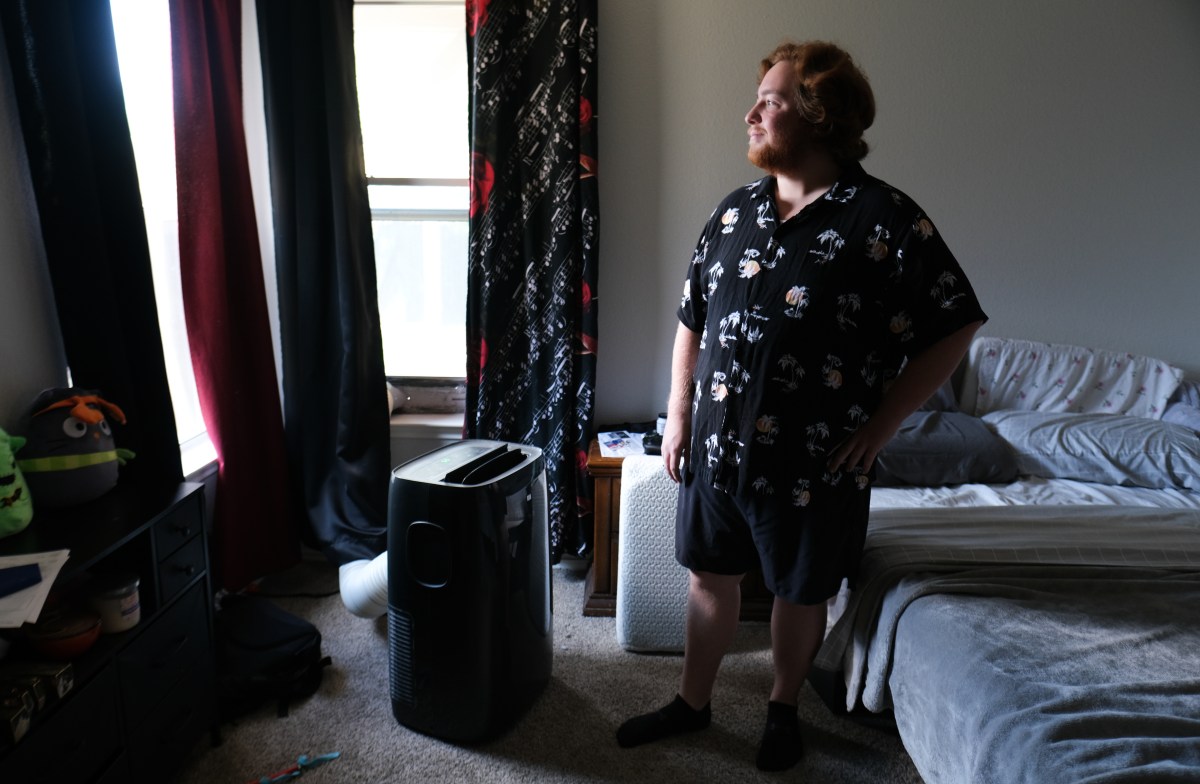
HUTTO, Texas — When Alek Micklethwait received his electricity bill in May, he was stunned. It was $545, more than double what his family had been paying during cooler weather, since moving into a 1,600-square-foot home in Central Texas last September.
It must be a mistake, he thought. But it wasn’t.
Micklethwait, who lives with his fiancée and her grandmother, was left wondering how they would afford to pay it, along with their mortgage, car insurance, groceries, gas and a growing pile of medical bills.
About ‘Powerless’
An ongoing series about what’s driving the relentless rise in Texas energy costs. Read more.
But they would have to figure it out. Getting disconnected wasn’t an option.
Micklethwait’s fiancée has a heart disease, inappropriate sinus tachycardia, a rare disorder that causes her heart rate to exceed 100 beats per minute while resting. When she gets too warm, her heart pumps faster, adding stress to an already racing organ. So they set the thermostat between 70 and 75 degrees.
Facing unaffordable electricity bills, yet needing consistent air conditioning, Micklethwait called their electricity provider, Chariot Energy, hoping the private company would work out a deal with them.
“We were told they don’t offer any discounts,” he said, “not even for low-income, seniors, disabled or military customers — nothing.”
Electricity costs are rising across the country, but in Texas, which leads the nation in disconnections for nonpayment, these costs have risen on average by 30% since 2020. It’s the sharpest rise in rates in the country and an upward trend that is expected to continue.
Texas is unique in that it runs its own grid in a largely deregulated market that rewards scarcity, not reliability. Power companies make higher profits when supply is low and demand is high. And surging demand, largely driven by data centers and other industries, has left residential electric customers footing rising bills.
On August 4, Gov. Greg Abbott blamed public utilities for rising electricity costs, calling out Austin and San Antonio’s. Abbott offered a solution: Invite private providers to compete with public utilities, of which there are 72 in Texas. Increased competition, he said, would lower costs.
But an investigation by Public Health Watch found that Texans like Micklethwait and his family, who live in deregulated markets, paid more on average — sometimes significantly more. The research suggests that opening additional markets to private investor-owned power companies could make things worse, not better, for millions of residential ratepayers.
This is the first article in Public Health Watch’s series, “Powerless,” which reveals why electricity costs are rising in Texas; how extreme indoor heat impacts health; who is suffering the most, and what can be done to make this essential service more affordable while strengthening an electric grid that is impacted by extreme weather.
Texans are falling through the cracks
Sherrie Daugherty has systemic lupus, a chronic disease in which her immune system attacks healthy tissue. She often suffers debilitating joint and muscle pain, has a high risk of blood clots and can no longer work.
“My body temperature is higher — what’s called a low-grade fever — because my body’s always fighting against itself,” Daugherty said. Since heat exacerbates her symptoms, Daugherty stays inside her home in Hutto, in Williamson County, when temperatures are high, relying on air conditioning for more than comfort.
“I’m much hotter in places where people may be freezing,” she said, “whether it’s at a doctor’s office or in a Walmart — today, I wouldn’t be able to go outside or I would get very ill.”
In July, TXU Energy charged Daugherty $460 for her electricity. Energy costs that exceed 6% of a household’s income are considered unaffordable. Daughtery’s bill is roughly 25% of the monthly income she receives from Social Security Disability Insurance.

Daugherty, who lives with her disabled son, Brandon, receives utility assistance from the federal Low Income Home Energy Assistance Program, or LIHEAP. Each state, including Texas, distributes its share of that funding through community action agencies. Households with incomes below 150% of the federal poverty guidelines are eligible to apply for help covering cooling, heating and weatherization to make homes safer and more energy efficient.
Daugherty applies for assistance through Opportunities for Williamson and Burnet Counties. In 2024, she received enough funding to pay her monthly electricity bills. But last year, Daugherty’s benefits were cut in half. Now she’s having trouble keeping up.
“We shouldn’t have a bill so high where people are getting their lights cut off because they can’t afford it,” she said. “Everything is almost unreachable.”
The swing in funding coincided with the COVID-19 pandemic. When people across the country lost their jobs, Congress approved an increase. The LIHEAP budget for 2021 peaked at $8.2 billion, double a typical year’s.
The COVID funding bump has ended, making that work more challenging, said Katrina Metzler, executive director of the National Energy and Utility Affordability Coalition.
“We had the ability to expand cooling programs, offer deeper benefits and address arrearages,” Metzler said. “That opened a lot of opportunities for us as a program to deeply address energy affordability in America during a time of crisis.”
The majority of households served by the federal assistance program earn less than $20,000 per year. Less than 3% of eligible Texas households received support in 2024.
Families like Daugherty’s are scrambling to cover their electricity bills with help from a patchwork of nonprofits, churches and food banks.
Holes in the safety net could get bigger. In April, President Donald Trump proposed eliminating the $4 billion LIHEAP program from the federal budget. But with strong bipartisan support from Congress the program has survived each of Trump’s six attempts to end it.
More than 3 million Texas households had their electricity turned off for nonpayment in 2024 — a dangerous scenario, especially during record-breaking heat waves.
Disconnections during extreme weather have a cascading impact on health, said Stephanie Ettinger de Cuba, a Boston University research associate professor whose studies with CATCH Heat Project and Children’s Health Watch focus on how social policies like energy assistance impact families.
“Cooling is vitally important to people in vulnerable categories. Pregnant women, people with chronic disease, seniors and very young children are most at risk,” Ettinger de Cuba said. “The littlest ones can’t put on or take off clothing as needed. They’re dependent on somebody else to get them water. Whatever it is, they are that much more vulnerable.”
When Hurricane Beryl made landfall over Matagorda Bay in July 2024, about 3 million people lost electricity for days. At least 36 people died as temperatures soared.
State Sen. Molly Cook, a Democrat from Houston and an emergency room nurse, treated elderly people trapped on dangerously hot floors of their senior living facilities. She recalled the struggle to “start [an IV] line on someone who is so dehydrated from the heat that you can’t find a vein.”
Disconnections, Cook said, not only endanger Texans’ health with preventable illnesses but also drive up healthcare costs and burden already-stressed frontline workers.
“If you don’t have reliable power or if you’re rationing power and you’re hot at night as well, the impact is cumulative,” she said. “And so people [end up] in that really panicky, scary, expensive situation where they’ve got to rush to the ER or call 911 and actually utilize first responder services.”
Austin Public Health Heat Illness Dashboard
Click the tabs below to explore the data.
Why Texans’ electricity costs are rising
Electricity costs in Texas were relatively stable from 2010 to 2020. That’s changed.
Data from the Texas Energy Poverty Research Institute, a nonpartisan nonprofit that studies energy affordability solutions, show that the 30% average increase in electricity costs for Texans outpaces other U.S. states. Those costs are expected to rise another 29% through 2030.
Costs are skyrocketing for several reasons. Extreme weather and unprecedented growth in demand from data centers and other energy-intensive industries account for most of the increases.
State regulators are considering commercial and industrial requests to connect to the Texas grid that would total 474 gigawatts — “five times Texas’ record peak electricity demand,” Abbott said in an August letter, calling for an audit and a pause on data center development.
The move represents a drastic change from the open-door policy for the centers he promoted more than a decade ago.
Overall demand in Texas peaked at 87 gigawatts in 2025, and the Electric Reliability Council of Texas, or ERCOT, which regulates the state’s electricity grid, forecasts that energy demands will continue to increase by about 60% to a peak of 145 gigawatts by 2031.
Transmission and distribution utilities, known as TDUs, bring electricity from power plants to communities. The TDUs and ERCOT are investing more than $96 billion to increase capacity and weatherize the state’s electric grid to improve reliability, according to the research institute. That includes adding power plants and transmission and distribution lines throughout the state.
Residential customers are footing a portion of the infrastructure costs through fees added to their monthly bills. Since 2022, transmission and distribution fees have increased to 39% of residential bills, an 11-point rise. The Texas Energy Poverty Research Institute projects transmission and distribution fees will soon surpass actual usage charges, increasing to 54% of monthly bills by 2030.
MORE FROM ‘POWERLESS’

A Storm Reveals How Texas’s Energy Market Is Manipulated for Profit
Texas is unique in that it runs its own grid in a largely deregulated market that rewards scarcity, not reliability.
In June, Abbott directed the utility commission and ERCOT to act so data center costs are not passed on to residential consumers, who pay higher rates than commercial and industrial customers. While residential consumers use about one third of the grid’s electricity, they account for half the revenue.
Abbott said on August 18 that his new guidelines calling for the Public Utility Commission to gather information about data center ownership, tax incentives and plans for electric and water conservation before approving projects are working and that “data centers across the state have either announced their full compliance or announced they are ending their data center project.”
Tax incentives passed in 2013 under Gov. Rick Perry and first expanded in 2015 under Abbott helped Texas become the fastest-growing data center market in the nation.
Gina Hinojosa, Abbott’s Democratic challenger, has campaigned for stricter regulation, saying rising residential utility costs show the need for “real laws” rather than unenforceable guidelines to protect Texans.
Hinojosa said that Abbott should call a special session to repeal the tax breaks and give more power to communities “to decide if and how data centers come into their communities.”
Competition has not lowered electricity prices for most Texans
Deregulating the Texas electricity market had strong bipartisan support.
The competitive market — in which investor-owned utilities split into separate power generators, distributors and sellers — was sold as a way to lower costs for consumers who could shop for the best rates. Competition was also supported by environmentalists who saw an opportunity to drive cleaner and cheaper renewable energy.
The plan worked — sort of.
Today, Texas leads the nation in wind production, and is second to California in solar. Competition, along with renewable policy, transmission projects and federal incentives, fostered the growth of cleaner energy sources.
Wind and solar projects are less expensive and quicker to deploy than fuel-burning generation and have enabled Texas to meet an increased energy demand.
But savings in wholesale energy costs haven’t been passed on to most consumers. Instead, investor-owned utilities have made more than $200 billion in profits since 2021, according to the Energy and Policy Institute, a nonprofit climate advocacy group.
Texans living in ZIP codes where they are forced into a competitive market were overcharged about $35 billion from 2004 to 2024, according to a report authored by energy advocate Laurel Peltier.
The report shows Texas leads the nation in overcharges. It’s a trend happening in states where consumers can choose whether to buy electricity in the competitive market or purchase it from regulated utilities without a retail markup.
Peltier, who has pushed for retail energy market reform, evaluated revenue, power usage and customer data from the U.S. Energy Information Administration. More than 11 million U.S. households would have saved $4 billion in 2024 if they had remained with regulated utilities instead of switching to the competitive market, she said.
Retail providers lure consumers with deals, like free electricity at night, Peltier said. But after the initial contract period ends, low introductory rates are raised or switched to variable rates without regulatory caps. Details are often buried within multipage contracts, and consumers would have to continuously hop from plan to plan to avoid overpaying. Nearly 75% of residential customers don’t or can’t do this.
Despite overcharges in the competitive market, Abbott — who has accepted millions of dollars in campaign contributions from the oil and electric industries — blamed public regulated utilities for driving up energy costs.
Earlier this month, he called out Austin Energy and CPS Energy, two municipally owned utilities serving Austin and San Antonio residents. Abbott claimed that introducing competition could save residential ratepayers up to 10% in Austin and 13% in San Antonio.
But Austin Energy customers have among the lowest electric bills in the state, paying on average $104.85 a month in 2024, compared with the Texas average of $166.19. CPS Energy customers in San Antonio also pay less than most Texans, with bills averaging $133.09 a month, according to data from the U.S. Energy Information Administration.
When Public Health Watch asked the governor’s office to produce the data Abbott used to calculate projected savings for Austin and San Antonio customers, his staff replied, “As this is a campaign proposal, I would have to refer you to the Governor’s campaign team.”
Abbott’s campaign team did not respond to Public Health Watch’s requests for detailed information.
Solutions for reliable and affordable electricity
Even the threat of a disconnection can trigger a downward spiral for a family, according to Gail Buttorff, a University of Houston research associate professor who studies energy affordability.
“Our surveys show that people are making tradeoffs — they’re saying, ‘Maybe I won’t buy as much food or medication,’ or ‘I’ll keep temperatures at potentially unsafe levels.’ That’s going to have an effect on people’s health, even their mental health,” Buttorff said.
The tradeoff for Alek Micklethwait includes raising the thermostat during the heat of the day.
“We’re having to cut back on how much we spend on groceries and reduce our usage on AC pretty heavily,” said Micklethwait, who installed a portable AC unit in one room, where his fiancée cools down when she becomes overheated.
Texans have some protections. The Public Utility Commission prohibits service disconnections for non-payment during heat advisories and freezing weather, and on days when utilities are unavailable to collect payment. There are additional protections for consumers with chronic medical conditions.
But unlike in Minnesota, no automatic triggers exist to reconnect Texans whose electricity has already been disconnected — not even during extreme weather.
“The fact of the matter is, Texas is really substandard when it comes to consumer protections that exist in so many other states,” said John Howat, a National Consumer Law Center senior energy analyst.
Late fees and high security deposits hurt consumers, Howat said. Texas also lacks seasonal disconnection protections. In contrast, Arizona has a summer utility shutoff moratorium from June 1 to October 15.
“They don’t sound like much,” Howat said. “But when you put them all together, it can really make a difference in helping people stay connected to the system.”
After Winter Storm Uri, in which millions of Texans lost power and hundreds of Texans died, the Legislature approved Senate Bill 3 in 2021 to weatherize the grid and avoid blackouts. Since then, most power plants that broke down during the storm have completed upgrades to comply with the weatherization requirements.
But in August 2025, the State Auditor’s Office released a report that found the Railroad Commission of Texas, which oversees the state’s oil and gas industry, failed to hold natural gas operators to the winterization standards.
“That’s a problem,” said Virginia Palacios, executive director of Commission Shift, a nonprofit that advocates for stronger oversight of the oil and gas industry.
“If you don’t have actual enforcement that’s making these companies weatherize the natural gas supply chain, then they’re not going to,” Palacios said. “You end up with a weak system that’s not reliable, so we could have these power outages happen again.”
So what does this mean for Texans who need affordable, reliable electricity?
Public Health Watch spoke with experts who said a multi-pronged approach is needed, including policy changes that put Texans’ needs ahead of campaign donors’ financial interests and provide more direct funding to Texans to lower their utility bills and weatherize their homes.
Solution 1: Accountability
Palacios said conflicts of interest must be addressed for elected officials and regulators who profit from the industries they’re regulating. She cites the Railroad Commission as particularly problematic, and recommends reforms.
Railroad Commissioner Christi Craddick, whose family has made millions of dollars in oil and gas rights, has financial interests in Energy Transfer, a company that made $2.4 billion during Winter Storm Uri.
“Craddick voted for a representative of Energy Transfer to have a seat on the Texas Energy Reliability Council,” or TERC, Palacios said. “She never recused herself from that decision.”
TERC was established as part of Senate Bill 3 to improve Texas energy infrastructure. The council includes regulators and representatives from different energy companies. It does not publish recordings or notes from its meetings.
“These companies have closed-door access to the regulators that other companies don’t get access to,” Palacios said. “So they have this very special competitive advantage.”
Palacios recommends triggers for recusals and stricter campaign contribution rules. For example, she said regulators should not be allowed to accept large donations from companies they’re regulating, and donations should only be allowed during campaign season.
Currently, campaign contribution limits exist for judicial candidates, but there are no contribution limits for Texas lawmakers or heads of state agencies.
Solution 2: Energy Efficiency
“A lot has been done to make our grid more resilient. But it hasn’t necessarily helped maintain low prices,” said Cyrus Reed, legislative and conservation director at the Texas chapter of the Sierra Club, an environmental nonprofit.
Reed said that many Texans pay more for electricity because they live in older, less energy efficient homes.
“Ultimately, the cheapest way to meet our needs is energy savings,” he said. When consumers use less energy, their bills go down. As demand decreases, that lowers costs for all Texans.
Reed points to the HOMES and HEAR rebate program as a model state lawmakers could consider. The federal program was authorized by the Inflation Reduction Act of 2022, and could bring $690 million to Texans next year, helping them subsidize costs to weatherize homes and replace inefficient appliances.
Debra Ponce, who lives in San Antonio, said CPS Energy provided rebates to weatherize her home about six years ago. At the time, Ponce was a single parent, and wasn’t making a lot of money. Lowering her electricity bills helped put more food on the table.
Workers performed pressure tests on her house to seal areas where air had been leaking; installed attic insulation and solar screens on windows to block harsh sun; and replaced inefficient light bulbs with LED versions.
After all those upgrades, Ponce said, “I noticed a dramatic change in my electricity bill in just one month, like $75.”
Now, Ponce works for Public Citizen as a climate justice organizer and has helped lower-income families in San Antonio sign up for CPS Energy’s weatherization program. She has also helped community members get grants to swap out their air conditioners for heat pumps, which are less expensive to operate.
Patricia Fabian, a Boston University professor whose research with CATCH Heat Project focuses on extreme heat and clean and affordable energy, said states should consider a layered approach, including planting trees.
“Shade decreases temperatures, say like ten degrees — that’s even less demand,” Fabian said. “Think about what you can do at a property level outside to cool things down, then at your building to weatherize. All these things come into play to impact electricity bills.”
Better technology may also offer relief. The Sierra Club has collaborated with ERCOT on a pilot program for homes and businesses with solar panels and battery storage to get them into the competitive market.
“The idea is people could provide power or reduce their power consumption when the grid gets tight, and be paid for it,” Reed said. “We don’t have to be so reliant on big solar farms or gas plants. Residential consumers can do the same.”
Solution 3: Direct financial support
Most households that receive assistance with their utility bills through the federal LIHEAP program make less than $20,000 a year, and only 1 in 40 Texan households received that support in 2024.
Cook, the state senator from Houston, said Texas should consider adopting payment plans based on a percentage of ratepayers’ incomes to provide “long-term financial stability, instead of temporary crisis management when the bill spikes.”
At least 10 U.S. states have enacted such plans, in which regulators decide an acceptable energy burden and lower-income ratepayers’ bills are capped.
Howat, the senior energy analyst, said percentage of income payment plans, or PIPPs, are typically financed through customer fees. The Legislature could also fund a program through appropriations.
“If you want a good PIPP that lowers payments to an actual affordable level, which may be 3% to 4% of their income for electricity,” Howat said, “to do it right, there is a cost.”
Lawmakers, including state Sen. Nathan Johnson, a Democrat from Dallas, tried rebooting the System Benefit Fund during the 2025 legislative session.
That fund, known as LITE-UP Texas, was established in 1999 as a safety net when Texas’ energy market was deregulated. Most households were charged about $0.65 a month to support the program, which provided 10% to 20% discounts on electricity for lower-income Texans. Medicaid and SNAP recipients were automatically enrolled, and households with incomes up to 125% of the federal poverty guidelines could apply to receive benefits.
Eventually, industrial consumers that used far more energy than residential consumers and paid higher fees toward the fund lobbied the Legislature to end it, said Carol Biedrzycki, retired executive director of Texas Ratepayers’ Organization to Save Energy, a consumer advocacy organization.
“They claimed if we have to keep paying this, we’re going to take our business elsewhere,” she said.
Lawmakers ended the surcharge in 2013, and the fund was closed in 2016.
“People relied upon those low bills,” said Randy Chapman, a retired legal aid attorney and former executive director of Texas Legal Services Center. “Many were not prepared for the rate shock that happened subsequently.”
Last year, Johnson and state Rep. Ana Hernandez, a Houston Democrat, introduced Senate Bill 1513 and House Bill 1359 which would have revived the program using tax revenue.
Hernandez argued that, since lawmakers had already appropriated $5 billion to help companies build natural gas power plants, the Legislature should provide assistance to lower-income residential consumers.
Neither measure passed.
If the System Benefit Fund were rebooted, it should be structured like the Universal Telephone Service, Biedrzycki said. “The Public Utility Commission manages that money,” she said. “It’s always been used the way it’s supposed to.”
CPS Energy and Austin Energy could serve as models for other retail electric providers across the state. The municipally owned utilities offer financial support for lower-income customers, including rate discounts and services for medically vulnerable customers.
With input from community advocates, Austin Energy in 2013 adopted an auto-enrollment process for households in programs such as Medicaid and the Supplemental Nutrition Assistance Program.
Households making up to 200% of the federal poverty guidelines can submit an application to cap their bills at 5% of their income. Everybody who is eligible is accepted, said Ronnie Mendoza, who leads Austin Energy’s customer assistance programs.
The programs are funded by customers who pay a community benefit fee on their bills. The fee generates up to $30 million a year to pay for the programs, as well as the city’s street lighting, Mendoza said.
The utility uses up to $2.6 million for its Plus 1 emergency assistance program, which is distributed through community partners, including churches, food banks, and nonprofits throughout the city.
All Saints’ Episcopal Church Loaves & Fishes Ministry is one of them. Every Tuesday morning, dozens of people seeking assistance with utility bills, food and other essentials line up in the shade of the church’s tree-lined courtyard. At 9 a.m., the doors open. Church volunteers help the first 60 people in line.
Most people who come for utility assistance have had a crisis, volunteers said. They have lost a job or were hospitalized, and need help getting back on their feet.
Bryan Pennington, who visited the church earlier this month, had been unhoused for a decade. He moved into public housing in March, and is recovering from spinal surgery.

Pennington said the utility assistance is a blessing. “I thought I was going to lose my power again,” he said. “The last time I didn’t have power for two weeks and lost all my food.”
Pennington is unable to work and has applied for Social Security Disability Insurance benefits. Volunteers used part of Austin Energy’s grant to cover his $287 electricity bill balance in full.
“Famlies are trying to get assistance in piecemeal ways,” All Saints’ Rev. Kim Kibby said. “Everyone is holding on by a thread.”
In Hutto, Sherrie Daugherty says her family has been more homebound and strategic with bills.
“We just go to doctors’ appointments and make one trip to the grocery store per week,” she said. “I have to pay my car payment every other month.”
With lupus, Daugherty said, the stress of struggling to keep up with her bills takes a physical toll but she’s coping. “You just have to deal with what life hands you.”
This story was funded by St. David’s Foundation through its Strengthening Local Media to Advance Community Health initiative. It was also funded in part by the Central Texas Climate Action Fund. Public Health Watch retains full authority over editorial content; read our editorial independence policy here.