More than one-third of people surveyed in a five-county region of East Texas reported having suicidal thoughts or attempting suicide — nearly eight times higher than the national rate — yet mental health services remain difficult to access, according to a survey conducted by Andrews Behavioral Health.
Top barriers to obtaining mental health services were high costs, limited or no health coverage, difficulty in getting timely appointments and lack of support among family, friends and others in their communities, according to the survey of residents of Smith, Woods, Van Zandt, Henderson and Rains counties, which make up Andrews’s coverage area.
“I work in the medical field and I’ve noticed that it is very difficult to get patients seen in a timely manner,” one respondent said. “This is distressing as we see the fallout of what can happen when people are not on the correct medication.”
The survey, conducted in 2025 with 360 responses, was included in a Community Needs Assessment report released in September by Andrews Behavioral Health, a nonprofit that serves as the local mental health authority for the five-county area.
Even in Smith County, which has more mental health resources than much of the rest of the area, survey responses showed that a majority of responders were not getting the care they needed.
“Your mental health drives everything, whether people acknowledge it or not,” said Mari Gutierrez, the lead author of the report who serves as director of population health and clinical informatics for Andrews Behavioral Health.
The survey results mirror the findings of an investigation by Public Health Watch earlier this year that found East Texas had been hit hard by gun-related suicides, exacerbated by a scarcity of mental health resources, the prevalence of guns and stigma attached to seeking help.
The survey responses are alarming, coming from a part of Texas that has experienced higher suicide rates for several years than much of the rest of the state, which had 14.3 suicides per 100,000 people in 2023.

The same year, Wood County reported 31.3 suicides per 100,000, and Henderson County 26.7 per 100,000, according to the U.S. Centers for Disease Control and Prevention’s National Center for Health Statistics.
Officials hope the findings will serve as a call to action for health care and mental health providers, as well as policymakers, to improve access and outreach to people in need, Gutierrez said.
“These are not just statistics — they represent people we know and care about,” Andrews CEO Becki Mangum said in the introduction to the report.
Hitting close to home
About 65% of those who responded to the survey said they live with someone who has a mental health or substance use disorder, while 42% said they themselves live with a mental health disorder.
Yet the majority of people responding to the survey said they had not sought treatment or support from Andrews Behavioral Health. Respondents cited economic challenges, wait times and community antipathy toward mental health services.

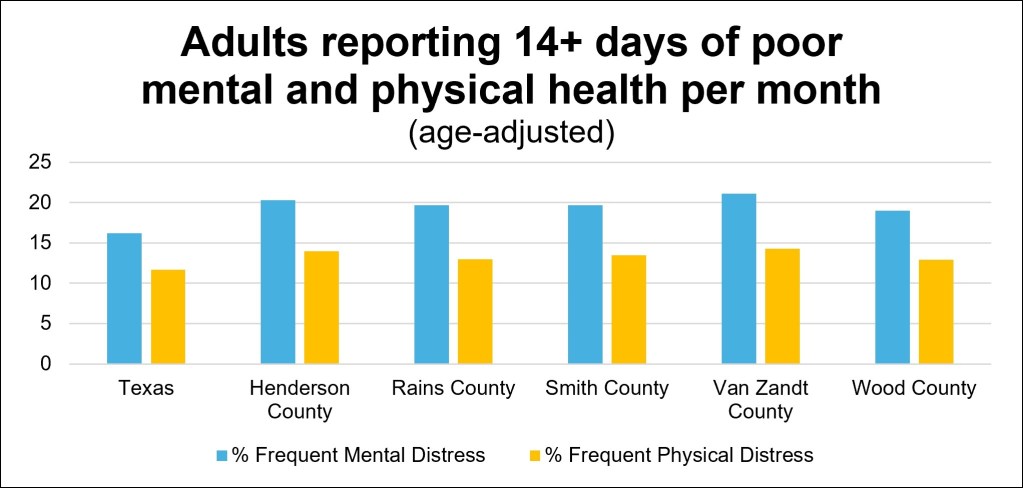
Gutierrez said that mental health professionals and policymakers must find ways to overcome a deeply ingrained societal stigma that plays a significant role in preventing people from seeking the care they need. She pointed to data from the CDC that shows that residents in all five counties reported having more days per month with mental health distress than with physical distress.
Most survey respondents had some form of health insurance, with 62% saying they had employer-provided or private insurance, and 18% saying they were covered by Medicare, according to the report. About 13% of those surveyed said they were uninsured.
The report includes data from multiple other sources beyond the survey. According to the Wisconsin Population Health Institute’s County Health Rankings and Roadmaps, a program that maintains a national database, 35% or more of respondents in Henderson, Smith, Wood and Van Zandt counties reported feeling lonely, compared to the statewide average of 34%, Gutierrez noted.
“There are so many nonprofits, especially in Smith County, so many community organizations and events,” she said. “Yet, how are we some of the loneliest people? Where is that disconnect coming from?”
The reality, she said, is that the five-county area of East Texas is not unique. Throughout the United States, even as people increasingly report feeling disconnected and lonely, they are struggling with mental health and substance use without finding treatment. And suicide rates nationwide remain troublingly high, at 13.7% per 100,000 in 2024, according to the CDC.
People who are already feeling lonely and unsupported are probably less likely to seek mental health services, increasing the need to normalize conversations around mental health treatment, she said.
Asking for help
The Andrews Community Needs Assessment does not provide specific recommendations but identifies challenges that need to be overcome to better connect residents with treatment and support programs, including financial barriers and gaps in insurance.
Because the five counties surveyed are designated mental health care “deserts,” policymakers and providers need to explore different — and more effective — ways to meet the needs of the community, the report concludes.
“We are committed to expanding awareness of available services, improving outreach, and strengthening programs that reduce isolation and support those at risk,” Mangum, the Andrews CEO, said in the report.
“Just as importantly, we will continue working to reduce stigma and create spaces where individuals feel safe asking for help,” she said, “because no one in our community should feel alone or unsure of where to go in a time of need.”
If you or someone you know is in need of support, the national suicide and crisis hotline, 988 Lifeline, can be reached by dialing 988. Veterans can access help by dialing 988 and then pressing 1. The National Alliance on Mental Illness also offers the NAMI HelpLine with support and resources. Crisis Counseling and other assistance for LGBTQ youth can be found at 866-488-7386 or The Trevor Project.