In the five years since Texas enacted its near-total abortion ban, research, reporting, and court filings have documented preventable deaths and widespread harm as a result of delays in care.
Severe complications like sepsis rose dramatically, as did blood transfusions during early pregnancy losses. Research indicated that maternal deaths in the state rose far more than nationally in the years immediately following the new restrictions, as doctors and hospitals, fearful of being accused of performing an illegal abortion, waited until patients were “on death’s door” before offering a pregnancy termination that would previously be considered the normal standard of care.
State maternal mortality and morbidity review committees could provide important insight on the impacts of abortion bans, as they give a close look at individual deaths and trends in severe complications to provide recommendations to state leaders. Yet a new Texas report — the first to look at these cases and data since the abortion bans went into effect — does not mention abortion or the laws that doctors, patients, and researchers say have completely altered the landscape of reproductive healthcare in Texas and around the country.
While the report found most pregnancy-related deaths were preventable and that significant racial disparities persist, maternal health advocates and experts say the Texas Maternal Mortality and Morbidity Review Committee is hamstrung, in part by state law, from fully investigating, and that gaps in data make it impossible to glean a clear picture of what is going on.
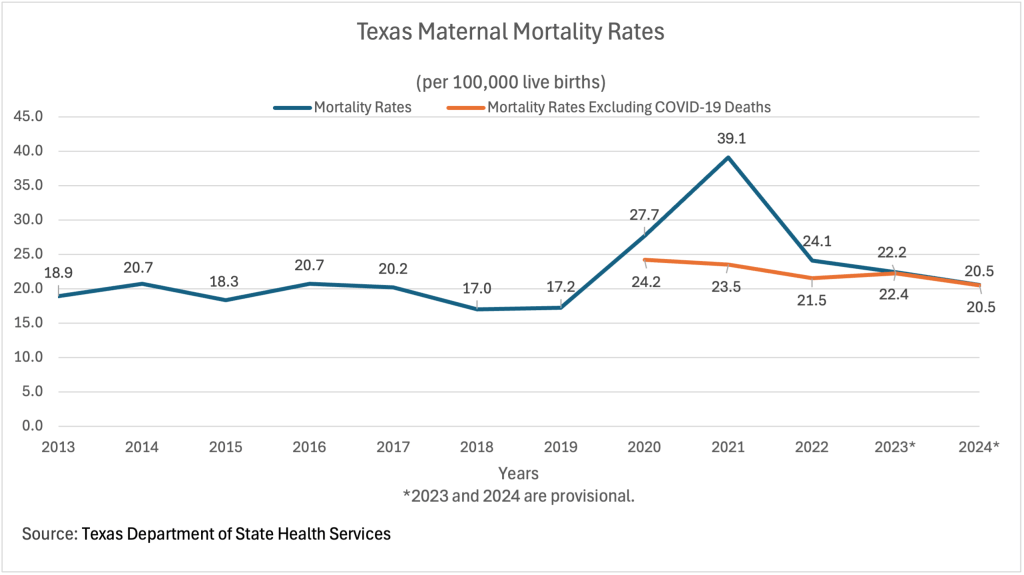
The state skipped studying 2022 and 2023 — the first full years since banning abortion — but data from the Texas Department of State Health Services, or DSHS, show maternal mortality and severe maternal morbidity spiked during the COVID-19 pandemic and remained materially higher than in 2018 and 2019. The state’s maternal mortality rate, which includes confirmed deaths during pregnancy and up to six weeks after, fell to 20.5 deaths per 100,000 live births in 2024, from 22.4 in 2023. While the new report calls this “a similar rate as before 2020,” it remains 20% higher than in the two years prior to the pandemic.
“Someone’s putting a spin on it,” said Dr. Elliott Main, a professor of obstetrics and gynecology at Stanford University and a founder of the California Maternal Quality Care Collaborative. “You have to hope that you’re improving care,” he said. “You don’t want to go back to the way you were 10 years ago.”
The state identified 470 deaths that occurred during pregnancy or up to a year after in 2021 and 2024, the years covered in the new report. Of those, a sample was sent to the review committee, which together with the state health department reports its findings and recommendations to state lawmakers every two years. The 23-member volunteer committee, which is composed primarily of medical professionals, determined that more than three-quarters of the deaths they found to be pregnancy-related could have been prevented.
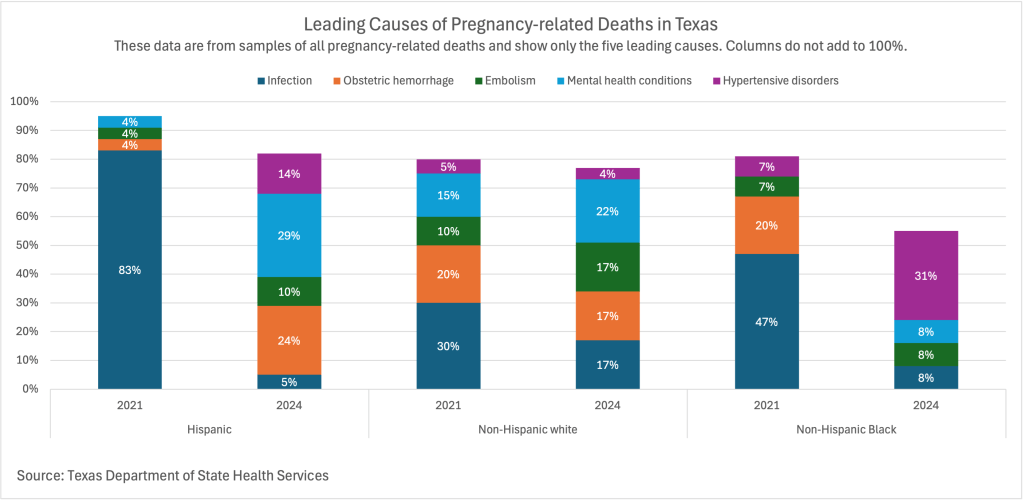
Infections were the most common identified cause of death in 2021, by a wide margin, in large part due to complications related to COVID-19. Five deaths reviewed that year were caused by hemorrhages due to ruptured ectopic pregnancies. In 2024, deaths tied to mental health conditions accounted for the largest share — with 75% occurring between six weeks and one year after pregnancy — followed relatively closely by hemorrhage, hypertensive disorders, embolism and infection.
Maternal mortality and morbidity rates for non-Hispanic Black women were more than twice as high as those for non-Hispanic white women. In 2024, Black women faced severe complications at the highest rate recorded over the last decade, 146.2 per 10,000 delivery hospitalizations. (The state report lists the morbidity rates as cases per 100,000 delivery hospitalizations, rather than the 10,000 that appears elsewhere in state data; this appears to be an error that underestimates the rates by a factor of 10 and has been repeated in media coverage.)
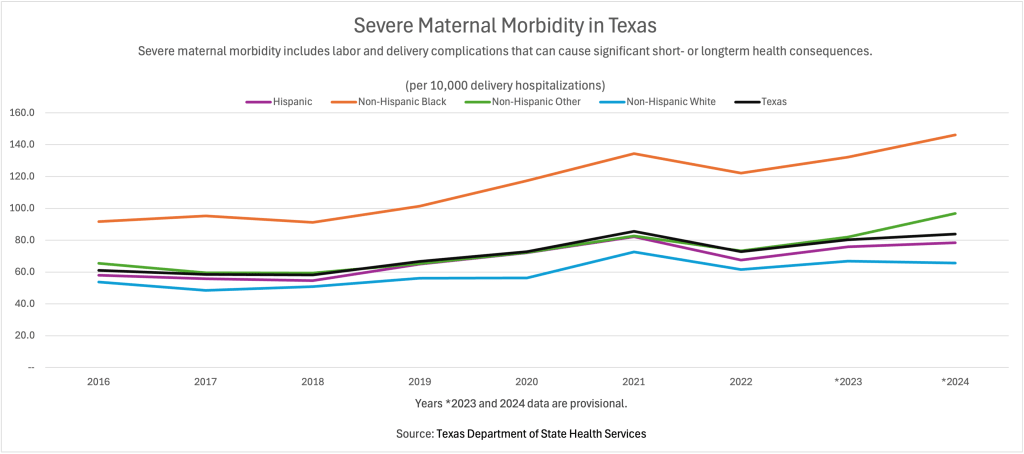
While Texas published some 2022 and 2023 data online, the full trends are not apparent in the report lawmakers use to craft legislation for the upcoming legislative session, which begins in January.
“By using 2021 and 2024, it does provide the opportunity to say, ‘We’ve improved so much.’ Well, of course, everybody’s improved since the peak of the pandemic,” said Eugene Declercq, a professor at Boston University and a researcher focused on maternal mortality and morbidity.
Several anti-abortion organizations pointed to the Texas report to make that argument last week.
Tracking and analyzing maternal deaths is challenging and complex, particularly in a large state like Texas that inherently sees more deaths, Declercq said. States have different approaches to collecting and analyzing data. But Texas, in particular, has isolated itself from national tracking efforts and created its own methods that make it difficult to compare progress with other states and even within its own data.
“My complaint is lack of clarity,” said Declercq, who is a member of the Massachusetts Maternal Mortality Review Committee. “I can usually figure out how states got the numbers they got in almost every case, and I couldn’t here.”
An Incomplete Picture
Significant jumps in certain severe complications in recent years are evident in state data that was not included in the new report. Statewide, the rate of sepsis complications in deliveries doubled between 2019 and 2023, according to the most recent data available.
Main, who is a national leader in efforts to reduce maternal mortality and morbidity, said the dramatic increase “does raise alarm.”
The number of people experiencing sepsis during delivery grew from 474 in the two years prior to the pandemic, 2018 and 2019, to 1,086 in 2022 and 2023, according to state data provided to Public Health Watch.
Amanda Zurawski was one of nearly 500 cases in 2022.
Hers is one of the most striking and well-known cases of emergency care denied under Texas’ abortion bans. Zurawski was 18 weeks pregnant when her water broke well before fetal viability, leaving her at high risk for infection. But Texas’ abortion bans had vague exceptions only for medical emergencies, leaving doctors confused and fearful about what medical care they could legally provide.
Zurawski was sent home and returned days later in septic shock. Once she was finally given an abortion, she had become so sick that she spent days in the ICU and one of her fallopian tubes was permanently closed.
She was the lead plaintiff in a lawsuit against Texas in 2023, aiming to clarify the laws’ medical exceptions as similar stories were cropping up in Texas and across the country.
Yet her experience and others like it weren’t studied by the state. The state review committee, like others around the country, focuses on individual cases of deaths, but not on what are considered “near misses.” Because of the large volume of severe complications, the committee looks at morbidity trends instead.
If someone in Zurawski’s situation had not survived, her death still wouldn’t be reviewed in Texas because her care involved an abortion. And if she never received abortion care, it still wouldn’t be included, because it occurred in 2022 — one of the years excluded from study.
In Texas, state law bars the committee from looking at cases involving a “voluntary or therapeutic termination of pregnancy,” which by definition would include care in medical emergencies.
Dr. Carla Ortique, who chairs the review committee, said members do not receive any cases that involve any intervention to end the pregnancy before 20 weeks — including when there is no longer fetal cardiac activity.
The only other reasons a death would be considered “out of scope” and not sent to the review committee would be if the person were younger than 5 or older than 60, or in a motor vehicle accident, said DSHS spokesperson Chris Van Deusen. Deaths that involve a pregnancy termination are coded as “MVA maternal” — originally standing for “motor vehicle accident” — to signify exclusion from review, he said, and all records associated with them are destroyed.
Several of the half-dozen or so deaths connected to abortion bans that have been publicly reported would appear to fall into this category.
The deaths of Amber Thurman and Candi Miller, which ProPublica reported on after Georgia’s maternal mortality review committee deemed them to be preventable and tied to the state’s abortion ban, would not have been reviewed if they had lived in Texas. In 2021, just days after Texas’ six-week abortion ban went into effect, Josseli Barnica died of sepsis after Houston doctors waited 40 hours for the fetal heartbeat to stop before giving Barnica medicine to speed delivery. Porsha Ngumezi was given misoprostol instead of a dilation and curettage procedure, or D&C, that she needed to stop her hemorrhaging during a miscarriage in Houston in 2023 — one of the years excluded from review.
In Texas, the committee may review cases where abortion care was never offered and the person died as a result, but not cases where abortion care was ultimately provided but came too late to save the patient’s life.
When asked how many cases were excluded from review each year because they involved a pregnancy termination, Van Deusen said there were three in 2020 and zero in both 2021 and 2024. He did not respond to follow-up questions to clarify whether cases like Barnica’s, where intervention was provided after there was no longer fetal cardiac activity, were excluded.
Several doctors told Public Health Watch that it is hard to believe there were no deaths where a pregnancy termination was provided in the most recent years reviewed.
Abortion care is extremely safe, so under normal circumstances, reports of no abortion-related deaths wouldn’t be surprising, said Dr. Anitra Beasley, an OB-GYN in Houston. But given pervasive reports over the last five years of delays in emergency abortion care until patients are near death, she said, “I don’t see it being possible now with the information that has come out.”
As a doctor and researcher with Resound Research for Reproductive Health who surveys other providers around the state, Beasley said the impacts of restrictive laws on severe maternal morbidity and mortality are clear.
“We know that these laws cause harm,” she said. “The state does not want people to connect bad outcomes to bad abortion laws.”
Calls for Clarity
Experts say the committee’s role in reviewing and offering recommendations for reducing maternal deaths and severe complications is critical in a state that comprises 10% of births in the United States and continues to see high rates of mortality and morbidity and significant racial disparities.
Yet advocates and lawmakers say their work has been stymied in recent years.
This year and in 2022, the scheduled releases of the report were delayed until after the midterm elections, leaving legislators less time to craft bills based on the recommendations.
After Nakeenya Wilson, a maternal health advocate in Austin who served as the community advocate on the committee, spoke out about the 2022 delay, the Legislature in 2023 eliminated her role on the committee halfway through her term.
A newly created rural community member position went to Dr. Ingrid Skop, an anti-abortion OB-GYN in San Antonio — the state’s second-largest city — who has argued that abortion bans aren’t responsible for maternal deaths.
In 2024, the committee announced that it would skip reviews of 2022 and 2023 cases, to make their recommendations more timely.
And Texas pulled out of the U.S. Centers for Disease Control and Prevention MMRIA, or “Maria” data system that supports review committees nationwide, becoming the only state to do so. Instead, Texas allocated millions of dollars to create a separate system to improve the efficiency of case reviews, officials said.
Leaving the CDC system made it harder to compare Texas’s data with that from other states and learn from those states, according to committee members and other experts.
Annual meetings of review committee members from around the country are important opportunities to trade insights and see what other states are doing well, said Declercq, the Boston University professor.
“I can’t figure out these numbers,” he said of Texas’s data. “But I don’t know if that’s a conscious effort to obfuscate findings or if it’s just breaking away from a national system — and the supports associated with that system — to come up with your own approach and not really being able to do it very well.”
The departure — together with an executive order from Gov. Greg Abbott that called diversity, equity, and inclusion a “divisive agenda” and mandated that state agencies be “color blind” — also limited the committee’s ability to make recommendations related to stark and persistent disparities.
While the CDC system includes fields to list discrimination and racism as contributing factors in maternal deaths, the Texas system does not, said Ortique, the Texas review committee chair. Texas is also no longer using a tool developed by the state committee to help guide documentation of discrimination that review committees in other states now use, she said.
Ortique said that creating a Texas-specific system should be an addition to, not a replacement for, the national one. “The data is still going to show what it shows,” she said. But “if you can’t use a term — if you can’t identify discrimination as a contributor — then you can’t make a recommendation about it.”
While the report released in 2022 noted that discrimination contributed to 12% of pregnancy-related deaths in 2019, the 2026 report does not mention the word.
Instead, the report points to “barriers to care,” including poverty, transportation, safety, and childcare.
The new report found issues with both accessing healthcare and the care provided. In 2024, common problems included “delays in receiving medical treatment”; “lack of access to healthcare before, during, and after pregnancy”; “repeated urgent or emergency care visits in a short time frame”; and “treatment decisions and recommendations that appeared to be inconsistent with best practices.”
As in the past, the committee highlighted the need for increased access to evidence-based healthcare and support services. It also made suggestions regarding its own work, including expanding membership and allowing for interviews with family members and others who could provide further context around the circumstances of maternal deaths.
Maternal health advocates hope that improvements could be possible with new state leadership next year.
Days after her party won control of the Texas House, State Rep. Donna Howard, an Austin Democrat who leads the Texas Women’s Health Caucus, said she’s hoping “to determine where do we need to get more clarity, where do we need to bring in more data.”
Rejoining the CDC system is one priority, she said.
Howard and other Democratic lawmakers have also filed bills to expand Medicaid, which could cover more than 1 million people in Texas. The state has long had the highest uninsured rate in the nation by far, and the expansion in coverage would go a long way toward the kind of increased healthcare access that the review committee calls for.
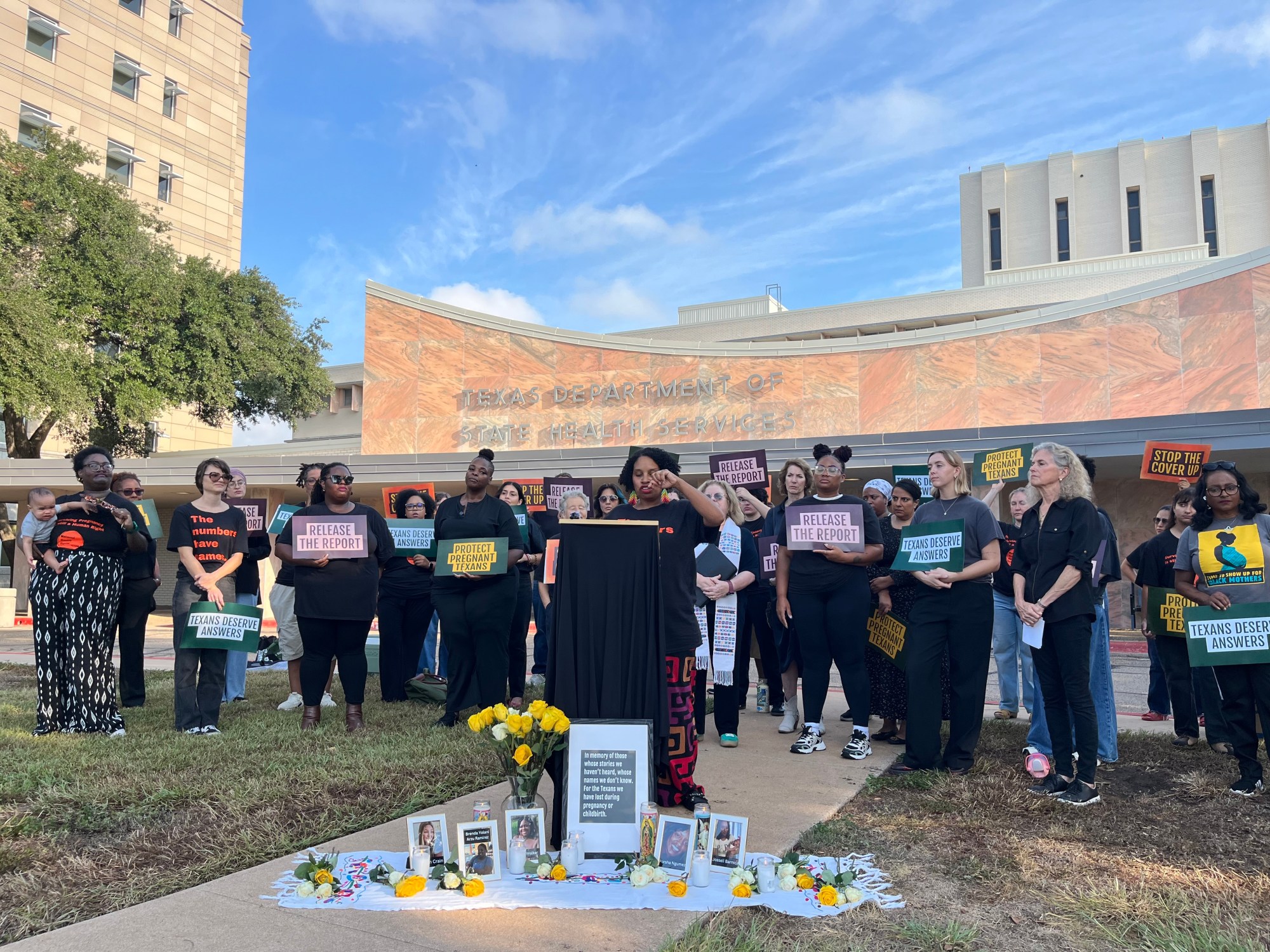
In late September, advocates and lawmakers, including Howard, gathered outside the DSHS building in Austin, where the review committee met in a closed session, to demand the release of the report that they said was completed but withheld for weeks.
When she was on the committee reviewing anonymized cases, Wilson told those gathered, members would refer to the women who died as “Maria,” “to remind ourselves that the numbers had names.”
On the lawn in front of the podium, an altar with yellow and white roses displayed photos of five Texans who died after being denied needed abortion care since 2021: Nevaeh Crain, Brenda Yolani Arzu Ramirez, Tierra Walker, Porsha Ngumezi, and Josseli Barnica. Most of their deaths haven’t been reviewed.
This story was funded by St. David’s Foundation through its Strengthening Local Media to Advance Community Health initiative. Public Health Watch retains full authority over editorial content; read our editorial independence policy here.