

A weekly roundup of public health news
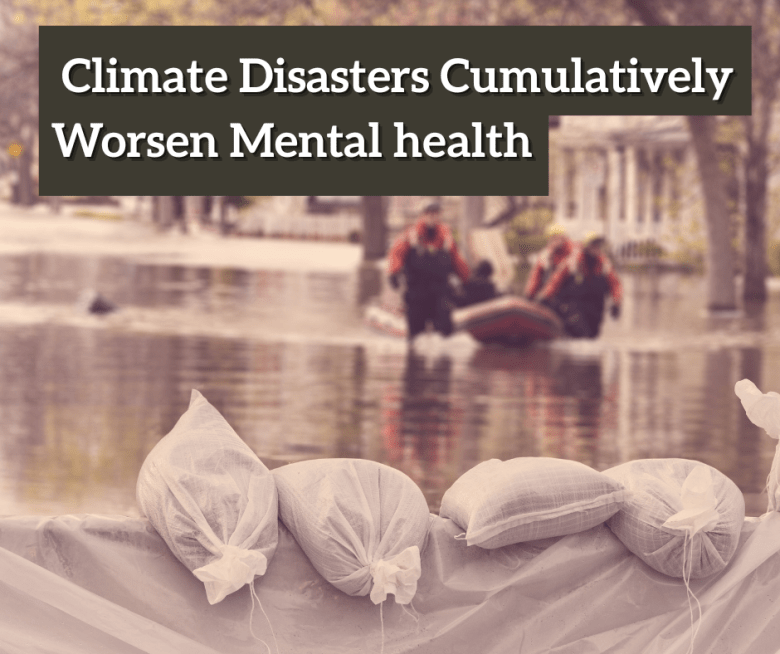
Climate disasters cumulatively worsen mental health
Flooding, wildfires, hurricanes and other climate disasters can be bad for your mental health. And the more disasters you experience, the worse your mental health may be, a new study finds.
The research, published April 30 in The Lancet Public Health, found that not only are mental health harms from climate disasters cumulative, they also take longer to recover from as more exposures occur.
Study researchers looked at the mental health of people who experienced home damage from at least one climate disaster over a 10-year period. They found mental health effects, such as depression, anxiety and post-traumatic stress, became more severe with successive disasters.
People who experienced a disaster within two years of a previous one had greater declines in mental health. Victims of multiple disasters were unlikely to bounce back to their pre-disaster level of mental health even years later, the study found.
Residents in rural and economically disadvantaged areas were more likely to experience multiple disasters. While the study was conducted in Australia, similar results have been found in the U.S., where rural and low-income people often have less access to preparedness resources, warning systems and recovery services.
Weather-related disasters are becoming more frequent with human-caused climate change. The U.S. experienced 27 weather and climate disasters in 2024, the second-highest number in two decades. Events included tropical cyclones, heat waves, droughts and severe winter storms, which cost about 570 lives.
Millions will lose health insurance if ACA signups become harder
Shortening the enrollment period for health insurance through the federal marketplace and instituting other roadblocks may deter millions of people from signing up, a new analysis finds.
A draft rule released by the Trump administration in March would cut the open enrollment period for signing up for marketplace insurance under the Affordable Care Act to just 45 days, which is about a month shorter than in recent years. The rule would also increase paperwork requirements for applicants to prove eligibility for coverage and tax credits and eliminate an additional enrollment period for low-income people.
With the added barriers to enrollment, as many as 2 million people could lose health insurance coverage in 2026, said the analysis, which was authored by researchers at Georgetown University’s Health Policy Institute. The rule would also discourage younger, healthier people from enrolling in plans, driving premiums up across the marketplace, they predicted.
The Trump administration previously shortened the enrollment period, canceled marketing and took other measures to limit ACA insurance signups during its previous term, which caused enrollment to fall nationwide, previous research has found.
Formaldehyde exposure from personal care products common
Many women of color are potentially being exposed to formaldehyde through their personal care products, new research finds.
While recent studies have examined the link between hair relaxers and formaldehyde exposure, the new research, published May 7 in Environmental Science & Technology Letters, shows the problem is more extensive. More than half of participants in the study of Black and Hispanic women were exposed to formaldehyde-releasing preservatives in their shampoo, lotion, shower gel and other personal care products, researchers said.
Formaldehyde exposure has been linked to range of health risks in women, including uterine and breast cancer. Some women in the study reported using the products, which also included eyeliner, face cream and hand soap, multiple times a day.
Formaldehyde and formaldehyde-releasing preservatives are added to personal care products to extend their shelf lives. At least 10 U.S. states have banned or proposed to ban formaldehyde and formaldehyde releasers in personal care products. In January, California’s Toxic-Free Cosmetics Act banned the chemicals from being used in hair products sold in the state.
US occupational safety agency gutted
Occupational safety and labor groups are protesting the elimination of nearly all staff at a much-lauded federal agency charged with preventing work-related injury and illness.
As of May 2, about 85% of staff at the National Institute for Occupational Safety and Health, including its director, had been laid off, according to news reports. The move will “take working conditions back centuries,” according to the AFL-CIO and 27 labor unions, which called on Congress to take action to reverse the cuts.
Established in 1970 under the same law that created the Occupational Safety and Health Administration, NIOSH is part of the Centers for Disease Control and Prevention. Among its work, the agency certifies respirators used by health care workers, tracks data on occupational respiratory diseases, analyzes exposure to workplace chemicals and oversees the World Trade Center Health Program.
United Mine Workers of America called the layoffs “an attack on the very foundation of worker safety” that stripped away protection for miners, citing NIOSH’s role in silicosis screening and coal dust monitoring.
NIOSH is also responsible for the National Firefighter Registry for Cancer, a program that is working to explore the link between firefighting chemicals and disease in the workforce. A message on the registry’s website says firefighters are no longer able to enroll in the registry “due to the reduction in force across NIOSH.”
Other recent public health news of note includes:
• Long-term exposure to air pollution is associated with Type 2 diabetes, a new study in Environmental Health Perspectives finds. Even at levels below federal air standards, breathing in fine-particle pollution and nitrogen dioxide — emitted by cars, power plants, wildfires and other sources — raises risks for the disease, researchers said.
• Power outages are more common in poorer neighborhoods, a recent study in the Journal of Exposure Science & Environmental Epidemiology concludes. Researchers found the rate of power outage calls from disadvantaged census tracts in New York City was nearly six times that of the most privileged tracts. Power outages can trigger health risks such as heat stroke, carbon monoxide poisoning and pregnancy complications, previous research has found.
• New research in BMC Public Health finds industrial noise in the workplace can impact health, even when exposure is below permissible limits. Workers exposed to higher noise levels also showed lower job performance, researchers said.
• A bacterial disease spread by rats could occur more widely in cities with climate change, according to a new study in PLOS Neglected Tropical Diseases. Researchers tracked the movements of rats in Boston, finding they spread Leptospira bacteria as they migrated within the city.
Contact with contaminated rat urine or feces can cause leptospirosis, a sometimes-fatal disease, in humans. Using genomic sequencing, researchers were able to determine a 2018 case of leptospirosis that occurred in a human in Boston was likely transmitted via rat exposure.
While leptospirosis is most common in tropical climates, global warming could cause the disease to become more common in other regions, as the bacteria thrive in warm, humid conditions.
• Exposure to two common types of “forever chemicals” may raise risks for high cholesterol, a recent study in the Journal of Exposure Science & Environmental Epidemiology reports. Researchers found two chemicals that were once widely used for stain resistance in carpets, clothing, food packaging and other products were linked to higher levels of both total cholesterol and low-density lipoprotein, known as LDL.
The Watch is written by Michele Late, who has more than two decades of experience as a public health journalist.