

A weekly roundup of public health news
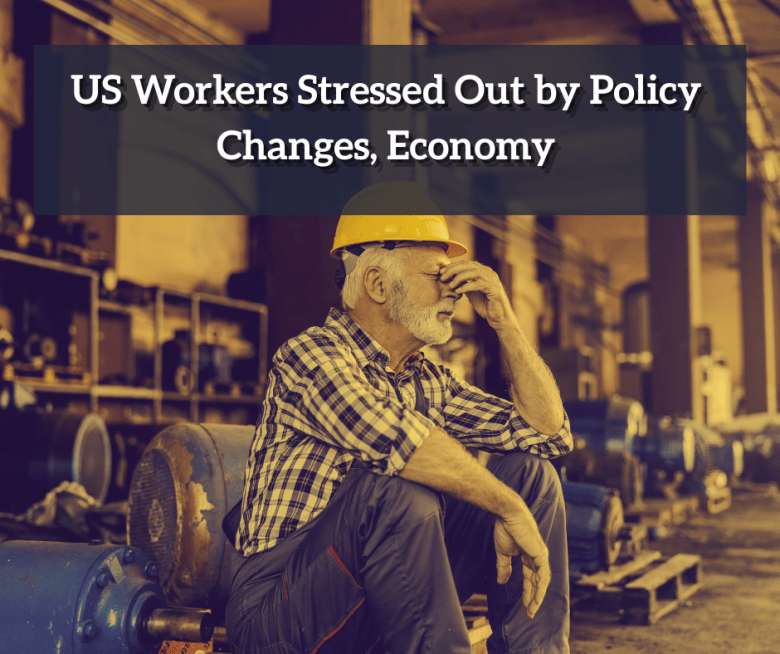
US workers stressed out by policy changes, economy
Growing uncertainty about the U.S. economy and changes in government policies under the Trump administration are causing stress for America’s workers, a recent poll finds.
Two-thirds of adult workers say their workplaces have been affected by recent federal policy changes, some of which have required drastic operational changes, finds the survey, which was conducted by Harris Poll on behalf of the American Psychological Association.
About 40% of workers said they were worried about losing their jobs in the next 12 months because of government policy changes, which have included funding and programming cuts, mass layoffs, workplace immigration raids and tariffs on imports. The federal-level actions by Trump officials are affecting U.S. workers in communities across the nation, according to the poll, which was conducted in March and April.
Rising inflation rates and costs of goods and housing may also be worsening worker stress. About 44% of workers said they were concerned that problems with the U.S. economy would cause them to lose their jobs in the next year, up from 36% in 2024.
More than half of all U.S. workers said job insecurity has increased their stress level on the job. Workers who worried about losing their jobs were more likely to say they had trouble sleeping and with their personal relationships.
Mothers reporting poorer mental health
Long-running health crises in the U.S. are causing the nation to have high rates of unexpected deaths, most of which are preventable, new research says.
From 2022 to 2023, the U.S. experienced more than 1.5 million “excess deaths” — the number of lives lost that exceeded what was expected — according to a May 23 study in JAMA Health Forum.
The nation’s annual number of excess deaths peaked at nearly 1.1 million at the height of the COVID-19 pandemic in 2021, before falling to about 820,000 in 2022 and then 705,000 in 2023. While the 35% decrease was significant, the 2023 total was still higher than the nation’s 631,000 excess deaths in 2019.
At the heart of the problem are preventable U.S. public health crises that are taking large numbers of lives, including drug overdoses, gun violence, car crashes and poor cardiometabolic health, researchers said.
Excess deaths accounted for nearly 23% of all deaths in the U.S. in 2023. Younger and working-age Americans were particularly impacted: The researchers estimated that almost half of all 2023 deaths among Americans under age 65 were avoidable.
Compared to other high-income countries, the U.S. experienced 14.7 million excess deaths from 1980 to 2023 relative to what would have occurred if the nation had mortality rates similar to its peers, the study found.
Preventable deaths costing US lives
Mental health is on the decline among mothers of children and teens in the U.S., new research finds.
From 2016 to 2023, the rate of U.S. mothers who said they were in excellent mental health fell by nearly 32%, according to the study, which was published May 27 in JAMA Internal Medicine. At the same time, the rate of mothers who said their mental health was fair or poor rose nearly 64%.
While some of the decline overlapped with the worst years of the COVID-19 pandemic, the decrease began before the outbreak. Mothers in the study had children ages 17 and younger.
Women with low levels of education, who were single mothers or who had children who lacked health insurance or were covered by Medicaid were more likely to report fair or poor mental health.
The researchers also examined mental health among fathers, finding about 4.5% of men said they had fair or poor mental health in 2023, compared to 8.5% of mothers.
While researchers did not examine the reasons for the declines, they noted that other research has cited poor access to care, social isolation and rising substance use disorders as potential contributors to rising rates of mental health issues in the U.S.
Other recent public health news of note includes:
• Ending Medicaid expansion would hurt hospitals and their communities, says a new Commonwealth Fund issue brief. If Congress and the Trump administration follow through on threats to make steep cuts to Medicaid funding, states may be forced to scale back on who is eligible for the program. For hospitals, that loss of Medicaid participants would translate to less revenue, increased uncompensated care costs and lower operating margins, the brief said.
• Global warming is increasing some types of cancer for women, says a new study in Frontiers in Public Health. Published May 27, the research found higher temperatures in the Middle East and North Africa are making breast, ovarian, uterine and cervical cancer more common and more deadly. Climate change is increasing exposure to unsafe water, air pollutants and ultraviolet radiation.
• Inequalities accelerate the spread of infectious diseases through populations, according to new findings in Scientific Reports. During outbreaks, low-income people, who have fewer resources to quarantine, are more likely to be exposed to infections, researchers said. At the same time, high-income people return to normal activities prematurely, setting the stage for renewed outbreaks.
• If rising sea levels from climate change in the Pacific Northwest combine with a powerful earthquake, residents of the region would be hit with major flooding, a new study in the Proceedings of the National Academy of Sciences predicts. A major earthquake could cause coastal land to sink up to 6.5 feet, researchers said, putting people in southern Washington, northern Oregon and Northern California at high risk for flooding.
• Exposure to air pollution can lead to weight increases in kids and raise their risks for diabetes, according to new research in JAMA Network Open. Scientists found kids exposed to higher levels of traffic-related air pollution were more likely to have higher BMIs and additional weight gain into young adulthood, leading to higher levels of insulin resistance.
• Nanoplastics can make E. coli bacteria more dangerous, new findings in the Journal of Nanobiotechnology warn. Food scientists at the University of Illinois Urbana-Champaign found microscopic pieces of plastic can cause physiological stress in E. coli O157:H7 — a severe strain of foodborne bacteria that causes more than 2,000 annual hospitalizations in the U.S. — leading it to emit more toxins.
• Tropical cyclones, including hurricanes and typhoons, are increasing infant deaths around the world with climate change, according to new research in Science Advances. Infant deaths linked to tropical cyclones rose an average of 11% in seven low- and middle-income countries between 2002 and 2021, the study found. Even lower-intensity storms were associated with increases in infant deaths.
The Watch is written by Michele Late, who has more than two decades of experience as a public health journalist.ore than two decades of experience as a public health journalist.