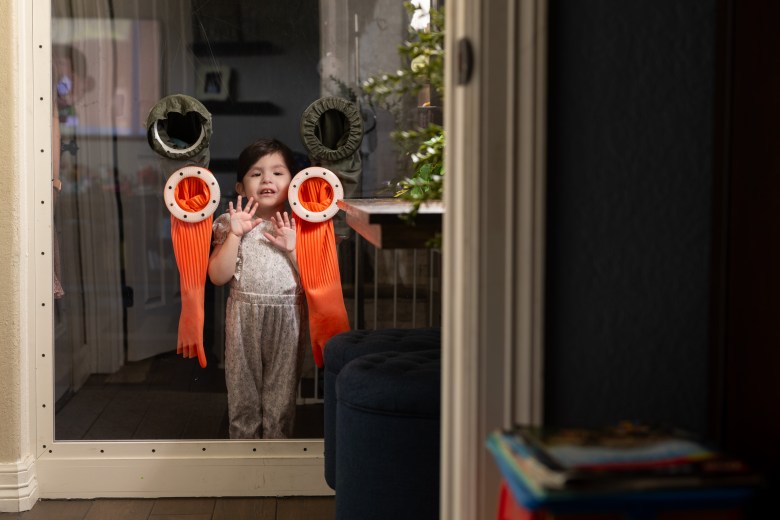
At 4 years old, Juliana Salazar spends her mornings moving between flashcards and puzzles, stacking magnetic tiles into towers that wobble and fall.
She laughs easily, her mother says, and is just starting to figure out how to bounce a ball without losing control of it. From the outside, her world looks like that of any other young child.
But inside her family’s home in the Houston suburb of Pearland, that world is carefully contained.
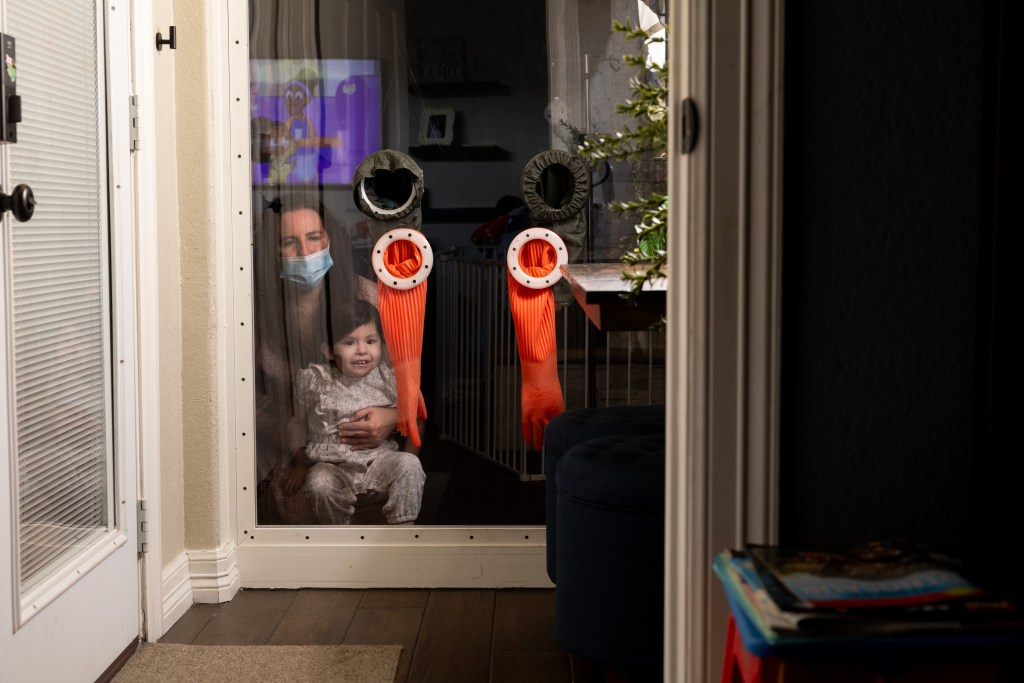
A clear plexiglass wall divides the house in two.
On one side, Juliana moves through her daily routine, protected from the outside with her mother, Ariana Salazar. On the other, her father and older brother come and go, entering through a separate door and keeping their distance, careful not to bring anything inside that could make her sick.
Juliana has never been inside a grocery store. She has never had a playdate. And no one beyond her immediate household has ever held her.
She was born with congenital athymia, a rare immune disorder that affects how the body fights infection. In her case, it is part of a broader genetic condition known as 22q11.2 deletion syndrome, also called DiGeorge syndrome.
The condition leaves her without a fully functioning immune system, meaning even common illnesses like a cold can pose serious risks, including infections that last longer; complications such as pneumonia; and, in some cases, hospitalization.
Salazar said the diagnosis reshaped nearly every aspect of the family’s lives.
Juliana’s condition was identified shortly after birth, after she failed a newborn screening and additional testing confirmed she had congenital athymia at just six days old, forcing her family to severely limit outings and contact with others to reduce the risk of infection.
“At least walking around, she looks like a normal little kid,” Salazar said. “But her body is just not equipped to face all the germs that are out there.”
Juliana cannot safely receive certain vaccines because of her condition, and her well-being depends largely on avoiding exposures altogether. Doctors told the family early on that Juliana’s prognosis would depend on how well they could protect her from infections while waiting for a thymus transplant, a procedure that can help restore immune function.
“If we get sick with something, it could literally kill her,” Salazar said.
For children like Juliana who cannot be vaccinated, and others who are medically vulnerable, protection also depends on the level of immunity in the surrounding community. But as childhood vaccination rates decline in some parts of Texas due to rising numbers of exemptions, diminished access to health care and declining public confidence in vaccines, that protection has become less certain.
“When people whose children are healthy don’t choose to vaccinate, it impacts children like Juliana,” Salazar said.
A doubling of vaccine exemptions
In January 2025, measles began spreading across West Texas, clustering in Gaines County, where vaccination rates had fallen below levels recommended to maintain herd immunity – when enough people in a community are protected against a disease, either through vaccination or prior infection, that it becomes difficult for a disease to spread.
By August 2025, 762 cases of measles had been confirmed statewide, according to the Texas Department of State Health Services. Ninety-nine people were hospitalized with the highly contagious disease, and two unvaccinated school-aged children died.
The West Texas outbreak accounted for the majority of measles cases reported in the United States in early 2025 and was the largest of more than 40 outbreaks nationwide that year.
State health data shows that such outbreaks become more likely as vaccination coverage declines. In Texas, more than 132,900 K–12 students had exemptions for at least one vaccine during the 2024–2025 school year, according to the Department of State Health Services. That school year, statewide kindergarten vaccination coverage fell below the threshold that public health experts say is needed to prevent measles outbreaks.
Vaccine exemptions have more than doubled in recent years. During the 2019–2020 school year, roughly 64,000 Texas students had exemptions on file, according to state data.
State records show the vast majority of those exemptions are for reasons of conscience, including personal or religious beliefs, rather than medical conditions, which account for a much smaller share.
The increase in exemptions means more risk for children like Juliana, whose world is defined by distance, walls, routines and careful separation from everyday exposures.
For others, vulnerability to illness is less apparent.
Fourteen-year-old Charlotte Murphy goes to school, plays volleyball and spends time with friends. To most people around her, she appears healthy.

Credit: Stephanie Murphy
But Charlotte, whose family lived in The Woodlands, Texas, a Houston suburb, for 13 years before moving to North Carolina, has common variable immune deficiency (CVID), a primary immune disorder that weakens her ability to fight infections. Illnesses that might mean a few days home from school for other children can leave Charlotte bedridden for weeks, turning everyday life into a constant calculation of risk.
Her mother, Stephanie Murphy, said the family’s routine often shifts depending on the risk.
When illness spreads through the school or community, small decisions — whether to attend practice, go to class or be around friends — carry more weight. Sometimes, it means pulling back on the activities that Charlotte loves for weeks at a time.
“We highly rely on other people for her safety,” Murphy said. “When other people are not focusing on public health, normal life becomes dangerous for her.”
For people with Charlotte’s condition, illnesses can last longer, occur more frequently or be more severe, sometimes requiring hospitalization or intensive treatment. High vaccination rates can help prevent an infection from ever reaching medically vulnerable children.
For contagious illnesses like measles, the threshold to attain herd immunity is exceptionally high – typically around 95% of a population. When vaccination rates fall below that level, the likelihood of disease transmission increases, particularly in shared spaces like schools, clinics and waiting rooms.
Despite the health risks, Texas state legislators have made it easier for those seeking childhood vaccine exemptions. Last year, for example, lawmakers in Austin passed and Gov. Greg Abbott signed House Bill 1586, which allows parents to download vaccine exemption forms online. Previously, parents had to ask the state health department for such forms.
Supporters of the new policy describe it as a way to reduce paperwork. Critics — including the Texas Medical Association and the Texas Pediatric Society — contend that easier access to nonmedical exemptions could drive down vaccination rates.
“As exemption rates increase, parents of immunocompromised children should have the right to know whether their children are going to a school where the exemption rate might put their child at risk,” Charles Stern, a family medicine doctor in Waco, said during testimony against HB 1586 on behalf of the two medical groups.
During the 2023 session, state legislators passed House Bill 44, which prevents doctors and health care providers who participate in Medicaid or the Children’s Health Insurance Program from declining to accept patients solely because of their refusal or failure to get a vaccine.
Health experts say that while the law protects access for some families, it also weakens infection-control strategies that clinics use to protect their medically vulnerable patients.
In Texas, schoolchildren are required to be immunized against nearly a dozen serious diseases, including measles, polio, rubella, and hepatitis A and B. The state’s requirements have historically aligned with national guidance. But in January — less than a year after anti-vaccine activist Robert F. Kennedy Jr. was confirmed as U.S. health and human services secretary — the Centers for Disease Control and Prevention scaled back its recommended childhood immunization schedule from 17 vaccines to 11.
The move garnered immediate backlash from medical and public health groups, including the American Academy of Pediatrics, which publicly split with the CDC and issued its own childhood-vaccine recommendations.
Rekha Lakshmanan, executive director of The Immunization Partnership, a Houston-based nonprofit that works on state vaccine policy, said the changes to the CDC’s guidance have only worsened confusion among parents unsure which vaccines their children should receive.
“What we’re seeing federally has created a lot of chaos,” Lakshmanan said.
Ikemefuna Okwuwa, a physician and president of the Texas Academy of Family Physicians, said this uncertainty often leads parents to seek reassurance from physicians they trust. Polls show pediatricians are still the most-trusted source of vaccine information.
Okwuwa said conversations about vaccines work best when families feel comfortable asking questions rather than feeling judged or dismissed.
“The physician-patient relationship is critical,” said Okwuwa, residency program director at Texas Tech University School of Medicine in the Permian Basin. “Parents need someone they trust enough to ask, ‘Is this safe? Is this right for my child?’”
Okwuwa said those conversations can help address misinformation and give families space to understand vaccine recommendations within the context of their child’s health.
A warning sign
Experts say the effects of declining vaccination rates often unfold gradually, making them harder to recognize in real time.
Maria Monge, a physician and chair of the Texas Public Health Coalition — a statewide network of medical and public health organizations that advocates for disease prevention policies — said the consequences of declining rates aren’t always immediately apparent, which can make it harder for families to understand the risks.
“When public health is effective, people don’t notice it because they’re not seeing disease,” Monge said. “But when vaccination rates begin to fall, those protections weaken over time.”
She said outbreaks like the recent one in Gaines County should serve as a warning sign: Even small declines in immunization coverage, spread across a state as large as Texas, can leave thousands more children vulnerable to preventable disease.
While some decisions not to vaccinate are driven by personal beliefs or hesitancy, others are tied to access, Lakshmanan said. In parts of Texas, particularly in rural areas and some urban pockets, families may have trouble finding nearby clinics that offer vaccinations.
“There are pockets of what we call vaccine deserts,” she said. Texas also has the nation’s highest rate of uninsured children — more than 1 million in 2024 — which impacts their access to vaccines.
For families navigating rare immune conditions, like Juliana Salazar’s in Pearland, those gaps can be life-threatening.
“I just wish people would understand that something that is normal in society, like a cold or the flu, could be life or death for my child,” said Juliana’s mother, Ariana.