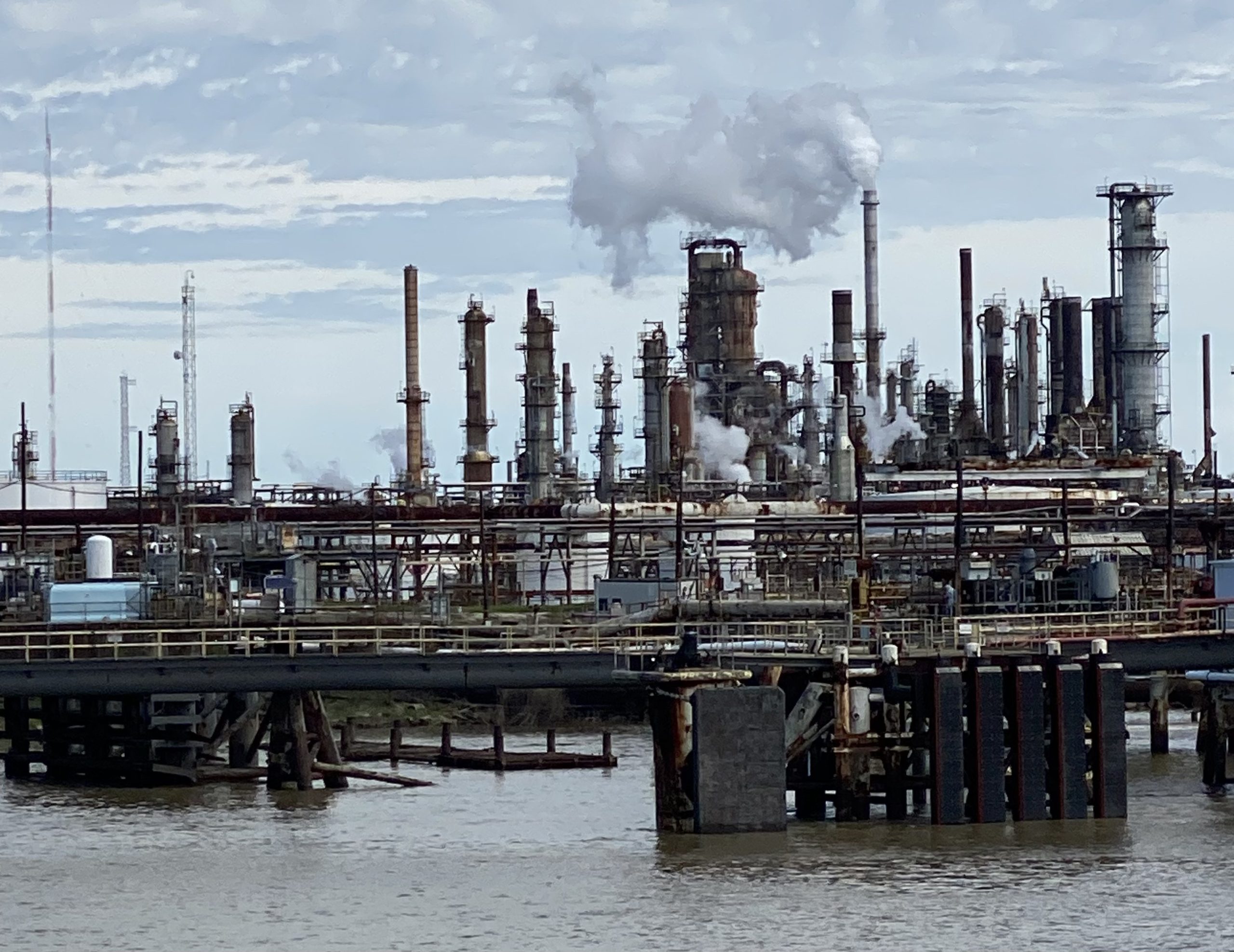
Nearly two decades had passed since the storm. For many, the memory of what had happened on Goat Island had largely vanished into the Gulf of Mexico.
Instead, what residents remembered that year were the piles of boats and cars washed up along the highway to Galveston and the twisted mounds of debris where homes once stood. It was late summer 2008, and Hurricane Ike had just struck, decimating parts of the upper Texas Gulf Coast.
But Goat Island — a spit of swampy land just east of Galveston — also flooded, and with it an oil and gas facility that sat on its uninhabited shores. When the hurricane struck, piping to the St. Mary Land and Exploration Company’s storage tanks snapped apart, releasing thousands of gallons of crude oil into the Gulf. By the time St. Mary workers arrived a day later, the tanks were empty.
There were nearly 450 reported releases of oil, gasoline and other hazardous substances into the air and water during Ike, including the incident on Goat Island. None of these releases was catastrophic. But the area’s luck may not hold.
Today, Galveston County is home to 22 refineries and chemical plants. Another five petrochemical facilities are proposed or under construction, according to Oil & Gas Watch. Since Ike, meanwhile, the county’s population has grown by more than 80,000.
Concern is mounting over the potential dangers industrial operations pose to nearby communities during extreme weather events. A Public Health Watch investigation found that petrochemical facilities aren’t all held to the same standard when it comes to preparing for natural disasters, like hurricanes and floods. Not even close, in fact.
Facility owners can determine what constitutes an extreme weather risk, create their own hazard-response plans and communicate with local emergency responders to the extent they wish. For the public, information is difficult, if not impossible, to access and federal agencies lack the resources to follow up with facilities on their emergency plans.
A facility’s emergency response is mostly regulated through the U.S. Environmental Protection Agency’s Risk Management Program, or RMP, a rule meant to safeguard industry, communities and the environment from chemical disasters. Of the nearly 12,000 RMP facilities in the United States, Texas has the highest number by far — just over 1,550. In the greater Houston area, which includes Galveston County, three of four residents live within three miles of one of these sites.
The RMP, now 30 years old, has failed these people, said Shiv Srivastava, policy director for the environmental justice nonprofit Fenceline Watch.
“The goal [of RMP] is not just to mitigate risk and be prepared for it, but have the public be aware of it, too,” he said. “It’s supposed to find alignment between the processes and precautions that facilities are supposed to take and give us information. Unfortunately, it’s not fulfilling either of those charges.”
At the same time, scientists have emphasized the growing intensity of extreme weather events on the Gulf Coast due to climate change. Storms, like Category 4 or 5 hurricanes, which at one point seemed unlikely to hit the coast in a lifetime, are now more possible, raising questions about the Texas petrochemical industry’s level of preparedness.
The Biden administration enhanced the RMP rule in 2024, adding requirements for industry to evaluate natural hazards, along with climate-change impacts, and granting the public greater access to information. However, the Trump EPA has since proposed removing these enhancements, saying they place unnecessary burdens on facility owners.

Some on the upper Texas coast aren’t waiting to see how events play out. Storied Houston meteorologist Matt Lanza, for example, is moving to Connecticut, in part because of the kind of storm he fears could be coming. He and other experts agree that climate change will make hurricanes more intense, and those storms will be more destructive due to sea-level rise. There could be a 10% increase in Category 4 and Category 5 hurricanes, according to a 2023 National Oceanic and Atmospheric Administration report.
“A lot of these storms are getting into the Gulf and they’re going crazy, ballistically intensifying, and then not long after they peak, they make landfall,” Lanza, managing editor of the publication Space City Weather, told Public Health Watch.
In his farewell letter to readers, Lanza wrote, “I do worry about our vulnerability here to hurricanes, and not just Beryl-type storms — much bigger storms …metaphorically, my concern for hurricanes is what keeps me up at night. I take this stuff seriously.” (Hurricane Beryl made landfall south of Houston as a Category 1 in July 2024, knocking out power to about 2.7 million people and killing 44, mostly in Harris County.)
It’s “a little troubling,” Lanza wrote, that the “Ike Dike” — a nearly $35 billion system of barriers, gates and dunes along the Gulf Coast — “is still mainly a plan on paper,” at least 20 to 30 years from completion.
Meanwhile, from early June to late November, people on the Texas Gulf Coast are in the thick of hurricane season. The weather gets muggier, the days hotter and the storms stronger — reminders of what may be lurking thousands of miles away in the Atlantic Ocean.
For some residents of Galveston County, it’s not hard to envision calamity. Faith Allred, 20, has spent her entire life in Texas City, an industrial hub just north of Galveston Island. She’s too young to remember Hurricane Ike in 2008, but clearly recalls Hurricane Harvey nine years later. Her father, who had worked in the petrochemical industry, took his boat out to help those stranded in flooded neighborhoods. The memory has stuck with her.
Among the plants in her community are Marathon’s Galveston Bay Refinery and Valero’s Texas City Refinery. Both use hydrogen fluoride, or HF, a chemical which, if released in sufficient concentrations, can be lethal. According to data on file with the EPA and reviewed by the Natural Resources Defense Council, a worst-case HF release at Marathon could affect a population of 680,071. At Valero, a worst-case release could affect 290,000 people.
Records show there have been eight accidents involving HF at the two refineries since 2000. Seven of these accidents caused at least one injury. In March 2005, the Marathon refinery, then owned by BP, sustained a series of blasts that killed 15 workers and injured 180.
“I don’t want to live here forever,” said Allred, who works in a bait shop. “I’m worried about the [petrochemical plants’] emissions, about what they put out there into the air. I don’t want to be here for the next disaster.”
MAP: Galveston County Facilities Required to File Risk Management Plans
Facilities that handle extremely hazardous substances are required to develop and submit plans to the EPA’s Risk Management Program, or RMP. In Galveston County, there are 22 RMP facilities, with varying complexities of chemical processes and completeness of emergency plans.
Colors show if facilities have identified hurricanes as a serious risk. The circles are sized by the number of chemical processes reported. The greater the number of processes, the larger and more complex the plant is.
Hold command and scroll or use the -/+ in the bottom lefthand corner to zoom into the outlined study area. Click the arrows in the top corner to view full-screen.
Map: Shelby Jouppi, Public Health Watch
Riddled with loopholes
Prompted by a chemical leak at a Union Carbide plant in Bhopal, India, which killed at least 15,000 people in 1984, the EPA enacted the RMP rule in 1996 as part of the Clean Air Act. Under the rule, facilities must analyze their chemical processes and calculate worst-case scenarios every five years. They’re also required to identify major hazards that could affect their facilities, such as hurricanes, floods or tornadoes. If a facility identifies such a hazard, it must demonstrate that it has a proper emergency-response plan.
Still, critics say the rule is riddled with loopholes.
“Just assuming that facilities are going to address the risks of extreme weather and their risk management plans alone is not sufficient,” said Darya Minovi, a fair access research manager for the Center for Science and Democracy with the Union of Concerned Scientists “Simply noting that a risk exists is not enough compared to actually planning for it and preventing it from happening.”
Minovi cited as an example an explosion at the Arkema chemical plant in Crosby, Texas, in northeastern Harris County, triggered by flooding during Hurricane Harvey in 2017. A fire burned for days at the plant and prompted the evacuation of residents within a 1.5-mile radius.
“Arkema addressed flooding as a risk in their previous risk management plan, but they didn’t actually do anything about it,” Minovi said. The Chemical Safety Board investigated the incident and found there had been a significant lack of planning for flooding or other severe weather events. The Trump administration’s new budget is planning to eliminate the board, a threat the board itself does not take lightly.
In Galveston County, eight of the 22 RMP facilities did not identify hurricanes and/or flooding as serious risks for some or all of their processes, according to a Public Health Watch review of EPA records. Most facilities did not mention these weather events in the summaries of their emergency-response plans.
“Simply noting that a risk exists is not enough compared to actually planning for it and preventing it from happening.”
Darya Minovi, research manager at the Center for Science and Democracy
Public Health Watch reached out to the owners of all 22 facilities to better understand their emergency plans. Only seven responded: Calumet Refining Products, Marathon Petroleum Products, Linde, Valero, Enterprise Products Operating, the city of La Marque and the Dickinson Water Control and Improvement District.
La Marque, for example, said its preparations include “monitoring weather conditions, adjusting operations in advance of storms, security equipment and chemical storage areas, verifying backup systems and maintaining communication with response agencies.” Marathon noted that it now has a “new centralized control room at its Galveston Bay refinery to withstand hurricane-force winds and storm surges” and “an integrated Contingency Plan, which includes a Tropical Weather Plan.”
Of the eight that did not identify hurricanes and/or flooding in their RMP reports, only three responded to questions by Public Health Watch. In one case, Marathon stated that “plans are in place to modify our RMP submission to reflect that level of preparedness for each of our process units.”
Katherine Culbert, a senior process safety engineer who works in the petrochemical industry, isn’t surprised by the variation in emergency plans. The thoroughness of an RMP report depends on the facilitator filling it out, she said; it can be either an employee or a contractor. An outside contractor may depend on facility staff to explain what hazards to look out for.
“A lot of this is voluntary reporting,” Culbert said. “And sometimes when they use internal people, the pressure from management is, ‘We don’t want any recommendations out of this [analysis], OK? So, do what you can to make sure that everything that we already have is good enough.’”
The results are reported to the appropriate EPA regional office. But there is little federal oversight, according to a 2022 report by the U.S. Government Accountability Office.
While the EPA does conduct inspections of RMP facilities, the agency’s capacity is limited. In 2019, it employed 43 credentialed RMP inspectors, who were able to get to only about 2% of all RMP facilities nationwide. These inspections determine if a facility has properly identified major hazards, like hurricanes or floods, and updated equipment and documentation.
The GAO report found that just over 30% of RMP facilities are in areas facing one or more natural hazards. This includes all 22 facilities in Galveston County, which is at extreme risk of flooding over the next 30 years, according to First Street, an organization focused on climate hazard research.
The state’s environmental regulator, the Texas Commission on Environmental Quality, or TCEQ, does not have the equivalent of an RMP, according to Victoria Cann, an agency spokesperson. It has regulations that address specific hazards, such as water utility emergency plans during a power outage and facility maintenance during a hurricane, but nothing that covers a facility’s entire safety plan, she said.
This void concerns Sabarethinam Kameshwar, an associate professor of civil and environmental engineering at Louisiana State University. For years, Kameshwar has researched the vulnerability of tanks that hold petroleum products and other chemicals to natural disasters.
“These tanks are like soda cans, literally they are like soda cans blown up,” Kameshwar said. “They can be crushed, float away and leak.”
Just within the past few weeks, the nation experienced one chemical disaster and one near-miss involving tanks. On May 26, a tank full of a caustic chemical known as white liquor exploded at a paper mill in Longview, Washington, killing 11 workers. Five days earlier, a leak in a tank at an aerospace manufacturing site in Garden Grove, California, led to the evacuation of 50,000 people within a nine-square-mile area. The vessel contained methyl methacrylate, a reactive chemical that attacks the nervous and respiratory systems. The crisis, which lasted nearly six days, was defused after a crack in the tank allowed pressure to subside.

During storms, tanks can dislodge and float away, leak or combust. On Goat Island, during Hurricane Ike, the tanks from St. Mary Land and Exploration were separated from their piping and released thousands of gallons of oil into the Gulf. During Hurricane Harvey, the tanks at the Arkema plant in Crosby exploded because the chemicals — meant to stay cold — combusted in the heat after the power went out.
The solution is to keep tanks full so they are too heavy to dislodge, Kameshwar said. But that may not be included in companies’ RMP plans.
“I have talked to people in the industry, and they are aware of this issue,” he said. “What they do to address it or what they do not do is up to them because they are usually insured one way or another. They are so big that they can cover the loss of a tank or two that may break apart.”
Other facilities operate under thin margins, Kameshwar said.
“They say, ‘I want to make sure my tank is safe now for this year’s season,’ but anything else is a luxury or is something they cannot afford right now,” he said. “They know it’s an important thing, but they don’t have the money to address it.”
Access restricted
Srivastava, of Fenceline Watch, has been researching RMP plans for months. Like many others, he struggled to get the information he needed to determine facilities’ disaster readiness.
Srivastava first had to schedule an appointment with the U.S. Department of Justice to visit a government reading room in downtown Houston. He was told he could see no more than 10 RMP reports every 30 days. He was not allowed to photocopy, photograph or scan any of the reports and had to take handwritten notes.
(Srivastava later learned that he was misinformed by the Justice Department. Residents can request more than 10 RMP reports if they live in the same county as each facility they are researching).
RMP reports vary in length. Some are 10 pages long. Others, like the one for Marathon’s Galveston Bay Refinery, are over 200 pages.
“It’s difficult for community groups to hold to account agencies and facilities when information regarding these plans is so difficult to access … and so difficult to make sense of,” Srivastava said. “At no point does it feel like consideration for regular people that would need this information was given.”
Some RMP data can be found on non-governmental websites, but details such as worst-case scenarios — officially known as offsite consequence analyses — are often missing.
For a time, these scenarios were publicly available. In 1999, however, the federal government restricted access due to concerns over terrorism. Today, only “qualified researchers” can access RMP information from the EPA. Who, exactly, counts as a qualified researcher remains unclear. As a result, members of the public must schedule a time to review the documents at a reading room.
Emergency information for facilities can also be found in EPA forms called Tier II Reports through the 1986 Emergency Planning and Community Right-to-Know Act, intended to protect public health and the environment from chemical hazards. Texas facilities must submit these reports once a year to the TCEQ. Like RMP reports, however, these documents are restricted from the public for national security reasons. Unlike RMP reports, however, community members cannot view them in reading rooms.
They can request Tier II Reports from their local emergency planning committees, known as LEPCs. Public Health Watch sought to obtain these reports from the Galveston County LEPC, but the request was initially denied and is under review by the county’s outside counsel.
LEPCs started in 1986 as part of the Right-to-Know Act. Facility emergency response documentation is required to be sent to these committees, which pass the information on to county or city emergency departments if requested.
However, LEPCs are volunteer-based organizations, with widely varying levels of staffing. Galveston County has a small one, for example, while Harris County has several well-resourced ones. This is true nationally as well. Of the more than 4,000 LEPCs, about 1,236 were reported as being inactive or of unknown status in 2023, according to an EPA report.
Facilities aren’t required to send emergency-response documentation directly to local governments. But Galveston County officials don’t see a problem.
“The Galveston County Office of Emergency Management maintains a general understanding of facility emergency procedures through coordination with local (authorities) and the LEPC,” Jesse Ryholt, the county’s emergency management coordinator, wrote in an email to Public Health Watch. “Facilities remain responsible for managing their own response and recovery operations.”
Galveston County Precinct 4 Commissioner Robin Armstrong, whose district includes part of Texas City, declined to comment. Precinct 1 Commissioner Darrell Apffel, whose district also includes part of Texas City, did not respond to requests for comment.
Responding to so-called fenceline communities, the EPA granted RMP access to residents who live or work in a six-mile radius around an RMP facility in its 2024 Biden-era rule. Residents could request emergency information from each facility in that range. Trump’s EPA has proposed rescinding this change.
In recent comments submitted to the agency, Srivastava argued that the Trump administration is “trying to drag us back to a time where the process basically said, ‘Are you in a flood zone? Do you experience hurricanes?’ And check that box, which is deficient. It isn’t protective.”
The Biden-era rule, while imperfect, was a good start, Srivastava said.
Forecasters believe this year’s hurricane season may be less active than usual along the Texas Gulf Coast because of the climate phenomenon known as El Niño. But a single storm, as Beryl showed two years ago, can still wreak havoc and take lives.
“People didn’t get serious about hurricane preparedness until really after we saw what Katrina did,” Srivastava said, referring to the powerful 2005 storm that inundated much of New Orleans and took 1,392 lives. “My true fear is we’re going to have to experience something like that again to get things done.”
Facility Responses to Public Health Watch
Emergency Plans
Calumet said the company’s structure is a formal interaction with first responders and local authorities, with which its incident command team regularly trains and maintains contact, and makes sure their infrastructure is as “bullet-proof as possible.”
Emergency Response
The City of Marque said the preparation may include monitoring weather conditions, adjusting operations in advance of storms, security equipment and chemical storage areas, verifying backup systems and maintaining communication with response agencies.
RMP
La Marque clarified that the reason that flooding was marked “yes” and hurricanes were marked “no” was because flooding associated with hurricanes is “evaluated and addressed” under the flood hazard category.
Emergency Plans
Marathon said that each of the company’s operating locations have emergency response teams and site-specific emergency plans with regular drills and exercises. The company also has a new centralized control room at the Galveston Bay refinery that can withstand hurricane-force winds and storm surges.
RMP
Marathon stated that “plans are in place to modify our RMP submission to reflect that level of preparedness for each of our process units.”
Emergency Plans
Enterprise said the company conducts meetings at the beginning of every hurricane season to become familiar with plans. There are ride-out teams that safeguard and protect the facilities, public and environment. The company may activate its “Emergency Operations Center” in Houston to bring in full resources.
RMP
With regard to Enterprise’s Emergency Response Plan flooding is identified in plan as a risk factor for facilities. Specific to the Texas City terminal, flooding is included as a potential hazard in the hurricane category.
Emergency Plans
Linde said the facility has robust procedures and policies to help ensure necessary measures are in place to prevent and minimize the consequences of incidents that could harm people, property or the environment.
Emergency Plans
The Dickinson Water Control and Improvement District said it maintains backup power at all critical facilities and has an interlocal agreement to provide and receive assistance if needed. The District also has backup water wells available in case all water sources are lost and pumps and hoses to support sanitary sewer bypass operations when necessary.
Emergency Plans
Valero sent a report on safety which included five generalized phases for hurricane preparedness, including assessment of the storm and possible evacuation, ride-out or shutdown