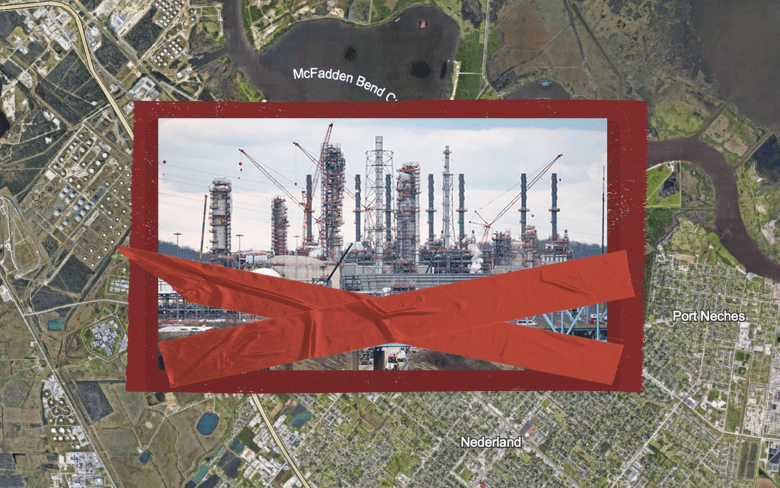
Energy Transfer has put the brakes on its plans for a $1.8 billion petrochemical complex in Jefferson County, Texas. Last week, company representatives withdrew an air permit application over three years in the making, despite having received approval from a top Texas environmental official in February.
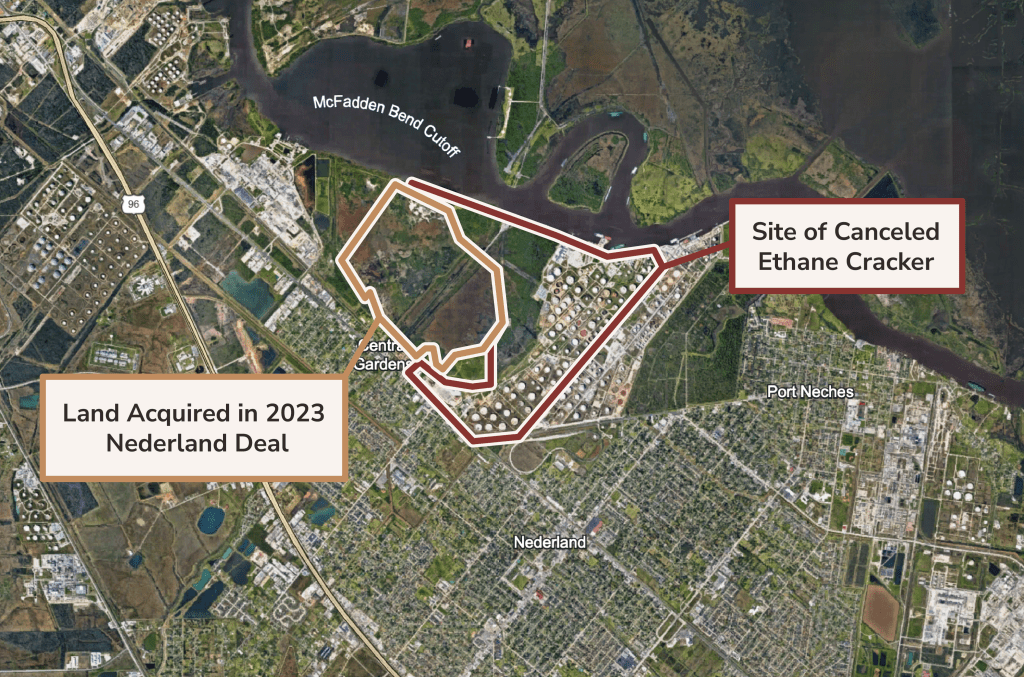
The oil and gas pipeline and logistics giant had planned to build a massive ethane cracking plant on undeveloped land next to its Nederland storage and export terminal. The facility would have converted components of natural gas into ethylene and propylene, two chemical building blocks of plastic.
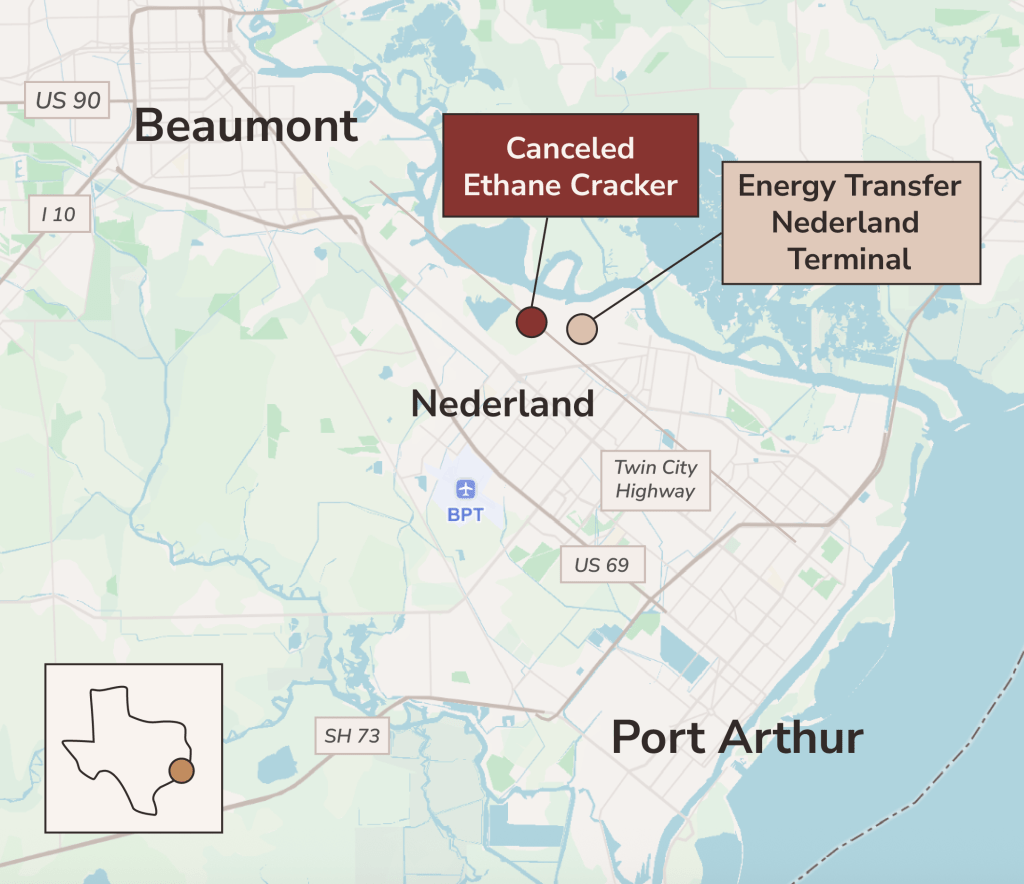
In December 2025, Public Health Watch reported that the company’s draft air permit allowed for unusually high emissions of smog-forming volatile organic compounds and nitrogen oxides. It had the potential to become one of the largest petrochemical sources of such air pollution in the state. Census data show roughly 40,000 people live within a few miles of the proposed site.
A Public Health Watch analysis of state air permits found that the odds of approval were heavily in Energy Transfer’s favor: Over the past 25 years, the Texas Commission on Environmental Quality, or TCEQ, has not denied a single permit for a new major source of air pollution.
Three area residents and four organizations challenged the Nederland project by requesting a contested case hearing from the TCEQ. In filings, their attorneys said the permit used improper emissions calculations; would have allowed the facility to use substandard pollution-control technology; and would ultimately violate federal limits for fine particles.

Despite these criticisms, the TCEQ’s executive director recommended approving the permit. The agency planned to vote in mid-June on whether to grant any of the objectors were “affected persons,” a designation that would have allowed them to fight the permit in court. If the residents had been granted legal standing, the Energy Transfer project would have entered into months of legal proceedings.
Terry Stelly, one of the seven parties that requested a hearing, lives a little over a mile from the proposed ethane cracker’s property line. After retiring from his position as a biologist with the Texas Parks and Wildlife Department, Stelly began reviewing and commenting on industrial air and water permit applications in Jefferson County as president of the environmental advocacy group Southeast Texas Clean Air and Water Inc.
Stelly said he was troubled by what he saw in Energy Transfer’s permit application. The company was asking to be allowed to release enormous amounts of greenhouse gases every year—the equivalent of emissions from about a dozen power plants—and high concentrations of volatile organic compounds, a class of chemicals that includes carcinogens like benzene.
Stelly said that while he was surprised and relieved to learn the project was not moving forward, he’s not letting down his guard.
“I’m not losing my notes or my comments, because you have no idea what’s going to happen in the field [next to the Energy Transfer terminal],” he said. “That property is still going to be there. They still have their plans.”
Energy Transfer acquired 800 acres of undeveloped riverfront land as part of its plans for the ethane cracker. Company representatives did not respond to questions about what it will do with the property or why it withdrew its air permit. It recently completed an expansion of the Nederland terminal and talked of increasing exports of ethane and propane—hydrocarbons derived from natural gas that are used to make petrochemicals—in a May 5 earnings call. The TCEQ told Public Health Watch in an email that it was unaware of the company’s reasoning behind pulling the application or any plans it might have for the site.
Industry analysts have noted that U.S. petrochemical manufacturers are not as profitable as they once were and are even under threat as Chinese and Indian ethylene manufacturers have ramped up production. Last fall Exxon Mobil paused its plans to build an ethane cracking and polyethylene manufacturing complex in Calhoun County, Texas, southwest of Houston, citing economic concerns. That facility faced local opposition.
Energy Transfer Co-CEO Mackie McCrea told investors in the earnings call that the company is “chasing ethane markets all over the world,” looking to partner with companies building crackers in other countries.
Environmental lawyer Amy Dinn, formerly with Lone Star Legal Aid, represented four of the parties opposing the Nederland plant.
She commended Energy Transfer for pulling its application “for a facility they’re not going to move forward with. That’s a lot of effort that our under-resourced agency [has been] dealing with to process the application for the past three to four years.”
The Nederland area has been “transformed” by industry over the past five years, she said.
“I think from the community’s perspective, one more project may not have been needed, given we already have an overburdened community.”