This story, part of Public Health Watch’s “Uninsured in America” project, was reported and co-published by public radio station KJZZ Phoenix. Amy Silverman is executive producer and Athena Ankrah a producer for the station.
PHOENIX — Patricia Huber’s day begins with a lift.
Each morning, her mom steps into Tricia’s suite — a living area, bedroom and bathroom, all decorated in hot pink — and helps her daughter prepare for the day.
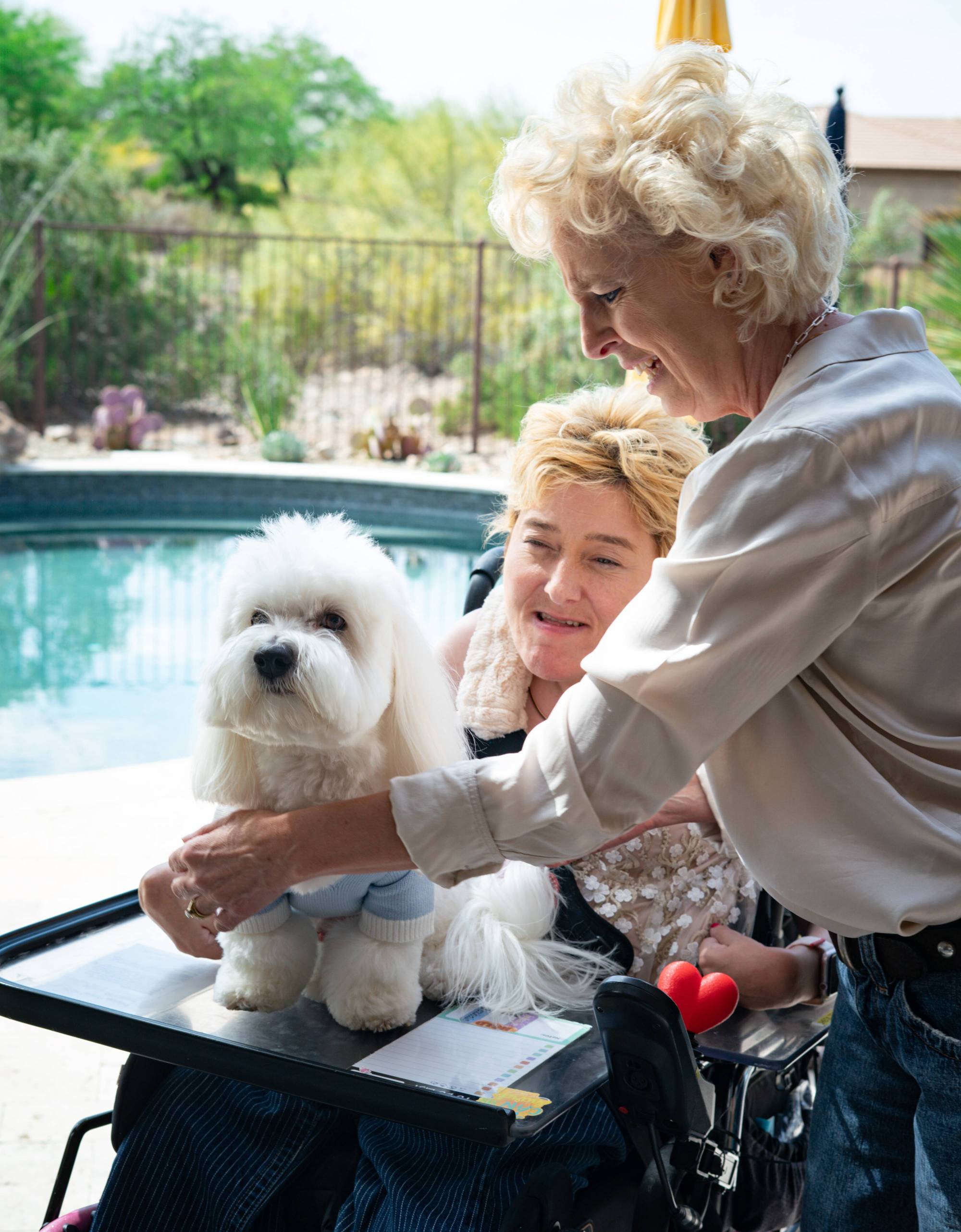
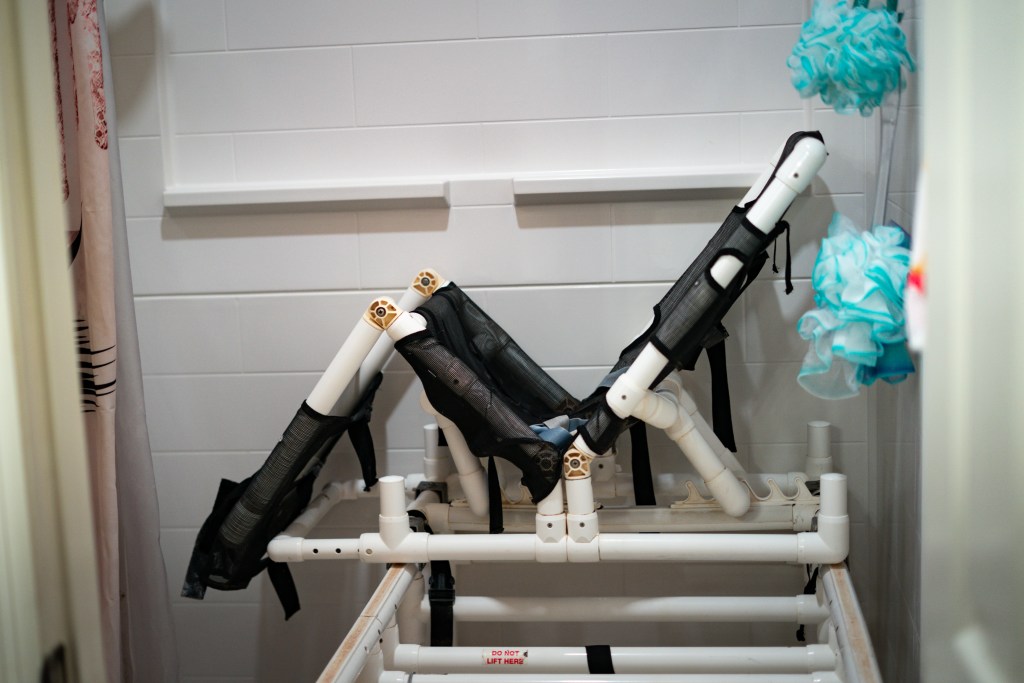
On a recent spring afternoon at the family’s home in south Phoenix, Cindy Mittlestadt walks through the average morning routine while Trish and her dad, Mark Huber, look on. A machine whirs across the ceiling with a hook and straps that can lift Trish from bed and into her motorized wheelchair, or to a mesh shower chair.
“This goes up and down and then uses a sling to attach her to [the ceiling lift],” Mittlestadt says. “And then she just goes from here into her shower room. So I’ll show you… She’s got her bathing system, rolls in and out.”
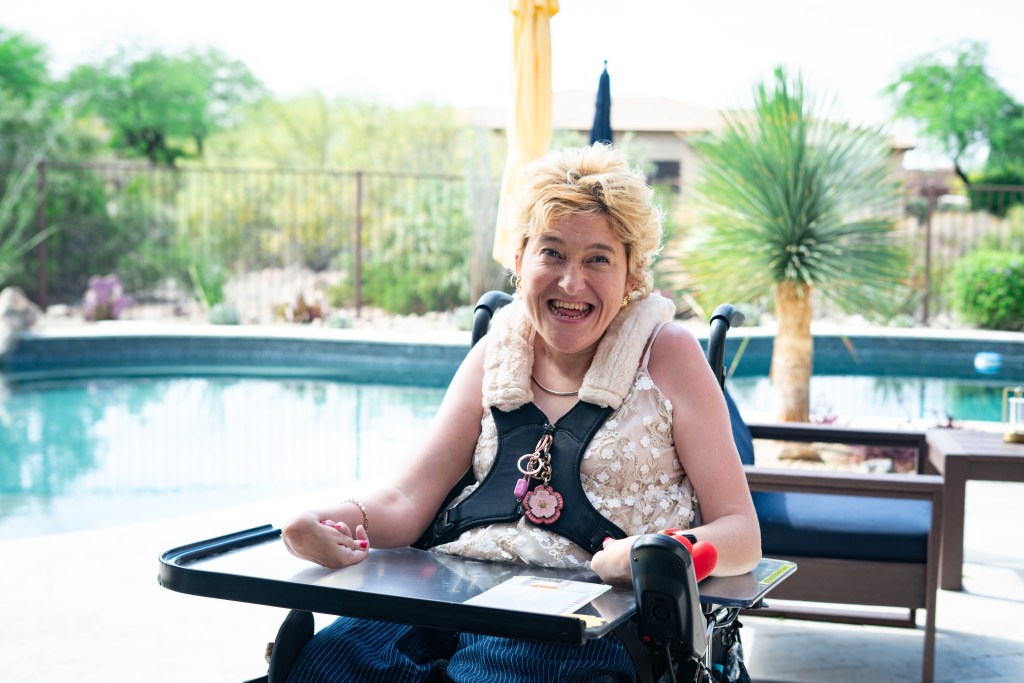
Tricia has cerebral palsy — specifically, spastic quadriplegic cerebral palsy. There are different kinds of CP that impact people in different ways, similar to autism and other developmental disabilities. For the lanky, short-haired 39-year-old, the condition means limited mobility and speech. Trish depends on her mom and other caregivers to help her out of bed, into the shower, into fresh clothes, to eat.
And that’s just the morning.
“I need help twenty-four by seven,” Tricia says.
It’s harder for people who don’t know her well to understand what Tricia is saying. Out of habit, her mom repeats for her: “I need help twenty-four by seven.”
Cindy and Mark know this well. Since relocating to Arizona from Alaska several years ago, the family has struggled to get Tricia services. The litmus test for qualifying for Home and Community Based Services (HCBS) under Medicaid is whether an individual would need to be institutionalized if they didn’t receive any government assistance. Even though Tricia requires 24/7 care, her family had to apply several times before Arizona’s system accepted her. They later found it difficult to hire caregivers because of the shortage — Tricia only has one aside from Cindy, recently. (Just before publication, Cindy learned that after waiting for five years Tricia will now be receiving part-time nursing assistance.)
Even so, the Medicaid services Tricia receives now are a lifeline — and not just for Tricia. Cindy is 56. Mark’s 65. Decades of caregiving have taken a physical and financial toll.
“From a physical capacity, my body is shot,” Mittlestadt says. “You don’t see it, but I’ve got torn shoulders … I can’t even have surgery, though, right now because we don’t have adequate care.”
For Tricia, the few services she does get might soon be eliminated.
Home and Community Based Services in Arizona are under threat because of anticipated cuts to Medicaid mandated by the sweeping federal budget bill, H.R. 1, signed into law last year. Technically, Medicaid is not required to fund HCBS.
For many Arizonans in the system, these services are essential.
Along with caregiving, Arizona’s long-term Medicaid services for people with intellectual and developmental disabilities, or IDD, include medical insurance; caregiving from simple respite to medical care; supplies like wheelchairs and the lift that gets Tricia out of bed; occupational, speech and physical therapies; and housing if one’s not living with family, which will likely be necessary for Tricia when her parents are gone.
In Tricia’s case, “if she loses her Medicaid, then it’s all out of pocket [costs],” her father says. “She’s not insurable at this point.”
Recently, Tricia was hospitalized three times in two weeks, for three or four days per visit. Most of her equipment is very old. Her parents have preserved what they could from their time in Alaska. But it’s impossible to ignore some current needs.
Tricia’s wheelchair is overdue to be replaced, at a cost of around $20,000. Her bathing system is 20 years old, and replacing that and other equipment could cost over $100,000.
Mark turns to Cindy.
“Honestly, we’d be poor, right?”
‘Too ingrained to change’
It’s a simple concept, mandated by the U.S. Supreme Court in the landmark 1999 Olmstead v. L.C. case and celebrated by disability advocates. Instead of housing people with intellectual and developmental disabilities in institutions, the government is tasked with finding ways to keep them in the community — in their own home (typically the family’s) or a small group home — providing them with medical insurance, therapies, caregiving and periodic oversight from a support coordinator..
Medicaid and the states foot the bill for all of this, for those who qualify. The set-up differs from state to state. Because of Arizona’s particular Medicaid waiver, if you qualify, you are immediately eligible for services. Most other states have long waiting lists. Often, disability advocates in Arizona observe that Arizona does, in effect, have waiting lists – the state and Medicaid just don’t refer to them as such. But Arizonans with IDD often wait months to get medical services, equipment and therapies; can’t find qualified medical professionals; and deal with a shortage of service providers.
Arizona’s unusual setup is a poorly kept secret in the disability community. Families have relocated to the state for years because of its seemingly abundant services. An annual national study by the advocacy group United Cerebral Palsy consistently ranked Arizona number one for community-based services for years in the 2010s. (In 2020, the report stopped ranking states.) Enrollment in Arizona’s Medicaid program has surged in recent years, in large part because the state extended a pandemic-era federal program that paid parents to provide care for children under 18 with IDD who have been approved for services.
In just five years, the total number of members enrolled with the Division of Developmental Disabilities rose from just over 44,000 in 2019 to over 58,000 by 2024, a more than 30% increase that has continued to balloon.
In 2025, when state lawmakers attempted to curb the program’s cost, the community backlash was so intense that political leaders have hesitated to say much in 2026, an election year. As of press time, the Arizona Legislature had recessed for several weeks; budget negotiations will likely pick up again in early June.
If the legislature or governor moves to cut the parent care provider program or other services, more community uproar is likely.
“Part of it is the community’s level of expectations,” says Jon Meyers, executive director of the Arizona Developmental Disability Planning Council. “At least when it comes to disability services, we have the most generous system in the nation. And as a result, people have gotten accustomed to receiving a really broad array of services that they would not even come close to receiving in most other states.”
He adds, “I feel like in Arizona, we have a system that is too ingrained to change.”
A foundation of care
Asher Valencia is 11. He has both Down syndrome and autism and lives with his family in Phoenix.

Asher’s mom, Brenna, says the early intervention services he received were invaluable. She says she was completely unprepared to parent a child with a disability, and the therapists and others who came into their home gave her a foundation for caring for Asher.
“It’s learning day to day new things that I would have not had the sense of mind to say, `Oh, he’s not sitting up. Let’s work on his core.’ You know, there’s things that, as a parent, you can do to love and prepare your kid and do your best as a mom. But then there’s things that I don’t know what I need to ask for help for that they identified immediately.”
Losing Asher’s Medicaid services would be “devastating,” Brenna says.
“He wouldn’t be able to get all of the things that he needs and uses and [those are] absolutely why he has been successful. I can’t personally afford it.”
Doing more with less
Some families maintain that despite the broad range of services they’re eligible for, many needs still go unmet.
Like Tricia Huber and her parents, a half dozen other Medicaid recipients and their families told KJZZ they aren’t getting adequate services in Arizona. Even without official waiting lists, providers are not available or services are subpar, they said. Eligibility for support doesn’t guarantee delivery of timely, quality services.
For example, Tricia qualifies for dozens of hours of care a week, but her mother has only been able to find one caregiver who works part-time. It took five years to find parttime nursing assistance. The family is prepared for months of negotiation with the state over Tricia’s much-needed new wheelchair and lift apparatus.
Yet people with disabilities and advocates agree that the level of support Arizona offers now makes a huge difference. They fear a return to the mid-20th century, when people with IDD were locked away in institutions where they were often subjected to isolation, harsh conditions and abuse.
That would not be good, according to Alex Green, an adjunct professor at Harvard Kennedy School and a visiting fellow at the Project on Disability at Harvard Law School. He advocates for eliminating the few institutions still in operation in the U.S. But Green hypothesizes something even worse than the return of institutions. He says he and other advocates talk about what might happen if HCBS services are dramatically cut.
“I don’t think they’re competent enough to build new institutions and new places,” Green says of current policymakers. “I think they’ll just let people die in their homes. They’re willing to cut all the services, but not provide anything.”
Most of Arizona’s approximately 61,000 Division of Developmental Disabilities members live at home or in community-based settings. Only about 1% are in institutional care. One factor that may work against any shift to institutional settings is the cost.
A 2023 report from the Centers for Medicare and Medicaid Services, or CMS, found that nationally, per-user Medicaid spending on institutional care was 68% higher than community-based services — about $17,000 versus $54,500 per person on average.
It’s impossible to know just what will change — but highly likely that something will.
Asked about the expected impact of H.R. 1, Arizona’s Medicaid agency, the Arizona Health Care Cost Containment System, or AHCCCS, said the law “will impact all Arizonans and will likely create significant strain for individuals with developmental disabilities and their families.”
“While AHCCCS is committed to renewing its HCBS waiver and continuing to serve this population, ultimately, decisions regarding whether and how to fund HCBS services are questions for Arizona’s policymakers,” the agency wrote in an email to KJZZ.
In a written statement, the state’s lead policymaker, Gov. Katie Hobbs’s office pledged to protect the program, but indicated changes may be necessary to ensure it survives.
“Arizona has a strong tradition of providing cost-effective, community-based services to those with autism and other intellectual and developmental disabilities,” Hobbs’s office said in an email to KJZZ.
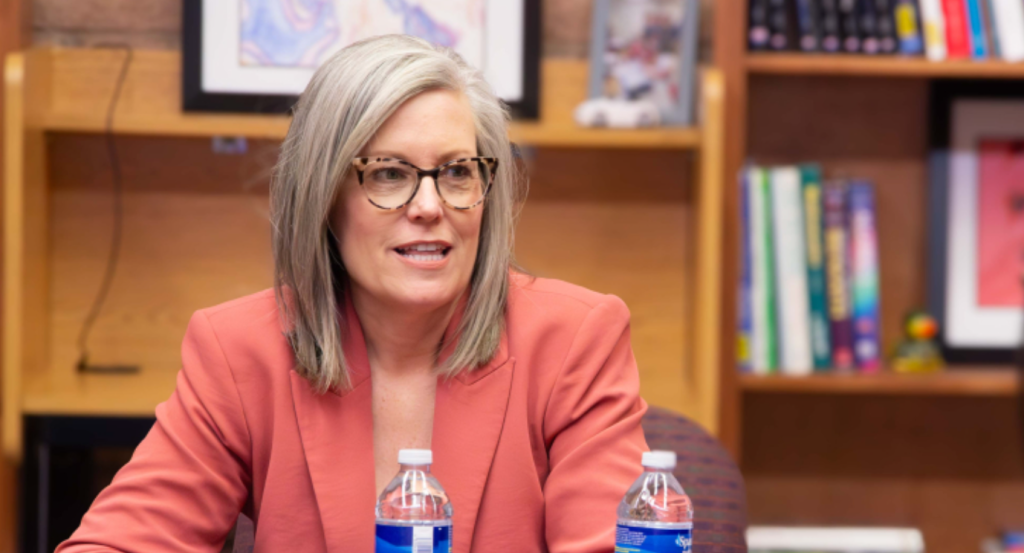
“But as the federal government forces Arizona to do more with less, we expect optional Medicaid services like HCBS programs to continue to be debated by Arizona policymakers.
“The governor remains committed to serving this population, protecting access to these vital services, and we are continuing to work with the community members, clinicians, and our partners at CMS on common sense reforms that will ensure these services are sustainable for generations to come.”
‘Lackluster but crucial’
Some Medicaid recipients are tired of talking about the cost of services. Lynn Wasley, 37, lives in downtown Phoenix. She has autism and cerebral palsy, which means she’s unable to work and often can’t care for herself, she says. She depends on Medicaid services.
Wasley hates the role that money plays in the lives of people like her.
“If we could have a magic wand, I wish that people with disabilities are not just money and that’s it. Like I wish we are people.”
But she also understands the gravity of her situation, and others’.
“It’s basically our essential needs that the community-based services are supposed to support,” Wasley says. “If the Medicaid went away, we would not have our survival.”
It’s not only about survival. It’s also about quality of life.
With help from caregivers, Tricia Huber is able to attend dances and Special Olympics events and spend time in the community, instead of sitting at home in front of the TV. Asher Valencia received crucial feeding therapy, and now other therapists are teaching him how to interact with peers — and the world.
And then there’s Alex Rank. They have cerebral palsy. Rank uses a wheelchair and requires help with daily tasks related to mobility. Rank lives in Phoenix with their family.
Now the 22-year-old wants to help others, in a different way.

Rank graduated from Arizona State University in December with a degree in psychology and poetry. They would like to pursue a career in talk therapy, working with others with disabilities.
That would be impossible without the services Rank gets from Medicaid and the state of Arizona.
“I will say the services I have gotten have been lackluster, but they’re still crucial. I feel like if I had nothing, then there would be no point of me trying to function in society.”
Not long ago, Rank felt like there might be a real chance for them to move out of their family’s house and live independently. Without adequate support, it’s only a dream.
Corrections: The story initially stated that replacing Tricia Huber’s bathing system could cost over $100,000. That cost includes the bathing system and other equipment. … The spelling of Cindy Mittlestadt’s name has been corrected.
This story is part of “Uninsured in America,” a project led by Public Health Watch, a nonprofit news organization that focuses on life in America’s health-coverage gaps and the impact of potential Medicaid cuts and other changes.