A former New York State Department of Environmental Conservation engineer who pushed for a Niagara Falls factory to be held accountable for dangerous emissions was recognized Monday by local activists.
Dylan Keenan, who has been suspended without pay for almost two years, reported the Goodyear Tire and Rubber plant to the U.S. Environmental Protection Agency for releasing more than the safe limit of a known bladder carcinogen, according to a civil rights suit filed in federal court.
“I am here because my findings were thorough and truthful, and I stood behind them,” Keenan said at a press conference outside the factory. “I would like to thank the community groups for supporting me in my concerns for protecting the community from exposure to a known human bladder carcinogen.”
Keenan was recognized with the ‘Environmental Justice Hero Award’ from several organizations.
Last year, Goodyear agreed to an order from New York regulators to install functional pollution control devices to remedy the emissions by October 31, 2026 and pay a $5,000 fine. The consent order came after months of reporting from BTPM and our partner Public Health Watch on DEC documentation showing the surrounding community was at risk while the factory operates with a faulty pollution control system.
However, as activists recognize Keenan, they worry the factory and the state are not going to hold to their promises. They are also concerned how the DEC is run, in light of Keenan being suspended after reporting the factory to the EPA, among other actions.
“I think people want it to go away, but we’re not going to allow it to go away, and that’s the whole point,” said Renae Kimble, President of the NAACP Niagara Falls Branch.
“I think they’re [the DEC] waiting to see if, in fact, that equipment is installed in October, but the thing is that they need to be really looking, totally reviewing, that permit and making sure that every ounce of OT is dissipated and it is not flowing into our community,” Kimble said. The DEC is currently reviewing a permit application from Goodyear.
The DEC responded to BTPM NPR’s request for comment saying the “consent order also required Goodyear to limit their production operations to manage current emissions.”
“DEC also required the installation of interim emission controls and temporary production limits to reduce emissions of ortho-toluidine,” the DEC told BTPM NPR. “The interim controls were installed as required and are currently operating.”
Likewise, in a statement to BTPM NPR, Goodyear says the interim controls are functional.
“Interim emissions controls are in place and working properly, and we are working closely with the DEC to install permanent control equipment,” Goodyear said.
The factory has had faulty pollution control measures, possibly as far back as 2010. A January 2010 email to Goodyear from Jacqueline DiPronio, then an environmental program specialist with the DEC in Buffalo, suggests the state was suspicious of the factory’s equipment.
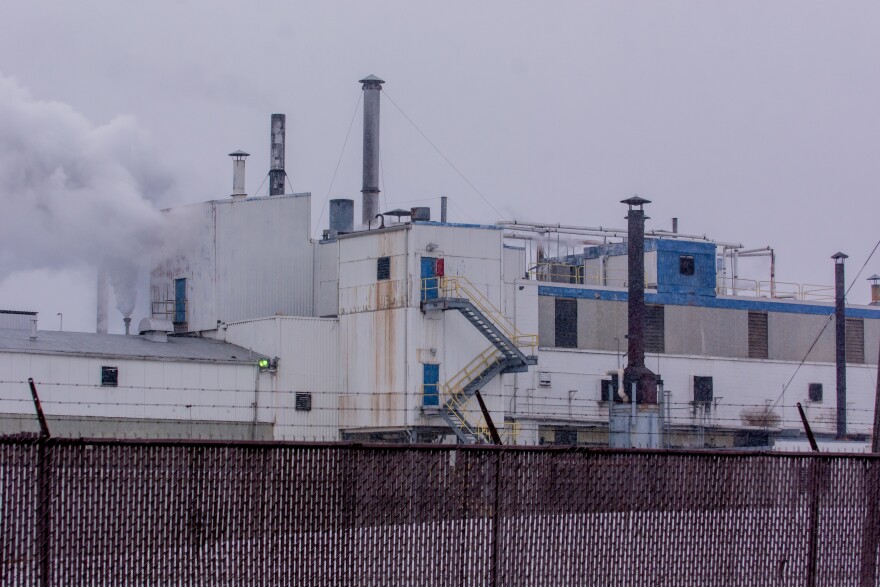
In the process of making a tire antioxidant, the factory uses a chemical called ortho-toluidine, or OT. OT is a known bladder carcinogen, and our investigation in September 2024 revealed documents showing the factory was releasing OT at dangerous levels. The DEC ordered a notice of violation in July 2023 to Goodyear for their two deficient pollution-control devices that allowed OT and another chemical, diphenylamine, to escape the plant.
In December 2024, we shared a DEC “plume map” from September 2024 revealing the factory may be releasing ortho-toluidine into the air at levels up to seven times higher than what the state considers safe to breathe.
At least 78 employees within the factory alone have developed bladder cancer since the mid-1980s.
Niagara County has one of the highest rates of bladder cancer in the state and country. Kimble says activists would prefer Goodyear and the state go beyond the minimum emission reductions. Regardless, she says, they will have their eyes on the two entities.
“We want to make sure that they meet the state health requirements,” Kimble said. “We want to make sure too that they know that we are watching the clock.”
The factory agreed to a plan with the state to fix their pollution control in January 2025. As activists have waited for the factory to permanently fix its pollution control measures, the formerly grey factory with dark, dripping vents appears to have been painted a dark blue color.
“Well, it’s like putting lipstick on a pig. Need I say more?” Kimble said.
Goodyear and the state DEC maintain that the community does not face a “imminent threat.”
“The health and safety of associates and the communities where we operate are our top priority,” said Goodyear in a statement to BTPM NPR. “The DEC and New York State health authorities have affirmed that our Niagara Falls facility poses no imminent threat to public health.”
“There is no imminent public health risk to the community from Goodyear’s emissions,” the DEC said in an email.