
Texas Gov. Greg Abbott rarely misses an opportunity to boast about his state’s “pro-growth, business-friendly” environment. His official biography says he has “achieved significant legislative victories to build a safer, freer, and more prosperous future for all Texans.”
That depends, of course, on how one defines safe, free and prosperous. Every year, Texas lands at or near the bottom of many key categories in state health rankings, including percentage of uninsured residents (50th, or worst in the nation, in 2024); primary care providers per 100,000 population (50th); mental health providers per 100,000 population (49th); and air pollution (45th). A report in May estimated that Texas had the nation’s highest number of people (nearly 5.4 million) experiencing food insecurity — limited or uncertain access to food — in 2023.
Now that the 89th Texas Legislature has adjourned, Public Health Watch has taken stock of what it did to improve those dismal standings. The verdict: Very little.
Once again, Texas lawmakers declined to expand Medicaid in the state to include uninsured adults who work in low-wage jobs but don’t currently qualify for the program, even though the federal government would pay 90% of the cost of such expansion. Nearly 5 million Texans lack health insurance, a number roughly equivalent to the entire population of Alabama.
Legislators did agree to allow Texans to vote on a measure that would earmark $3 billion in research funding for Alzheimer’s and other dementias — illnesses that have struck the Rio Grande Valley especially hard. That vote will come in November.
But they did nothing of note to help the hungry and homeless, address gun violence or improve air quality in industrial enclaves.
Lynn Cowles, health and food justice director for the advocacy group Every Texan, has concluded that some Republican lawmakers who dependably vote against programs like Medicaid expansion “are willing to accept the political risks of selling out their constituents … to achieve the goal of wealth accumulation among the richest households in the world. Others genuinely believe that poor people are out to game the system, which is categorically untrue. No one wants to sit in an office and argue for their child’s Medicaid coverage.”
Cowles worries that Abbott and other GOP leaders have fully embraced the anti-science posture held by the Trump administration.
“Instead of surrounding themselves with experts who can improve conditions and outcomes for people in the state, they surround themselves with fawning ‘yes’ people who deeply share their ideological perspectives rather than a commitment to public health,” she said. “Some lawmakers understand that public health experts are right but make decisions contrary to their expertise because they choose party objectives over people. Others believe the scientists are wrong. In either case, they’re actively supporting measles outbreaks in our state, and children will die. The awareness is so short, so acutely focused on the political moment.”
Public Health Watch asked Abbott’s office and the offices of Lt. Gov. Dan Patrick and House Speaker Dustin Burrows for examples of new legislation they believed would improve Texans’ health. None responded.
Here is a summary of what the Legislature did – and, more often, didn’t – do to improve public health in Texas this session.
(Note: Some bills were still on Abbott’s desk, unsigned, as of Thursday. Abbott has until June 22 to sign or veto those bills).

Access to Care
Although a recent poll found that the majority of Texans — 71% — support expanding Medicaid, bills to join the 40 other states that have taken that step for low-income adults never even got out of committee. Expansion would have extended coverage to more than a million Texans, according to researchers, and brought billions in federal health care dollars into the state. Right now, parents in a family of four can’t qualify for Texas Medicaid if they make more than $4,000 a year.
Legislators also had a chance to make it easier for low-income Texas children to get health insurance. Of the state’s nearly 1 million uninsured children, nearly half are actually eligible for Texas Medicaid or the Children’s Health Insurance Program but aren’t enrolled. A Public Health Watch story published earlier this year found a number of barriers that are keeping eligible Texas kids uninsured, including a confusing enrollment process and an application backlog of hundreds of thousands waiting to be reviewed.
HB 321 and SB 238 — bills introduced by Rep. John Bucy III, an Austin Democrat, and Sen. Nathan Johnson, a Democrat from Dallas — would have streamlined enrollment for eligible kids. The idea, known as express-lane eligibility, uses information that families are already submitting for other public programs, such as food assistance, to determine kids’ eligibility for Medicaid or CHIP.
“Every child in Texas deserves a chance to grow up healthy…and the truth is we can give that chance to thousands of kids with one, simple notification,” Bucy said in a post on social media.
The bill made it out of committee in April. Despite bipartisan support and the success of express-lane eligibility in other states, it failed to pass for the second session in a row.
One access-to-care bill that did make it to Abbott’s desk is HB 3940, which requires state health officials to provide additional information to parents and providers about newborn eligibility for Medicaid.

Mental Health and Gun Safety
Despite Texans reporting some of the highest rates of mental health illness in the country, lawmakers slashed funding for mental and behavioral health services by $2.3 billion this year, or around 20% of the program’s budget. Funding for programs that provide mental health alternatives to jail was also cut by $115 million, about one-third of last year’s budget.
Sen. Kevin Sparks (R-Midland) introduced a package of bills that aimed to solve another problem: nearly 50% of Texas counties don’t have enough mental health care providers. Sparks’ bills would have removed barriers to obtaining a Texas medical license, expanded out-of-state telehealth services, and reimbursed professionals for training. None of these bills made it to a vote. Nor did HB 5030, aimed at expanding Medicaid coverage for children experiencing mental health crises, even though the number of students contemplating suicide is on the rise. Bills intended to bridge a $7 million funding gap for the state’s suicide hotline also failed.
Instead, the Legislature focused on banning common-sense gun control measures that states across the nation have implemented. SB 1362, an “anti-red-flag” law, would bar judges from temporarily seizing guns unless an individual has been convicted of a crime. Advocates argue that red-flag laws could have prevented mass shootings in Houston and El Paso, where the assailants had histories of mental health crises and making threats on social media. HB 3053 would ban local governments from participating in gun buyback programs, which Harris County officials say removed more than 4,000 weapons from circulation. While these bills sit on the governor’s desk, Abbott has already signed a bill that allows marshals to carry handguns in public schools.

Food Insecurity
State lawmakers rejected bills that would have given the poorest Texans more access to fresh foods. The Legislature’s inaction will disproportionately affect people of color living in the state’s poorest areas, including the Rio Grande Valley, where 25% of households live in poverty — a rate double the statewide average.
HB 231, filed by state Rep. Christina Morales (D-Houston), would have ordered a study of the impacts of food deserts on communities of color.
Food deserts are areas that have less access to nutritious food — often, no grocery stores, only convenience stores — and a higher number of food-insecure households, meaning families aren’t sure where their next meal will come from. More than half of the Rio Grande Valley is considered a food desert.
DHR Health, which offers health care services in McAllen, Edinburg, Brownsville and other communities on the U.S.- Mexico border, said in its 2025 Health Equity Needs Assessment that food deserts contribute to higher prevalence of obesity and premature death.
Lawmakers did vote to ban the purchase of certain foods and drinks under the Supplemental Nutrition Assistance Program, also known as SNAP, or food stamps. SB 379, authored by state Sen. Mayes Middleton (R-Galveston), mandates that food stamps not be used to buy sweetened or carbonated drinks, as well as candy, potato or corn chips, and cookies. But many people living in food deserts are poor and sometimes rely on junk food to sate their hunger.
State Sen. Jose Menendez (D-San Antonio) introduced a bill that would have helped reimburse certain fresh-food delivery service fees for SNAP recipients. But SB 770 didn’t receive a hearing in the Health & Human Services Committee.

Environmental Health
Bills tackling industrial pollution have long had an uphill battle in Texas, and this year’s session was no different.
“It was a session of many missed opportunities by our representatives,” Air Alliance Houston, a nonprofit environmental group, said in a statement. “Even widely supported, data-driven bills often fail to advance due to procedural bottlenecks and lack of political will.”
One possible reason for the inertia: In the last two years, Texas legislators received nearly $3 million in campaign contributions from the oil, gas and petrochemical industries, according to FollowTheMoney.org.
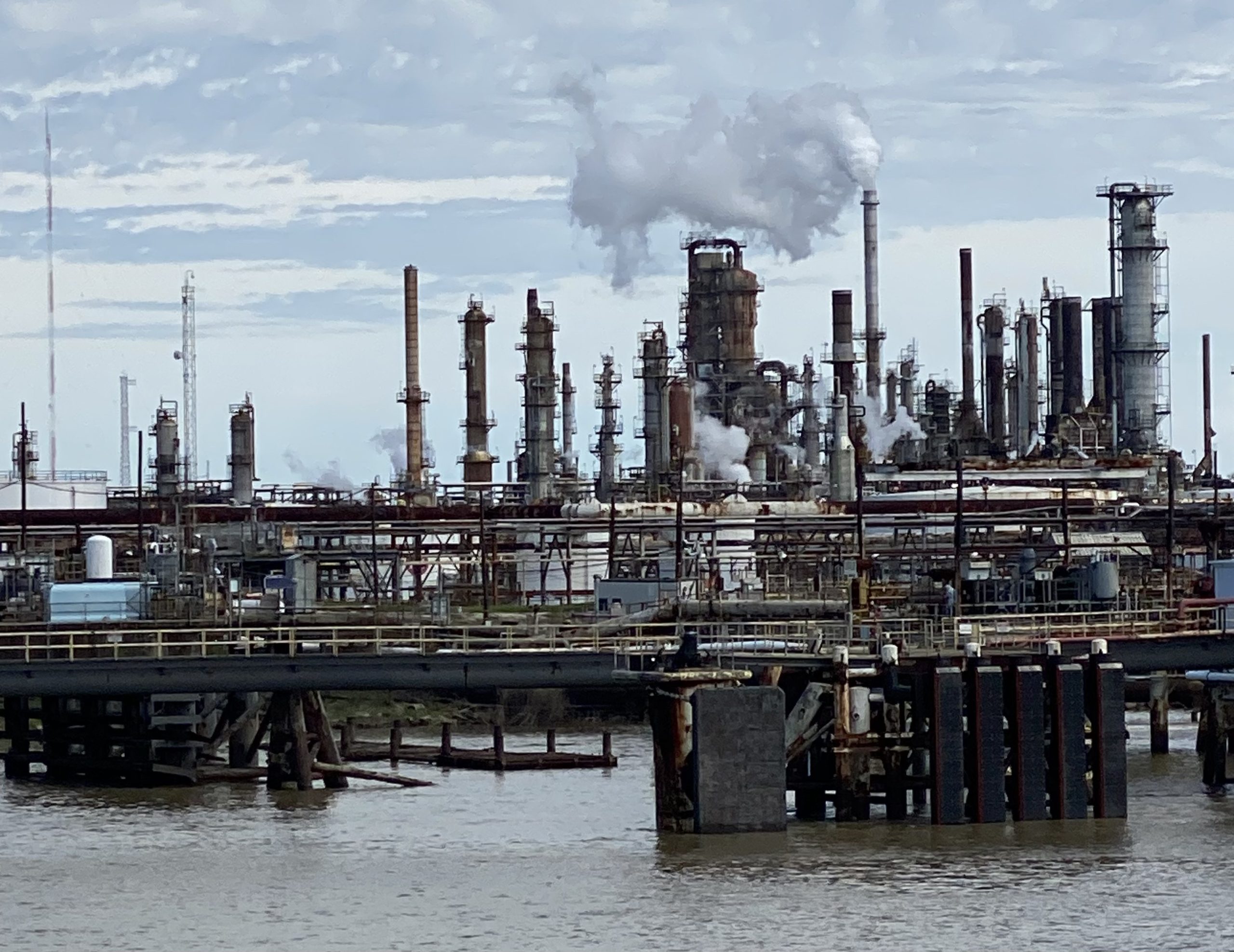
State Sen. Carol Alvarado, a Democrat, tried to address pollution problems in Channelview, a majority-Latino community north of the Houston Ship Channel, the epicenter of America’s petrochemical industry. Fumed, a Public Health Watch podcast, describes how the once-quiet community became dominated by petrochemical plants and chemical-carrying barges.

SB 1179 would have increased monitoring and inspections for chemical distributors and required those facilities to install first-rate pollution controls for volatile organic compounds, a group of chemicals that includes carcinogens like benzene. But the bill didn’t receive a hearing. Nor did a range of other environmental bills, including several that would have required the state to study and prepare for the effects of climate change.
The House Energy Resources Committee did conduct a hearing for a bill requiring companies to get permission from landowners before burying toxic waste from oil and gas drilling. A public comment filed by a landowner who supported the bill noted that no other industry can “do as it pleases on private property with state immunity.”
But the committee never voted on the bill.
One piece of legislation that made it through the committee, SB 763, would be a small win for public health. It requires the state to review permits every six years for concrete batch plants — long a nuisance in urban areas. Fine particles from these plants have been linked to a growing number of health effects, including dementia, heart disease and breast cancer. The bill awaits the governor’s signature.
Reproductive rights
Maternal deaths in Texas increased 56% in the year after the state implemented its 2021 abortion ban, a study from the Gender Equity Policy Institute found last April. This year, the Texas Legislature failed to pass several bills that aimed to curb those deaths or better understand the problem.
One would have allowed Texas’s maternal mortality committee, a 23-member group tasked with reviewing pregnancy-related deaths, to review deaths regardless of the pregnancy outcome (HB 1989) as well as deaths related to lack of abortion access (SB 737). Currently, the committee isn’t allowed to review abortion-related maternal deaths, a gap that members have said hinders their capacity to make appropriate recommendations. The Legislature also ignored HB 731, which would have had Texas rejoin the CDC’s maternal mortality tracking system. Texas removed itself from the tracking system during the last legislative session.
Maternal deaths in Texas increased 56% in the year after the state implemented its 2021 abortion ban. This year, the Texas Legislature failed to pass several bills that aimed to curb those deaths or better understand the problem.
The Legislature also rejected HB 3121, which would have allowed Medicaid to cover doulas — professionals with no formal obstetric training who provide support during pregnancy and delivery. A recent study found that women on Medicaid who used doulas had a 29% lower risk of preterm birth and were 46% more likely to attend postpartum check-ups. It also rejected HB 1201, which would have created a pilot program for doula services.
The Legislature did pass SB 33, which forbids the use of taxpayer dollars to pay groups that provide child-care, shelter, money or logistical help to Texans seeking out-of-state abortions. If the bill becomes law, it will prevent San Antonio and Austin from continuing to support abortion travel funds, making it difficult for domestic violence victims to seek out-of-state abortion care. Last year, Public Health Watch reported that domestic violence shelters in Texas saw an uptick in pregnant women or women with newborns after the Dobbs decision and Texas’s abortion ban.
The Legislature took one small step toward improving maternal health when it passed SB 31, known as the “Life of the Mother Act,” to clarify the state abortion ban. It says that a physician can legally perform an abortion if a woman has a pregnancy-associated “life-threatening condition,” even if the risk isn’t imminent. At least three women have died in Texas after doctors refused to intervene in their miscarriages because they were afraid of violating Texas’ abortion ban.
While the Legislature passed both bills, Abbott hasn’t signed them yet.