
Nikki Myles knew the hospital bill about to hit her mailbox would be expensive and probably take years to pay off. But she wasn’t prepared for what she saw.
Myles, 38, got the bill in March, a couple weeks after an emergency hospitalization that included a three-night stay and surgery to remove her gallbladder. She had hoped doctors at Houston Methodist Hospital in Baytown, Texas — a city on the north shore of Galveston Bay — could treat the unceasing pain in her abdomen with a prescription. But the culprit was gallstones, and her gallbladder had to come out.
Myles declined the operation at first because she didn’t have health insurance. She relented after her doctor warned her that the horrible pain would return.
A few weeks after the surgery, the hospital bills started to arrive. Myles braced for a big number — she thought $20,000, maybe $30,000. The total exceeded $117,000. A first payment of $989 was due in a month.
Myles said a nurse had mentioned the possibility of financial assistance while she was still in the hospital. But that was the last she remembers hearing about it before she learned of her six-figure debt.
“I panicked,” said Myles, who was working as a case manager at a Houston-area nonprofit that helps children in foster care. “I had no resources to pay.” The burden was too much. She dropped her master’s degree courses, which she had hoped would help her land a higher-paying job.
Like all nonprofit hospitals, Houston Methodist is required under federal and state laws to offer eligible patients financial assistance, or charity care, as a condition of its tax-exempt status. Hospitals also must communicate to patients that the program exists and make it accessible.
But in interviews with Public Health Watch, some patients, researchers and advocacy groups said nonprofit hospitals are falling short in letting patients know about charity care and making it easy to apply. As a result, low-income patients can fall into heavy medical debt that upends their lives.
“These are people living paycheck to paycheck,” said Jared Walker, founder of Dollar For, a national nonprofit that helps people find and apply for hospital charity care. “Most of those people are eligible for some sort of financial assistance. They just don’t know about it.”
The poster in the ER doesn’t work. … So then what happens? They get a bill and they panic.
Jared Walker, founder of the nonprofit dollar for
The organization has helped more than 8,000 Texans apply for hospital charity care. Among the takeaways, Walker said, is that “there is a huge lack of awareness in Texas that these programs exist.”
Houston Methodist declined Public Health Watch’s request for an interview, but emailed a statement about its charity care program. “We actively promote and communicate our financial assistance program through signage in our emergency departments, information on our website and notices on how to reach out for assistance included with patient billing statements,” the hospital said. Staff is available to help patients apply.
The approach reflects three key requirements in state and federal law for how hospitals must publicize charity care: posting fliers about it in the ER or other areas, posting online and providing a notice to patients, such as a document with billing materials and a yearly notice in a local newspaper.
The Texas Hospital Association, the main advocate for the state’s acute-care hospitals and healthcare systems, declined to grant an interview. But it has issued statements and data on charity care, saying that evidence shows all Texas nonprofit hospitals meet the legal standards for providing financial assistance and notifying patients about it.
With state charity-care laws, “there’s no room for hospitals to be uncharitable around these parts,” the group’s website says.
Walker said even if hospitals are meeting the minimum standards for publicizing and offering charity care, it’s not enough, as indicated by the thousands of Texans who have turned to the nonprofit for help.
“Most [patients] leave the hospital and they have absolutely no clue that this program exists,” he said. “The poster in the ER doesn’t work. … So then what happens? They get a bill and they panic.”
In follow-ups with clients, Dollar For asks if they felt well-informed about charity care from the hospitals where they were treated. “The answer is almost always no,” Walker said. In a national survey of more than 1,600 people with hospital debt, the organization found that the top reason for people not applying for charity care was they didn’t know about it. The other mains reasons were they didn’t believe they were eligible or were confused about the process.
A survey of 800 Texans last year by the Texas Public Policy Foundation, a conservative research group, also found general awareness of hospital charity care is lacking — less than half had heard of it.

A ‘Wild West’ of charity care
For many Texans, the need for financial assistance to pay hospital bills is significant.
The state has the highest uninsured rate in the nation, at 19.2% — nearly double the national rate. Texas is among 10 states that declined to expand Medicaid to cover more low-income adults, and it has the 12th highest poverty rate in the country, at over 13%.
Those traits have contributed to high rates of medical debt and, for hospitals, a high rate of uncompensated care, experts say.
According to Texas 2036, a nonpartisan public policy group, 28% of Texas adults, or 8.7 million, have unpaid medical debt from hospitals, doctors or other sources. Eight percent of Texans — more than double the national rate — have medical debt that went to collections, an Urban Institute analysis of 2025 credit bureau data found.
Uncompensated care comes in two main forms: bad debt, where the hospital expects payment but is unable to collect the bill, and charity care, in which the hospital intentionally provides free or discounted care to low-income patients.
According to some studies, nonprofit Texas hospitals have one of the highest levels of charity care in the U.S., at more than 6% of operating expenses. The rates can vary widely among hospitals.
A Meticulous Policy
The financial assistance policy for Texas Health Resources hospitals — including Presbyterian Hospital in Dallas (shown) — runs 19 pages, with many details. Patients have up to 240 days after receiving their first bill to apply for charity care. But bills can be sent to an outside collection agency months before.

In 2024, according to Texas Hospital Association data, nonprofit hospitals across the state provided nearly $15 billion in charity care and other community benefits, and in unreimbursed costs for government-sponsored indigent care.
At the same time, evidence mounts that many nonprofit hospitals are failing to do enough to ensure low-income patients know about charity care and how to access it.
One analysis of more than 100 nonprofit Texas hospitals — published by the Baker Institute of Public Policy at Rice University in Houston and based on 2019 tax data — estimated the hospitals reported at least $127 million in bad debt for patients who should have received charity care.
“It’s all about who’s slipping through the cracks,” said Derek Jenkins, a health economist at Rice University and author of the analysis. “Because a lot of hospitals seem to be saying, our financial assistance policies are posted, so patients must know about them.”
Jenkins said his study likely undercounts the real number of people who qualify for charity care but don’t receive it. In tax filings, nonprofit hospitals must estimate how much of their bad debt is attributable to those types of patients — a potential indicator of how well a hospital is publicizing charity care.
But Jenkins said hospitals can choose their own estimation methods and aren’t always transparent about them. The result is “sporadic and unreliable” data, he wrote.
He cited an example: In 2022, Ascension Seton, a large hospital system in Central Texas, reported $0 in bad debt attributable to patients eligible for charity care. That was down from more than $41 million three years earlier, his analysis found. In its 2022 filing, Ascension had only a short explanation for its $0 estimate, saying it was “based on the organization’s administration of its financial assistance program.”
Bad debt at hospitals is an important metric to get right, Jenkins said, but it still won’t capture the full scope of patients’ medical debt that was eligible for relief. For example, some patients may use credit cards or borrow money to pay hospital bills without knowing about charity care.
That won’t show up as bad debt on a hospital’s ledger, though it may take years for patients to pay off what’s owed, if ever. Last year, a West Health-Gallup Healthcare Survey reported that 31 million Americans had borrowed a total of $74 billion in 2024 to pay for medical care.
If the patient is eligible, they don’t need to receive a bill.
Hossein Zare, a professor at Johns Hopkins University
Patients who don’t find a way to pay are subject to collections. Under federal law, nonprofit hospitals must make “reasonable efforts” to ensure a patient isn’t eligible for charity care before taking “extraordinary collection actions,” such as suing or denying care. But they can hire agencies to pursue unpaid bills before then.
“Once that debt collection starts, people’s lives start to spin out of control,” said Berneta Haynes, a senior attorney at the National Consumer Law Center. Even if a hospital later cancels the debt, “a person has already started being hounded and harassed” and making financial decisions based on the debt that are detrimental.
Hossein Zare, a professor at Johns Hopkins University’s Department of Health Policy and Management who studies hospital charity care, said hospitals should do more to make sure patients don’t qualify before taking payment actions. “If the patient is eligible,” Zare said, “they don’t need to receive a bill.”
He expects medical debt and the need for charity care to swell alongside projected rises in the U.S. uninsured rate. According to the Congressional Budget Office, the number of uninsured Americans will grow from 30 million this year to 37 million in 2036, largely due to changes enacted under President Donald Trump’s “big, beautiful” budget bill.
“All the hospitals around the country now need to work on their financial assistance programs, and make them easy to access,” Zare said.
Texans search for help
Dollar For arose from the same conclusion. Walker started the nonprofit in 2015 in Portland, Oregon, after years of organizing small fundraisers to help people pay off medical debt; he realized many would have qualified for hospital financial assistance. The organization maintains a national database of hospital charity care programs, allowing anyone to see if they qualify; the nonprofit will help them apply if they want.
Walker said Dollar For has helped eliminate about $180 million in medical debt across the nation. The biggest demand comes from “Texas, without question,” he said. The 8,000-plus charity-care applications it has submitted in the state make up 14% of its nationwide total. The runner-up is Florida, with about 5,200.
Texas is one of only several states that require a legal minimum of charity care-related spending from nonprofit hospitals or health systems. The state requires at least 4% of net patient revenue be devoted to charity or other indigent care.
Hospitals must also comply with laws about making patients aware of their charity care programs, such as posting policies on their websites. But how proactive they are in helping patients avoid debt can vary widely.
Going After Unpaid Bills
Hospitals have discretion in how aggressively they go after unpaid bills. Dell Seton Medical Center at the University of Texas, part of Ascension, reserves the right to deploy “extraordinary collections actions” in pursuing payment, but says it does so only in “extreme circumstances.” Actions can include selling patients’ debt to third parties or denying “medically necessary” care.

The hospitals have discretion in how aggressively they screen patients for financial assistance before billing, what’s required to apply and win approval, and what actions are taken if debt goes unpaid. Some Texas hospitals say they regularly assess patients for charity-care eligibility before pursuing payment actions, but it’s not required by law, unlike in some other states.
Under federal law, patients treated at nonprofit hospitals have at least 240 days after getting their first post-discharge bill to apply for charity care. But the bills can go to collections before then.
Eligibility differs by hospital, too. For example, at Comanche County Medical Center, a two-hour drive southwest of Fort Worth, patients with household incomes up to 150% of the federal poverty level — or about $41,000 for a family of three — may be eligible for free care. At Houston Methodist, eligibility for free care goes up to 200% of the poverty level. At El Campo Memorial Hospital, south of Houston, it’s 400%.
“It’s a bit of a Wild West,” said Vikas Saini, president of the Lown Institute, a nonpartisan think tank in Massachusetts that studies hospital charity care. “Some are incredibly generous, some are incredibly stingy. And it’s impossible to discern, at least for us from the outside … how the decisions are made.”
Last year, the institute released a dataset of financial assistance and collections policies at 2,500 nonprofit, for-profit and public hospitals in the U.S. In an analysis for Public Health Watch, it found nonprofit hospitals in Texas are meeting minimum rules about posting information about their programs on their websites.
But in other ways, Texas nonprofits were less forgiving.
The analysis found that, compared to peers in other states, Texas nonprofit hospitals are more likely to sell patients’ medical debt to collectors and deny non-emergency care to patients with outstanding debt.
A recent investigation by the news outlet Tradeoffs found that about half of nonprofit Texas hospitals will bill patients before screening them for financial assistance.
A bill introduced last year by Republican state Rep. Tom Oliverson would have required hospitals to verify a patient isn’t eligible for financial assistance before pursuing debt collections. Six states have enacted similar auto-screening laws, known as presumptive eligibility, but the Texas bill never made it to the governor’s desk.
An Ample Offer of Charity
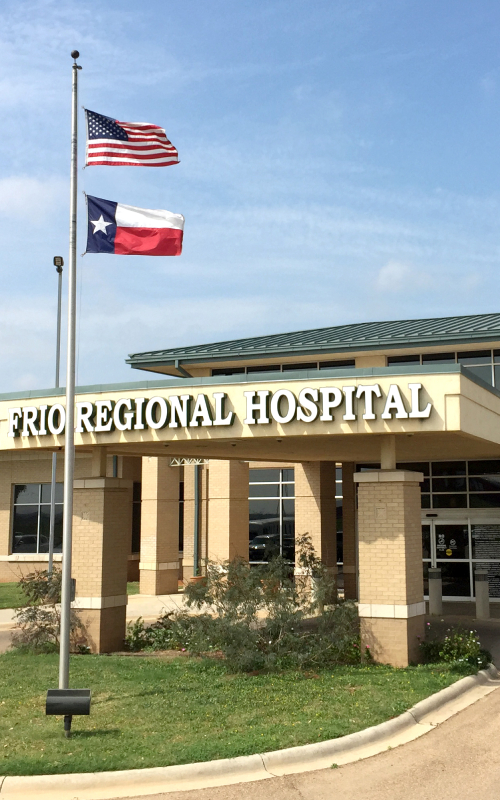
Texas nonprofit hospitals must offer charity care, but which patients are eligible varies by facility or health system. Frio Regional Hospital in South Texas has relatively generous criteria for eligibility for free care. Patients in households with incomes up to 500% of the federal poverty level, or $165,000 for a family of four, can be approved. More typical is between 200% and 300%.
The specter of medical debt
According to the latest Census Bureau data, 16% of U.S households reported having medical debt in 2024; the average debt per household was more than $10,000. Much of that medical debt is for hospital services, studies show.
“What you’re really seeing is a healthcare delivery system that costs more than most people — working people — can pay,” said Saini, of the Lown Institute.
Walker said the impact of medical debt on people’s lives can be crippling — such as delayed health care and life-altering financial strain — and it’s why hospitals should make the charity care process easier. Instead, he said, many Americans face confusing applications, long lists of required documents and long wait times for an answer.
For example, the application for financial assistance at Texas Health Resources, which runs hospitals across north Texas, requires a detailed breakdown of patients’ income, expenses and assets. Dozens of documents may be required, including pay stubs, Social Security statements, bank statements, proof of ineligibility for Medicaid and letters from employers.
If an application for charity care is intimidating and complex, advocates say, eligible patients may give up or turn to outside advocates for help.
That’s how Myles, in Baytown, Texas, was able to gain relief for her $117,000 hospital debt.
One night, she searched online for help with hospital bills and found Dollar For. With its support, her debt was reduced from about $117,000 to $7,000, which she said will still be hard for her to pay back.
Myles doesn’t think the hospital was very forthcoming or proactive about its available charity care after her medical emergency. She said staff there screened her for Texas Medicaid eligibility — her income was barely above the cutoff — so she wonders why they didn’t screen her for charity care, too.
She believes she’d still be on the hook for a six-figure debt if not for Dollar For’s assistance.
“That bill,” she said. “It haunted me.”
This story is part of “Uninsured in America,” a project led by Public Health Watch, that focuses on life in America’s health-coverage gaps and the impact of potential Medicaid cuts and other changes.