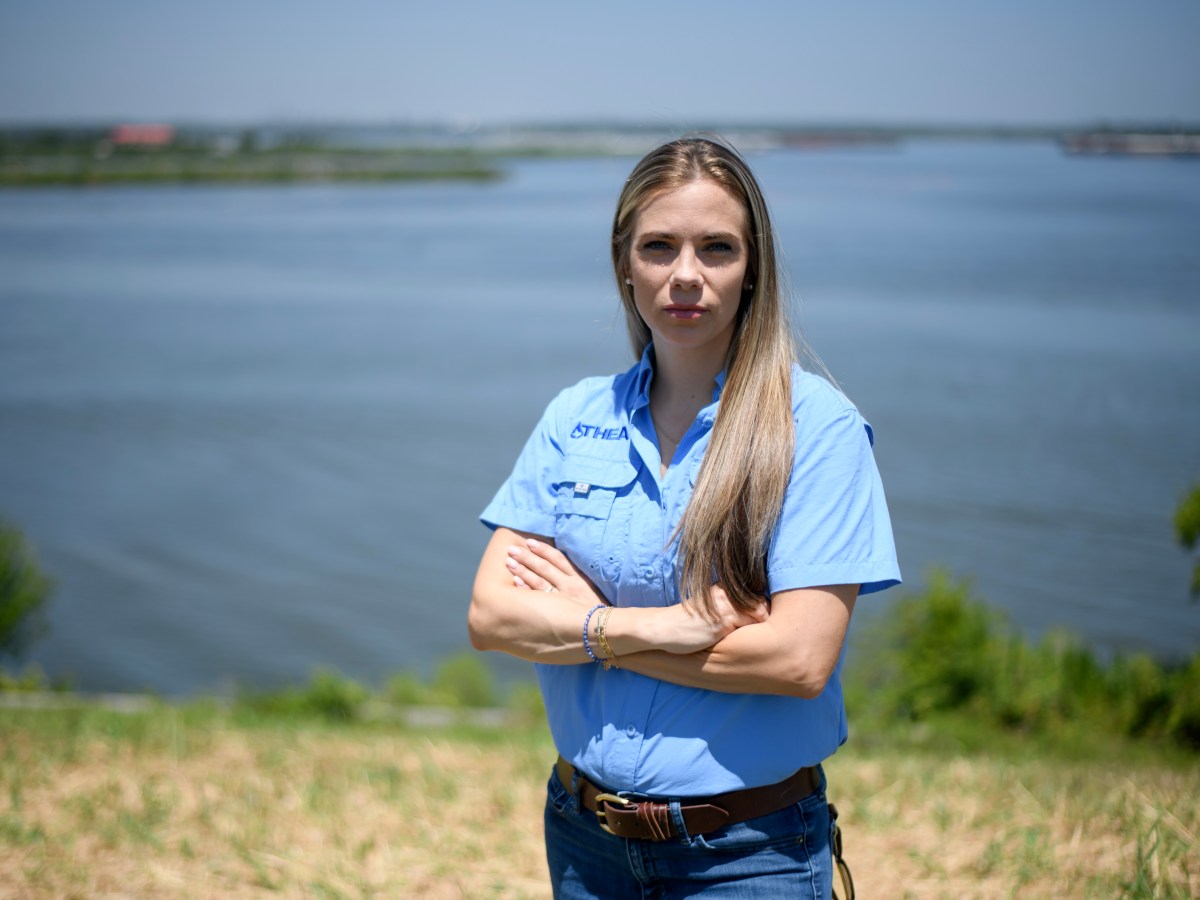


In March of 2016, Carolyn Stone woke to the grinding of heavy machinery and the smell of smoke. It was early — maybe 7 a.m. — and the sun had barely risen in Channelview, Texas, a small community east of Houston. Stone jumped out of bed and threw open her living room curtains. The day she’d fought to prevent had finally arrived.
An army of bulldozers, commercial mowers, woodchippers and other heavy equipment lined the property directly across the street. For decades, the piece of land had been home to large trees, fields of purple azaleas and some of Stone’s closest neighbors. Its location along the banks of the San Jacinto River made it a popular place for backyard barbecues and fireworks on the Fourth of July.
But, like other properties along Lakeside Drive, it had been sold to a chemical barge company that served facilities along the nearby Houston Ship Channel. And now, despite neighborhood zoning restrictions blocking industrial activity in the area, it was about to become the latest foothold for the petrochemical industry in South Channelview.
It felt like the “horsemen of the industrial apocalypse” had arrived at her doorstep, Stone told Public Health Watch. Moments later, the machines moved in.
“They mowed everything down,” Stone said. “They mowed all the trees down and the residential houses down as quickly as they could. They destroyed everything.”

Stone tried to stop the destruction. She called Houston’s Planning Department and Harris County’s Engineering Department, the two agencies with jurisdiction in the area. She also called the office of the most powerful man in Houston — the Harris County attorney. But nobody would help.
“It was a moment of extreme desperation. Like being in the penthouse of a skyscraper in the elevator,” Stone said. “The brakes are failing and you’re plummeting down. There’s no stopping and you’re pushing buttons. You’re calling all these people and they’re saying, ‘Oh this is horrible. This should not be happening.’ Then they hang up on you.”
That sequence of events, which the city’s planning department and the county’s engineering department declined to discuss with Public Health Watch, formed a critical scene in the first season of our investigative podcast, Fumed. Stone’s interactions with the planning department were a key element. Although Stone proved that her neighborhood has zoning restrictions for “private residence purposes only” that do not allow “noxious or offensive industry,” the department still allowed a barge company to move in and park dozens of chemical-filled vessels across the street from Stone and her neighbors.
The fourth episode of Fumed was released on March 28, 2025, nearly a decade after Stone lost her fight with the planning department. During a July 10 meeting held by the city’s Planning Commission — about three months after the episode’s release — the department introduced an affidavit meant to safeguard against the exact situation Stone experienced.
The new Deed Restriction Compliance Affidavit requires individuals or companies seeking to develop, alter or combine lots to first review and acknowledge an area’s deed restrictions. The form is clear in its intent.
“I understand a person or entity, including the City of Houston, may have authority to enforce deed restrictions and may seek legal action against me for violation of deed restrictions pertaining to this property,” the second paragraph reads.
Amy Dinn, a lawyer with the Houston-based nonprofit Lone Star Legal Aid, was at the meeting on July 10. The decision shocked Dinn, who spent years representing Stone in a 2019 lawsuit against the city’s planning department and Harris County for their failure to enforce South Channelview’s deed restrictions.
“It was so weird and unexpected. I couldn’t help but think, ‘What are the odds they would mention this the same day I’m down here? Are they telling me they did it for us, that we were the problem children that finally pushed them to make a change?’” Dinn told Public Health Watch. “This is something we’ve been asking them to do for years. We sat down with them multiple times after the issues that happened with Carolyn’s house and the property across the street. We’ve sued them over this exact thing.”

A planning department spokesperson said the decision to create the affidavit came solely from the department’s efforts to “actively look at our processes and work on improving the workflow.” The affidavit will allow the department to “review deed restrictions at the beginning of the process rather than at the end after a project is designed,” the spokesperson said.
The spokesperson also attributed the policy change to the arrival in July 2024 of planning department Director Vonn Tran, who spent more than two decades working in commercial real estate. The department denied Public Health Watch’s request to interview Tran.
To understand the significance of the new policy and why it may be tied to Public Health Watch’s coverage, it’s important to understand Stone’s longstanding efforts to enforce her neighborhood’s deed restrictions.
When a barge company, Harley Marine, purchased the property across the street from Stone’s house to combine a handful of residential plots into one large industrial plot, she turned to the planning department for help. Because Channelview falls within Houston’s extraterritorial jurisdiction — the area along the city’s borders — the department has influence over issues like property development. Houston’s and Harris County’s notoriously loose zoning laws often allow industries to sit side-by-side with homes and schools. But the neighborhood restrictions cited on the deed to Stone’s house are explicit.
“All lots, plots or parcels of land shall be used for private residence purposes only,” the deed reads. “No noxious or offensive industry, business, or activity shall be carried on … upon any lot, nor shall anything be done on any lot … to which may be or become an annoyance or nuisance to the neighborhood.”
A Public Health Watch analysis of the planning department’s internal emails found that officials knew Harley Marine’s plan “violated deed restrictions” in Stone’s neighborhood. Yet, after initially blocking the barge company’s efforts, the department allowed Harley Marine to move forward with its plans. Stone received an email explaining the decision about a month after the bulldozers leveled the property across the street.
“Unfortunately, I don’t believe there’s anything the City of Houston can do to stop the Harley development,” wrote Jennifer Ostlind, a staffer who later became the department’s interim director. “The City cannot deny [Harley’s request] on the basis of a potential action by the owner in the future.”
Asked about this email, a planning department spokesperson said these events “happened during a prior administration” and “we don’t know what [department employees] knew at the time and whether there was an oversight.”

What is clear, the spokesperson said, is that the department’s new affidavit will protect the next person in Stone’s position — whether they live next to Stone on Lakeside Drive or miles away from Channelview.
“The affidavit will apply to any new applications,” the spokesperson said in an email, “regardless of the property location.”
Kellen Zale, a University of Houston professor who teaches property law, land use and real estate, told Public Health Watch the new affidavit could be especially helpful for communities on Harris County’s industrialized east side. Areas with lower incomes and large populations of color are typically the places most burdened by industrial development, Zale said.
“This affidavit will be one more piece of evidence for residents seeking to protect themselves and their communities, whether through a lawsuit or through direct action by the Houston Planning Department,” Zale said. “There’s now documentation that will be on the record, signed by the person applying for a permit, that acknowledges their project doesn’t violate deed restrictions. If it turns out later that the project did indeed violate those restrictions, that affidavit’s very helpful in a future court proceeding or civil violation hearing.”

Zale stressed that the affidavit applies only to residents of Houston and its extraterritorial jurisdiction because Texas law prohibits counties from creating zoning ordinances.
Nearly a decade has passed since Stone’s fight with Harley Marine began. In the years since, she and Dinn sued the company and the city’s planning department, but the case failed and Harley Marine’s headquarters — and its rows of barges — remain intact. While nothing will bring back the peace she once enjoyed, Stone said, she’s hopeful others won’t have to go through what she did.
“I’m happy to know that they made this change because of our efforts, that other communities — even other parts of Channelview — will benefit. We may have lost the battle, but we created true progress,” she said. “But I’m not celebrating yet. I know what it’s like to lose because the rules are disregarded. I’m holding my breath to see if that piece of paper means anything.”