
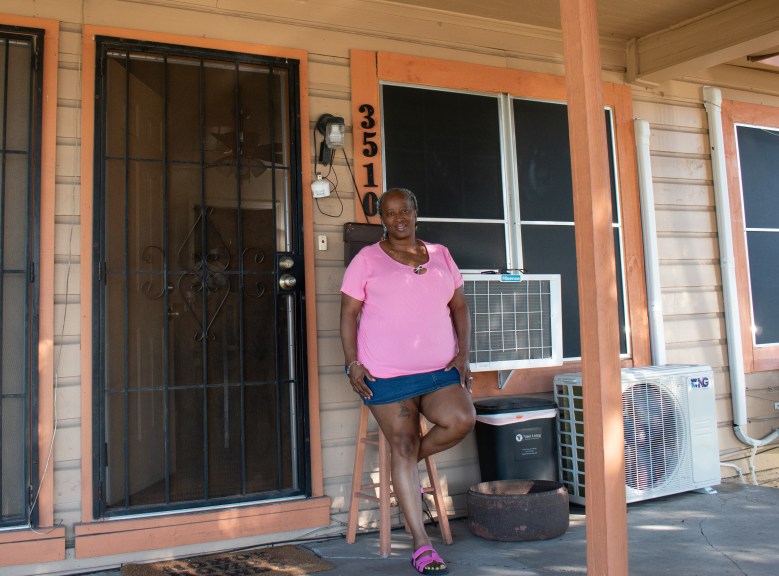
In the days after Hurricane Harvey dropped more than 50 inches of rain on parts of the Houston area, Connie Boulware was rustling through her home in the hard-hit neighborhood of Kashmere Gardens.
Roughly four feet of water had blanketed her one-story duplex. And Boulware was quickly salvaging what she could of her sodden belongings.
Having lived in Houston for nearly two decades at the time Harvey hit, Boulware, now 57, was familiar with the wrath of Texas storms. She kept an emergency stash of water in her pantry and extra food to pass out from her front porch.
What she wasn’t prepared for was the lingering smell.
“We had some kind of odor in the air. I couldn’t figure out what it was,” Boulware said. “It was just floating around.”
Unbeknownst to Boulware at the time, approximately 8.3 million pounds of unpermitted air emissions were released by industrial facilities in Texas after Harvey, according to a report by the Environmental Integrity Project, a Washington, D.C.-based watchdog organization. More than 63% of those emissions, or 5.3 million pounds, were released in the Houston area alone.
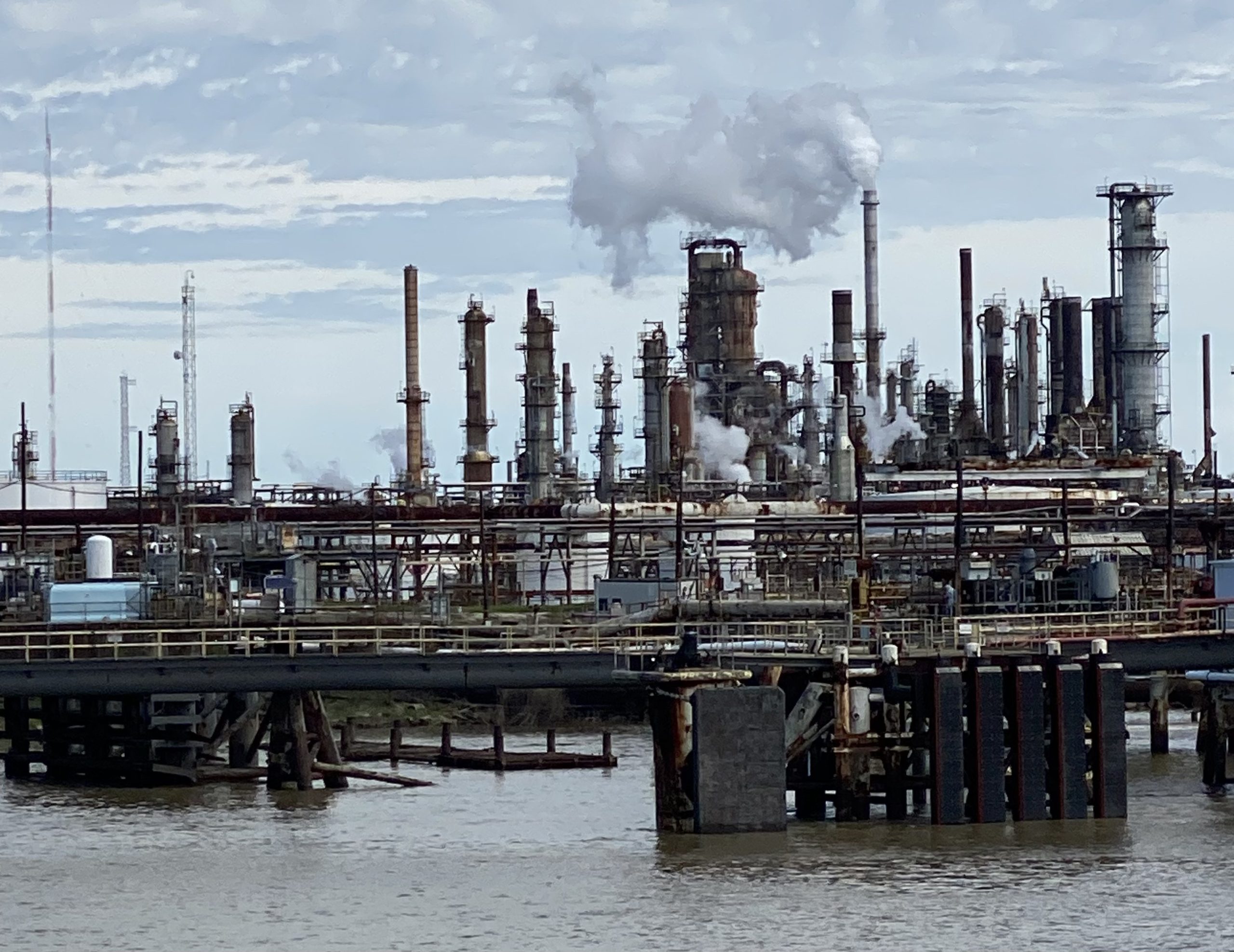
The impacts of that industrial failure were devastating. Noxious chemicals spilled into the storm water that residents waded through. Vapor clouds saturated the air. The region’s working-class, Black, and Hispanic neighborhoods bore the brunt of the toxic onslaught.
Despite the enduring risks posed by the region’s nearly 3,000 refineries, chemical plants and other dangerous facilities, little has changed in Houston since Harvey. Residents still face a litany of industrial hazards during storms, but the city of Houston and Harris County haven’t developed measures to address those risks, Public Health Watch found in a review of more than 1,000 pages of government documents.
Other communities across the country, including in California and New Jersey, have made improvements to community chemical-alert systems or developed pre-defined mass haz-mat evacuation routes in the wake of industrial incidents. But that’s not the case in the Houston area.
“We’re limited in terms of what we can do,” said Brian Murray, the deputy coordinator of Harris County’s Office of Homeland Security and Emergency Management. “A lot of things, we don’t have direct legal responsibility for, or even the power to address.”
Boulware told Public Health Watch that without stronger oversight from local governments — the first line of defense during environmental catastrophes — the region’s residents are left to fend for themselves during a crisis.
“They’re basically saying it’s our problem, that they don’t care,” she said. “We have to deal with it.”
‘Hazards of Concern’
The preparation gap is reflected in the city and county’s Hazard Mitigation Plans, a set of risk analysis documents that evaluate the area’s vulnerabilities every five years and set strategies to address them.
In the county’s plan, which encompasses cities including Deer Park, Pasadena and Galena Park, only six pages of the 500-page document evaluate industrial hazards. Unlike other sections dedicated to floods, fires and dam failures, which are given formal risk assessments, the industrial analysis is identified as a “short profile” that omits an in-depth review.
In it, the county concludes that industrial incidents are not considered “hazards of concern.”
Data within the county’s own analysis, however, tells a different story. In its written evaluation, air emissions were found to pose a serious threat to residents, especially in the wake of severe weather.
“Such events can cause multiple deaths, shut down facilities or operations, and cause major damage to nearby properties,” the analysis said. “Weather conditions will directly affect how the hazard develops.”
The likelihood of an emissions or hazardous-waste event, the county added, is once every 1.46 days year-round, not just during disasters, based on historical data from the Harris County Fire Marshal’s Office. And the warning time for residents to prepare or respond to these events is “minimal to none,” the analysis says.

Pipeline ruptures are identified as a serious threat, too. Harris County contains over 35,000 miles of pipeline, according to the Railroad Commission of Texas, which regulates the oil and gas industry. Some are critical arteries to the nation’s energy supply.
“Much of this infrastructure is aging,” the county document says. “If any of the energy pipelines… were to rupture, such an event could endanger lives and cause damage to property in the immediate area.”
Roughly 1.7 million people in Harris County live within a half-mile of these pipelines, according to a 2019 study conducted by the research group Penta Consortium. The most vulnerable residents are those on Harris County’s industrial eastside, which has the highest concentration of pipelines.
A natural disaster or major disruption to the system could have “far-reaching consequences,” the county says, affecting not only neighborhoods within the urban industrial sprawl but also access to oil and gas nationwide.
A rupture is not unlikely. A pipeline failure occurs once every 47 days in Harris County, according to historical data from the county’s fire marshal’s office.
But the county’s office of emergency management says it hasn’t developed any mitigation initiatives to address those issues.
“Something that happens along the Ship Channel or in one of the plants, or even on a rail car passing through Harris County, we have no control over that,” Murray said. “A lot of situations, you know, because of what it is, and how it operates, there’s not a lot of immediate things that you can do to completely safeguard the public.”
The region’s lack of oversight stems from an issue with overlapping jurisdictions. If the county wanted to adopt stronger disaster mitigation protocols on industrial air toxics or pipelines, it would need to work with the area’s powerful group of companies and other state agencies to obtain the access it needs to install additional air monitors or renovate eroded portions of pipeline.
Even then, local emergency agencies have only a fraction of the budget needed to carry out that level of coordination.
The city of Houston takes an even more hands-off approach. Its hazard mitigation plan makes no mention of industrial disasters. Melissa Bartis, assistant director of Houston’s Office of Emergency Management, calls it a conscious decision by the city.
“It is really challenging for us to try to reduce the risks from the plant side, on those sides of the walls. That’s where it originates and we have no real ability to change that,” she said.
Not a ‘single-solution issue’
Despite the barriers to safeguarding industry, there are steps that the region could take to better protect residents against the cascading effects of natural disasters.
Garrett Sansom, an assistant professor of environmental and occupational health at Texas A&M University, says Houston and Harris County should be taking a more creative approach to disaster mitigation.
“We need better urban planning. We need green space solutions to be able to reduce toxic exposures as well as get water … out [after a flood],” he said. “And we need to have better relationships with the industry and the community to be able to come up with those solutions together. This is not going to be a single-solution issue.”
Local emergency management agencies need to do more to emphasize the importance of evacuations, too, says Jim Blackburn, the co-director of Rice University’s Severe Storm Prediction, Education and Evacuation from Disasters Center.
“We have seen a phenomenon called rapid intensification, and that means that a category one or two storm can turn into a four or five overnight,” he said. “There’s a very real potential that the surge would bring chemicals and oil up into the city of Houston. … The sooner that we are transparent and honest with the public about these risks, the better.”
One of the first steps for Houston and Harris County would be to include details of industrial disasters in their hazard mitigation plans.
The Federal Emergency Management Agency, or FEMA, dispenses millions of dollars each year through its hazard mitigation grant program. In order to qualify for those grants, government bodies must have a FEMA-approved hazard mitigation plan. And the funding may only be used for projects associated with hazards addressed in the plan.
If Houston and Harris County expanded their mitigation plans to incorporate the array of threats posed by industry year-round and in the aftermath of severe weather, it would allow federal funds to start flowing.
Oluponmile Olonilua, an emergency management professor at Texas Southern University, sat on the local oversight committee that reviewed Harris County’s hazard mitigation plan in 2015.
Instead of waiting for the region to act, she says, it’s time for FEMA to change its policy. Under current guidelines, industrial disaster mitigation planning is recommended but not required in order to qualify for FEMA grant funding.
“We should be including those,” she said. “It should be required.”
Helping people
Since Harvey inundated her community with the pungent odor of chemicals in 2017, Connie Boulware has become a staunch advocate for disaster preparedness.
With the help of West Street Recovery, a local nonprofit group dedicated to local disaster resilience, she’s repurposed half of her duplex into a “hub house” for mutual aid in Kashmere Gardens. Boulware now keeps a stock of emergency resources on hand to lend during a crisis.
She spends her time telling others about her hub house and grassroots organizations that can help others prepare. She’s a member of several community groups that try to educate people on environmental issues, and she attends weekly group meetings to stay informed.
When the next Harvey hits — and it will — she hopes her work across Houston will have helped at least some residents be better prepared.
“When something does come about, now they know what to do and how they can help themselves,” she said. But she hopes local governments will, one day, be equally prepared.
“They could be doing more,” she said. “But since they don’t have to live in our neighborhood … it doesn’t matter, I guess.”
Support for this story came from the Environmental Defense Fund through a grant from the Wellcome Trust. Public Health Watch retained full editorial control.