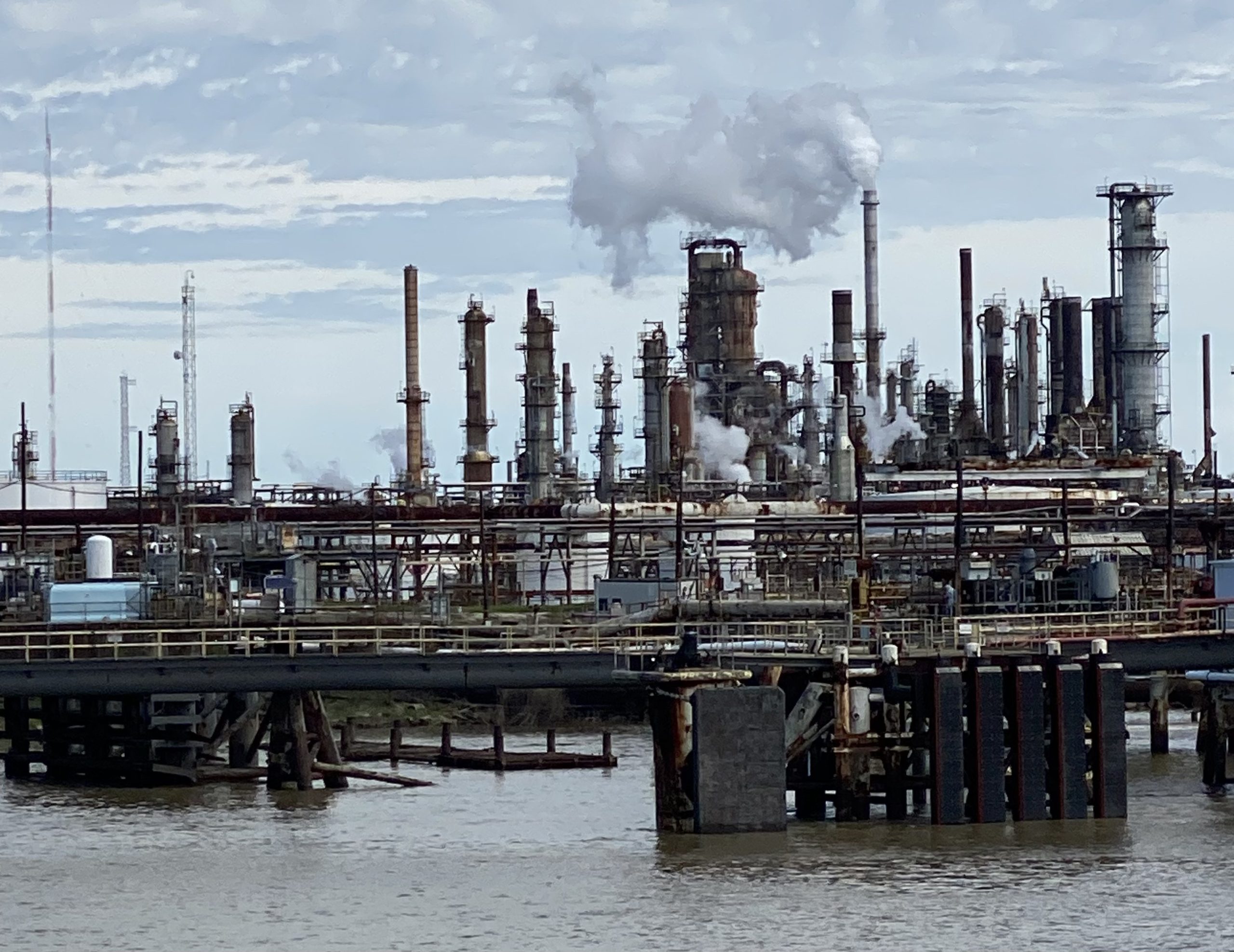


In March, the Trump administration announced it would reconsider the Biden-era standards for hazardous air pollutants and invited polluters to request exemptions from the rules while they were under review. Two lobbying groups requested exemptions on behalf of all 218 chemical plants subject to one of the new regulations — known as the HON rule — which aimed to reduce cancer risk for millions of Americans.
Public Health Watch wanted to understand who could be impacted by delaying or dismantling the standard. We analyzed data from the Centers for Disease Control, the Environmental Protection Agency and found that pausing the HON rule would protect polluters that frequently violate their air permits and worsen health risks for communities already experiencing health and social challenges.
Click the links below to read about each of our analyses. Our annotated notebooks and data are available in this Google Folder, so you can make a copy and reproduce our work.
2023 American Community Survey Analysis
2023 CDC PLACES Census Tract Analysis
2025 EPA Enforcement and Compliance History Online (ECHO) Analysis
2023 Toxics Release Inventory Analysis
2023 American Community Survey Analysis
Question: How many people live within a certain radius of HON Plants? What is the demographic composition and income level of these groups?
Radius Choice:
- 2 miles: Air quality experts and the EPA say that people living closest to the plants are typically exposed to the highest concentrations of pollutants. Peter DeCarlo, author of a 2023 study of air quality in Louisiana, said a radius of 1-2 kilometers would be appropriate. Two kilometers is 1.8 miles, so we rounded up to 2 miles. We ran this by researchers familiar with pollution data.
- 6.2 miles: The EPA uses a radius of 10 kilometers, or 6.2 miles, when analyzing who might be impacted by new air quality standards. Experts and advocates reminded us that pollution doesn’t know boundaries, and depending on weather and wind patterns, it can travel dozens of miles. The EPA uses a 50-kilometer — or 31-mile — radius to give a more generous idea of who could be affected by major sources of air pollution.
Buffer: To calculate a radius for each facility, we mapped the plants using a dataset from the Environmental Defense Fund that included latitude and longitude for each facility. We then created a 2-mile and 6.2-mile buffer from the center of those points. Given that some facilities are very large and latitude and longitude points could be in the middle of a complex, our analysis might be an underestimate.
Analysis: We overlaid the buffer on census tract-level data from the 2023 American Community Survey. We calculated the area of each census tract as well as the area that is within the radius. Using those two numbers we calculated a percent:
Buffer_Percent = Buffer_Area / Tract_Area
To estimate the population within the radius, we took the ‘Buffer_Percent’ of the total estimated population for the census tract:
Buffer_Population = Buffer_Pct x Total_Population
We calculated the population below the poverty line as well as the race and ethnicity populations using the method above. For the groups referenced in the story, we used the “Hispanic or Latino alone” field and “Black alone.”
CDC PLACES: Local Data for Better Health Analysis
Question: How do the health and social challenges of those living closest to HON plants compare with those living elsewhere?
About the Data: The CDC PLACES dataset provides health information about communities across the U.S. down to the census tract. Each row in the data is an estimated percent of population per census tract that are experiencing a particular health or social measure (i.e. food insecurity, obesity, short sleep duration, etc). The percentages are not based on exact counts, but are predictions based on Behavioral Risk Factor Surveillance System data, Census population data and American Community Survey data. It’s the CDC’s best guess about the health issues facing local communities.
Analysis: We consulted with data and public health experts for this analysis, and came to the following decisions from our conversations with them:
We chose to limit our analysis to HON facilities that are in or bordering one of the Census Bureau’s “Urban Areas,” which have a minimum population of 5,000. We excluded rural facilities because many rural census tracts cover large geographic areas. If included, the tracts could skew the results of our analysis which was intended to look at populations closest to HON plants. Of the 218 HON plants, 183 are in or bordering designated Urban Areas.
Even within Urban Areas, our 2-mile buffer intersected many large tracts that extended beyond our analysis area. Because we wanted to get the clearest picture of the health issues facing people that live closest to HON facilities, we decided to only include census tracts that had at least 50% of their area within the 2-mile buffer.
Due to this choice, over half of the census tracts within the Urban HON radius were omitted from the analysis. In the end 368 out of 844 tracts were included. (We expanded our radius, and thus the number of tracts, in a stress test described below.)
We used the CDC PLACES US rates included in the counties dataset as a point of comparison for our national analysis. We used the CDC PLACES county-level estimates to create rates for each of the five states with the most HON plants. We then created a group rate for all HON census tracts at the state and national level. This method is less sensitive to outliers and accounts for variation in sample sizes:
Example:
Estimated_FoodInsecurity_Percent x Adult_Population = Estimated_FoodInsecurity_Population
SUM(Estimated_FoodInsecurity_Population) / SUM(Adult_Population) = Estimated_FoodInsecurity_National_Rate
We then compared the differences in rates and displayed the top 25 disparities. To show the greatest differences, we did not include measures with less than 2 percentage points.
Eleven states are missing from the Health-Related Social Needs data because they did not administer that portion of the behavioral risk survey. The missing states include AR, CO, HI, IL, LA, ND, NY, OR, PA, SD, and VA.
| Geography | HON Census Tracts | Urban Area HON Plants |
| Nationwide | 368 | 183 |
| Texas | 105 | 73 |
| Louisiana | 36 | 45 |
| Ohio | 72 | 12 |
| Illinois | 13 | 6 |
| Kentucky | 29 | 6 |
Testing: We conducted a stress test by expanding our radius to 4 miles and found higher rates in the HON group, though a slightly smaller effect. When we showed our results to a public health expert, they said it reinforces the fact that industrial facilities are more likely to be located near people who have existing health and social challenges, and those disparities are worse the closer you get to the plant.
We did not calculate separate confidence intervals for the weighted averages, but we reviewed the tract-level data for potential overlaps. To do this, we plotted the histograms and the geometric means of both the HON group and the Non-HON group for each health measure. Some had larger differences than others. Some nearly overlapped, like the uninsured measure. We decided to highlight measures in the article that had larger differences and charted the top 25 measures with the greatest difference in weighted averages.
We conducted a two-sample t-test comparing the tract-level estimated values of the HON and non-HON groups that found statistically significant differences between the two groups for 37 out of 40 measures. View the histograms and the statistical test results in our analysis notebook.
Note: Our analysis does not show HON facilities cause these health and social challenges. Instead, it describes the communities that may be most impacted by an exemption to or dismantling of the HON rule.
EPA Enforcement and Compliance History Online (ECHO) Analysis
Question: How do HON facilities compare to other air polluters in terms of violation history?
About the Data: ECHO is the EPA’s database of the violation histories of the hundreds of thousands of facilities the agency regulates. There are inconsistencies and holes in the data, but it is the most comprehensive data available for polluters nationwide.
Finding HON Facilities: The EPA released a list of 218 facilities subject to the HON rule. The agency also included the facilities’ Facility Registry Service (FRS) IDs, which allow you to find them in EPA datasets. We were able to find 197 out of 218 HON facilities in the ECHO database. Because the EPA sometimes gives facilities multiple FRS IDs, we manually searched for the remaining 21 facilities in the EPA’s FRS database, which aggregates identification data from all EPA programs into one place. We determined an FRS ID was correct if the facility had the same address and name as the one in the EPA’s list of HON facilities. In some cases, the facility had a different name due to change of ownership, but we confirmed it previously shared the name.
Analysis: Of the 216 HON facilities we found in ECHO, 207 had air permits classified as “major”, and nine had “minor”, “synthetic minor” or no classification in their permits. We decided to narrow our comparison to all “major” sources of air pollution because they make up 96 percent of the HON plants in ECHO.
We created two groups:
- 207 HON Major Sources
- 17,928 Other Major Sources
We then compared the two groups for the following information:
- High Priority Violation Flag: `CAA_HPV_FLAG`
- The EPA gives this label to violations that are likely to pose a significant risk to human health and the environment. Read more about the agency’s criteria.
- Quarters with Noncompliance: `CAA_QTRS_W_NC`
- This field looks at the number of quarters out of the past 12 quarters (3 years) that a facility was out of compliance with their air permit. We calculated the number of facilities that were out of compliance for at least eight out of the past 12 quarters and labeled them as “Chronically Noncompliant.”
- Formal Enforcement Action Count: `CAA_FORMAL_ACTION_COUNT`
- This is the number of state or federal enforcement measures taken against the facility in the past five years. “Formal” actions are court orders or lawsuits that typically come with penalties.
- Total Penalties: `CAA_PENALTIES`
- Total amount in fines assessed to the facility in the past five years.
2023 EPA Toxics Release Inventory
Question: How do HON facilities’ emissions of toxic chemicals compare to other air polluters?
About the Data: Facilities with more than 10 employees must report to the EPA’s Toxics Release Inventory (TRI) if they release a toxic chemical above the agency’s threshold. The most recent data available at the time of publication was from 2023.
Analysis: We used our list of HON FRS IDs and found 194 HON facilities in the 2023 TRI data. Then we calculated HON facility’s share of total TRI emissions for the following categories:
- The six carcinogens subject to the fenceline monitoring requirement in the HON rule: benzene, 1,3 butadiene, ethylene oxide, ethylene dichloride, vinyl chloride, chloroprene
- Hazardous Air Pollutants (HAPs), a group of 188 chemicals
We found all of the six carcinogens in the TRI and 154 out of 188 HAPs using their unique ID number (Chemical Abstracts Service, or CAS). We found 17 HAP compounds, which are not listed by CAS, by searching for the name (ie “lead”, “manganese”) per the following instructions from the EPA:
“For all listings above which contain the word “compounds” and for glycol ethers, the following applies: Unless otherwise specified, these listings are defined as including any unique chemical substance that contains the named chemical (i.e., antimony, arsenic, etc.) as part of that chemical’s infrastructure.”
The remaining 17 HAPs could not be found in the TRI using their CAS number.
Because we were interested in the facilities’ total emissions, we used the `TOTAL RELEASES` field for each chemical. We then compared the HON facilities’ totals with the totals from all other sources to determine a share of emissions.