
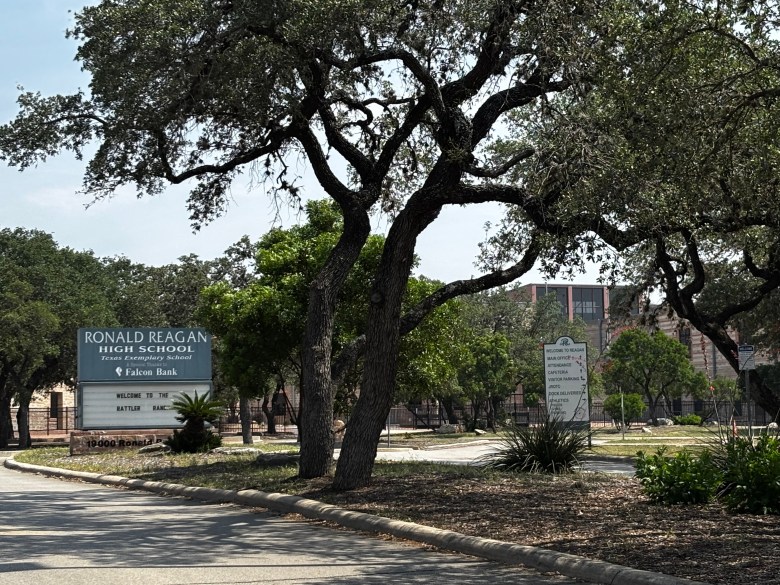
It was February of 2020, and Andy Gonzalez, then a junior at Reagan High School in San Antonio, was on his lunch break when he noticed a burst of activity among the faculty. Then the news began to spread.
A body had been found in the gym, a 16-year-old student who had killed himself at school. Gonzalez had worked with the teen at Taco Cabana, but they weren’t close. He thought he was a happy kid; he had no idea he was having a hard time.
“Always full of energy and making everyone laugh, always very joyous,” Gonzalez, now 21, told Public Health Watch. “People are struggling with these tendencies and thoughts every day, and they wear really good masks.”
It’s not known if the young man had sought therapy, but in Texas, he likely would have struggled to get help through the public schools.
A Public Health Watch records analysis found that the state has fallen short in providing Texas students with the mental health resources they need to prevent problems from becoming crises, as happened at Reagan High.
The shortfalls have hit particularly hard on low-income and low-wealth school districts, where counselors and other staff may take on class scheduling, testing and other responsibilities in addition to addressing students’ mental health problems, according to the Public Health Watch analysis of data from the Texas Education Agency.
Under a sweeping school safety allotment measure passed by the Legislature in 2023, the state provides districts with $10 per student and $15,000 per campus for school safety and mental health services. The state provides an additional $1 per student for every $50 that a district receives above the basic state allotment of $6,160.
“What are schools able to do to prevent mental health issues from escalating?”
-Jessie Higgins, chief mental health officer for the city of San Antonio.
Many districts, however, have chosen to spend the money on physical safety measures such as metal detectors, physical barriers and security cameras, rather than on mental health prevention programs.
“The question really is, what is being done in schools to prevent people from having their worst day ever and committing an act of mass violence?” said Jessie Higgins, chief mental health officer for the city of San Antonio. “What are schools able to do to prevent mental health issues from escalating?”
Now, with the Texas Legislature nearing the end of its current session on June 2, lawmakers have hammered out an $8 billion school funding bill that would double the school safety allotment to $500 million statewide. Dubbed a “masterpiece of school finance” by Lt. Gov. Dan Patrick, the deal was announced May 14 after weeks of negotiations by leaders in the House and Senate.
The deal came after educators, mental health advocates and law enforcement officers had worked together to convince lawmakers to provide additional funds for mental health prevention programs.
San Antonio Assistant Police Chief Jesus Salame told Public Health Watch that mental health prevention programs could reduce the number of calls for law enforcement help by public schools and other student interactions with police.
“ When kids don’t have access to the right mental health resources early on, they are going to start acting out in ways that are just going to inevitably bring them in contact with police,” Salame said.
At least 12 bills have been filed in the Legislature this session to address mental health issues in public schools, though most have not advanced beyond their legislative committees for votes in the House or Senate.
One key bill, Senate Bill 260 — a bipartisan measure that proposed doubling state funding for the school safety allotment for security, mental health and prevention programs — landed in a House-Senate conference committee in late April. The funding increases in the bill have been largely incorporated into the broader school finance bill announced May 14.
“We ask our school districts to do a lot of things and we often create mandates without adequately funding them,” said state Rep. Donna Howard, D-Austin, who has filed a bill that would provide grants of up to $10 million a year to school districts to support the physical and mental health of students.
“It creates a situation where they’re constantly having to divert funds from operations, from instruction, from a variety of places, to be able to achieve the mandates that the Legislature imposes upon them,” Howard told Public Health Watch.
‘Unsafe behaviors’
Mental health problems exacerbated by bullying, school stress or family issues have contributed to some of the worst crises in Texas public schools, including school shootings and other violence, as well as suicides.
The COVID-19 pandemic —- which struck the nation just after the boy’s suicide at Reagan High in 2020 —- made things worse by increasing stress, feelings of isolation and depression.
Texas school districts responded to the pandemic with an array of mental health services, and many signed on to the Texas Child Health Access Through Telemedicine program, known as TCHATT, which was approved by the Legislature in 2019.
“We are at a loss on how to help these kids because we do not have the expertise to help them”
-a school official, in responding to a state task force survey
Resources have been lower for mental health prevention and intervention efforts, however, particularly in staffing levels for school counselors, social workers, school psychologists or licensed specialists in school psychology, known as LSSPs.
“We have seen a significant uptick in explosive, destructive, aggressive, and unsafe behaviors directly tied to mental health issues,” one school official said, in responding to a survey by the Texas Collaborative Task Force on Public School Mental Health Services.
“We are at a loss on how to help these kids because we do not have the expertise to help them,” the official said.
From 2019 to 2021, the percentage of Texas high school students who seriously considered suicide rose from 19 to 22 percent, and the number who actually made a plan to die by suicide went from 15 to 20 percent, according to the 2023 Youth Risk Behavior Survey by the Centers for Disease Control and Prevention. The Texas findings track closely with responses nationally, with 22.2 percent of high school students nationwide saying they had seriously considered suicide and 17.6 percent saying they had made a plan to do it, according to the survey.
The numbers never went back to pre-pandemic levels, even after COVID began to wane. In 2023, the Texas numbers showed that 21 percent of students had seriously considered killing themselves and 18 percent had made a plan, according to the CDC survey.
The state task force was created by the Legislature in 2019 to evaluate state-funded, school-based mental health services and training over a five-year period. The group issued its final report in 2024, including recommendations for targeted mental health funding to schools and continuation of the task force, whose term expired last year.
“The rate and intensity of mental and behavioral health concerns has remained elevated following the pandemic and many schools continue to struggle with the lack of adequate resources and capacity,” according to the 2024 report.
“Overall, schools remain important in the public health response to child and youth mental health concerns, both as a setting to promote healthy child development, and as a means for identifying and connecting students with mental health challenges to effective treatment and support,” the report concluded.
Staffing issues
The national American School Counselor Association recommends that schools have at least one counselor for every 250 students, but Texas comes nowhere close to that number.
Only 21 percent of the state’s more than 1,000 public school districts reached the recommended threshold this year. Nearly 19 percent – just under 200 districts – reported a ratio of at least 500 students or more per counselor, Public Health Watch found.
Statewide, the average counselor handles 385 students.
School districts with high percentages of economically disadvantaged students appear to have some of the fewest resources.
“If you only have one counselor for 300 or 400 kids, think about it. That’s insane.”
-Selena Valdez, president of the North East Education Association in San Antonio
Statewide, 61 percent of the state’s 5 million public school students are considered economically disadvantaged, based on whether they receive free or reduced-price lunch or other public assistance, according to the Texas Academic Performance Report, known as TAPR, for the 2022-2023 school year, the most recent year for which complete data is available.

The Houston Independent School District, for example, the state’s largest district with about 80 percent of students economically disadvantaged, had just one counselor per 554 students this school year, according to the TEA data.
San Antonio ISD, with nearly 89 percent of students considered economically disadvantaged, had one counselor per 437 students. And Dallas ISD, with 87 percent of students economically disadvantaged, had one counselor per 341 students this year.
With additional responsibilities to take up their time, school counselors often struggle to keep up, said Selena Valdez, president of the North East Education Association, the union for the North East Independent School District in San Antonio.
“If you only have one counselor for 300 or 400 kids, think about it,” Valdez said.
In 2021, the Legislature adopted the task force recommendation and passed a bill that required school counselors to spend 80 percent of their time counseling rather than on administrative duties, but the task force survey last year found that 40 percent of Texas school districts had not yet been able to comply with the law.
Rina Moreno Saldana, an elementary school counselor at Schertz-Cibolo-Universal City ISD, is the only counselor for 700 kids. She is supposed to split her time among students with different needs — developing lessons on topics such as kindness, drug abuse prevention or social skills for targeted groups, or handling cries for help from students in need.
With the school so short-staffed, however, she told Public Health Watch that she often finds herself spending more and more time handling children in crisis. The situation reminds her of a metaphoric tale she once heard, about a town finding bodies at the bottom of a river and putting all of its resources toward removing them.
“Nobody is looking at what’s causing the bodies to float down the river,” she said. “That’s kind of my mindset right now.”
School counselors are often forced to address what is most urgent, said Rosa Rodriguez, an elementary school counselor in El Paso. She, too, is the only counselor for almost 700 kids at her school.
“How do I tell a little one, ‘Sorry, baby, I know your grandma died, but I can’t talk to you right now because someone just had a suicide outcry,’” Rodriguez said.
The numbers are even worse for school-based social workers, who help students access resources such as mental health treatment, handle case management, work with families and provide support to teachers.
Nearly 81 percent of Texas public school districts do not have any social workers, not even part-time, according to the 2024-2025 data from TEA.
Dallas ISD reports just one social worker for every 17,471 students — a ratio that has worsened since the 2022-2023 school year, before the new state allotment passed the Legislature. Houston ISD is close behind with one social worker per 11,802 students – nearly three times more students per social worker than was reported in 2022-2023. San Antonio ISD has one social worker per 1,396 students.
The number of psychologists and licensed specialists in school psychology are also scarce, with 63 percent of school districts reporting they do not have any psychologists or LSSPs at all, according to the TEA data.
Statewide, public school districts average one psychologist/LSSP per 2,404 students. Dallas ISD has one per 8,101 students, Houston has one per 4,384 students, and San Antonio, 1 per 1,276 students.
Funding options
The financial repercussions for school districts have worsened since the end of COVID relief funds, known as Elementary and Secondary School Emergency Relief, or ESSER funds, allocated by the state to help schools address problems arising from the pandemic.
Many schools used the funds to support mental health-related positions, although the funds weren’t designated specifically for that use. Those districts are now facing funding cuts, said Jeni Janek, a counselor and member of the Collaborative Task Force.
“What that meant was less eyes and less hands and less hearts in the fight to help keep students safe, both physically, emotionally, and mentally,” Janek said.
San Antonio lSD is now looking at cutting positions for social and emotional learning (SEL) and academic success coordinators, who help teachers deal with emotional learning in their classrooms.
“The budget is still being built, but that is one of the positions that we anticipate being impacted,” said Alejandra López, president of the San Antonio Alliance of Teachers and Support Personnel, the elected employee union for the San Antonio ISD.
Schools can receive outside funds for staff from Communities in Schools, which requires matching funds, or other programs. And some of the wealthier districts have sizable district foundations — similar to a booster club — that can provide additional resources.
The use of school foundations grew after the state passed its so-called Robin Hood school funding system, which takes some tax monies from wealthy districts and redistributes it to poorer districts. Funds provided by foundations do not have to be shared, but those resources can be scant in low-income areas.
The state has authorized a multi-tiered system of support for students with mental health issues that calls for prevention programs in Tier 1, interventions for at-risk students in Tier 2, and crisis programs in Tier 3. About 40 percent of schools reported to the task force in 2024, however, that they had not yet fully implemented the multi-tiered system.
Rebecca Fowler, a task force member who is also director of public policy and government affairs for Mental Health America of Greater Houston, said school districts have made progress in developing programs for students with acute needs. But services are lacking in the first and second tiers, she said.
“What we need in addition to [crisis programs] are more robust Tier 1 programs,” Fowler said. “So what are those prevention programs in place that we can make sure all students have?”
Legislative wrangling
For now, eyes have turned to the Texas Legislature.
A number of bills filed in the current session would address funding shortfalls in the school safety allotment, and additional bills would provide grants, increases in staffing and other resources.
Leaders in the House and Senate had been working through a conference committee to resolve differences over changes to the school safety allotment through Senate Bill 260, filed by state Sen. Joan Huffman, R-Houston, who is chair of the Senate Finance Committee.
Then came the announcement May 14 of a broader school finance deal. Buried in the new bill, which was filed as a substitute for the House’s funding bill, House Bill 2, are changes to the school safety allotment.
Under the latest proposal being considered in the Senate, the basic state allotment would increase from $6,160 to $6,555. The per-student allotment would increase from $10 to $20, and the per-school allotment would increase to $34,000.
The latest bill would double the school safety allotment to $500 million, and has drawn support of the state’s top Republican leaders, including Gov. Greg Abbott.
Other bills pending include Senate Bill 1871 by state Sen. Charles Perry, R-Lubbock, which would lower the threshold for removing or expelling students and would require schools to provide mental telehealth services to students, with parental approval, through the TCHATT telehealth program.
An analysis by the Senate Research Center includes a statement from the bill’s author highlighting the need to address mental health problems in schools.
“In recent years there has been a steady increase in assaults on school employees, and school related threats,” according to the statement. “Furthermore, there has also been a steady rise in the number of students who are engaging in classroom disruptions and inappropriate behaviors. These disruptions are impeding both the ability of teachers to teach and of students to learn.”
Other bills would create a separate school allotment for mental health, to separate those funds from state allotments for school safety. Those bills had not yet advanced out of their legislative committees, however, as of May 16.
The legislative session ends June 2, but the governor can call lawmakers back into special session to address specific issues.
Looking ahead
Higgins, the chief mental health officer for the City of San Antonio, would like to see a wide range of programs in schools. Some schools might need substance abuse prevention, she said, while others might need to deal with bullying.
She would also like for schools to offer mental health training for teachers and families; use a universal screening tool; and promote a mental health awareness day.
“I am extremely proud of our crisis services in our community,” Higgins said. “ We are prepared to handle both law enforcement crises and behavioral health crises. What I would like to see is more prevention.”
Gonzalez, the former Reagan High student who now works as a software engineer, wishes mental health had been discussed more openly when he was a teenager. He wishes students had known there was someone available to talk.
“You don’t hear it until something happens,” he said.
Adam, another 2020 Reagan graduate who asked that his full name not be used, remembers the aftermath of the 16-year-old’s suicide at the school. He said students need help before problems become irreversible.
During his time at Reagan, which is in the North East Independent School District, Adam recalls speaking to his school counselor only when he was trying to figure out his class schedule. He wishes more counselors had been available. He is now a doctoral student at Baylor University.
“You have to be really brave to talk about what you are feeling,” he said. “It is incredibly brave for that person who is having those [suicidal] thoughts to even admit to someone else that they are.”
Public Health Watch is part of the Mental Health Parity Collaborative, a group of newsrooms covering stories on mental health care access and inequities in the U.S. The partners on this project include The Carter Center and newsrooms in select states across the country.