

Update, May 27, 2025: Sen. Carol Alvarado’s bill died in committee.
A bill addressing high levels of cancer-causing benzene in Channelview, Texas, an unincorporated community east of Houston, will die in committee if state lawmakers don’t take action by May 24.
Senate Bill 1179 is the first piece of legislation tailored to deal with pollution problems in Channelview, a predominantly Latino community that has been plagued by benzene since at least 2005. It would require chemical distributors to have “state-of-the-art” pollution controls for volatile organic compounds, a class of chemicals that includes benzene, and increased monitoring and inspections.
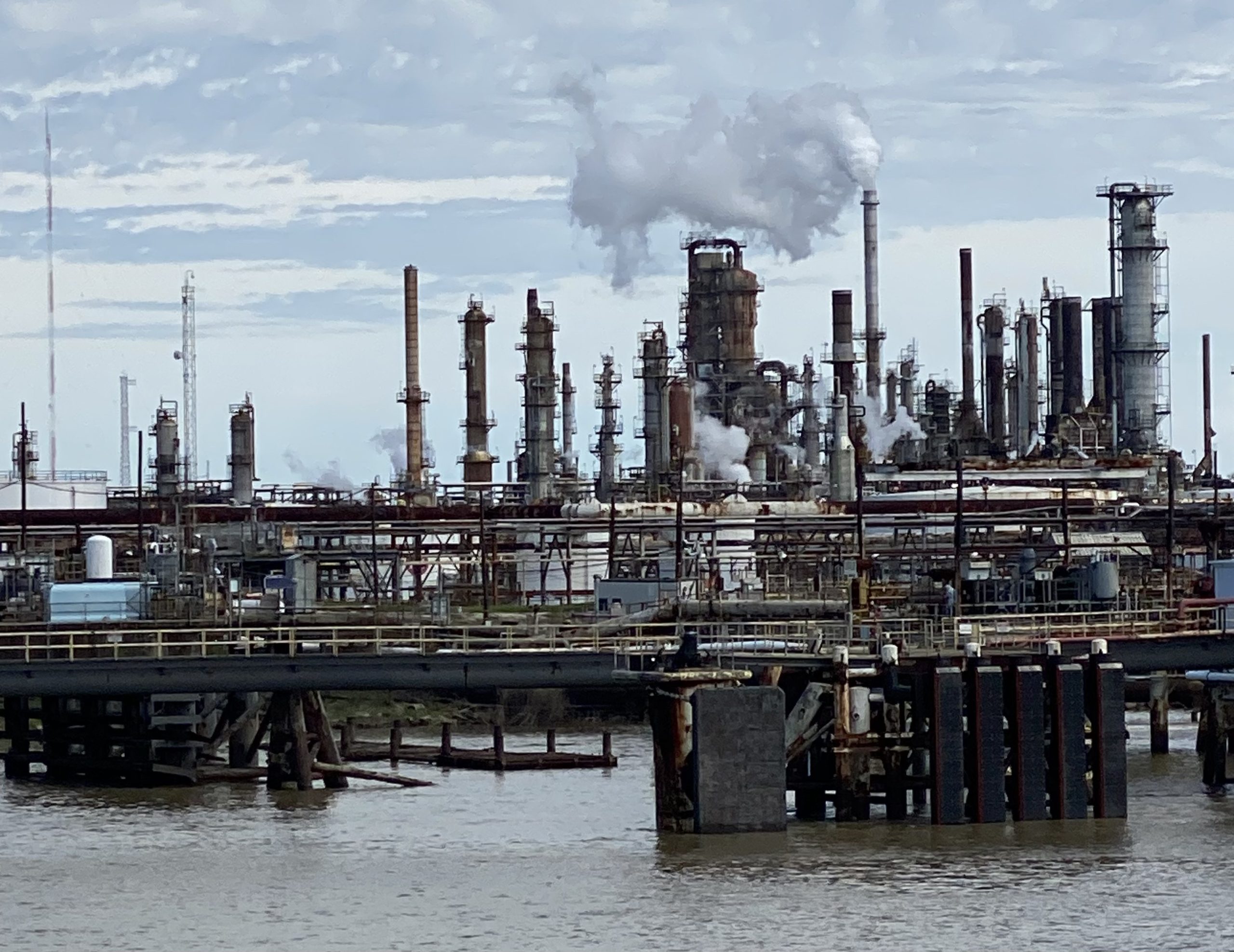
Public Health Watch has been reporting on Channelview for two years. Fumed, our recently released investigative podcast, chronicles its transformation from a quiet, riverside neighborhood to an environmental justice community plagued by pollution from chemical-filled barges and petrochemical facilities.
State Sen. Carol Alvarado, a Democrat who represents Channelview, was inspired to write the bill after a 2023 Public Health Watch investigation revealed that the Texas Commission on Environmental Quality, or TCEQ, had known for more than two decades about high levels of benzene downwind of a chemical distribution company called K-Solv. A more recent report revealed that TCEQ scientists found record-high benzene levels downwind of K-Solv again in 2021.
The Republican-dominated Texas Legislature has long been resistant to bills that tackle industrial pollution. Legislators received nearly $3 million in campaign contributions from the oil, gas and petrochemical industries in 2023 and 2024, according to FollowTheMoney.org.
Before Alvarado’s bill can be voted on by the entire Senate, it must first pass through the Senate Committee on Natural Resources. But the committee hasn’t scheduled a hearing for SB1179 and is unlikely to do so, given that Alvarado’s other bills have already received hearings. The legislative session ends on June 2.

“We have to exercise a lot of patience here,” Alvarado said last week when she met with a coalition of local environmental nonprofits. “I would love to do more but we just don’t have the political climate and the votes here in the Senate or in the House to make those more sweeping changes that we’d like to see.”
State Rep. Ana Hernandez, whose district also includes Channelview, filed an identical bill in the House, as well as two other bills related to benzene monitoring. None of those bills received committee hearings.
On the same day Alvarado spoke to community groups, she attended a Senate hearing with TCEQ chairwoman Brooke Paup, who was appointed to the job by Gov. Greg Abbott in January. Paup previously chaired the Texas Water Development Board.
During the hearing, Alvarado cited TCEQ records showing that between 2021 and 2023 the agency issued 27 notices of violation to K-Solv, along with 10 enforcement actions.
“It’s clear though that the TCEQ’s approach up to this point isn’t having the desired effect,” Alvarado said. “I don’t understand how a facility with so many violations and enforcement actions continues to get their permit renewed.”
Paup said she wasn’t familiar with K-Solv, but felt that her agency would take further enforcement action “because they have so many violations.”
The TCEQ did not elaborate on Paup’s comment but said it had settled its most recent case against K-Solv in March, fining it $132,000 for 17 violations.
K-Solv can now legally emit almost 20 times more volatile organic compounds than it did when Channelview’s benzene problem was discovered two decades ago. The company’s chemical permit is up for renewal in 2029.
In a statement to Public Health Watch, K-Solv said the type of monitoring required in Alvarado’s bill can’t pinpoint emissions from a single facility.
“We share Senator Alvarado’s concern for the environment and the residents of Channelview,” the company said. “Some of the published information about our firm does not accurately represent the challenges present in identifying emissions sources in such a heavily industrialized area … nor does it reflect our firm’s commitment and investments to protect our employees, neighbors and the environment.”
K-Solv said it is one of the smallest chemical plants in the area and has invested millions of dollars into upgrading the facility “with protection in mind.”
Alvarado told Public Health Watch in a statement that she will work with the TCEQ to hold companies accountable for their pollution.
“Environmental policy is an uphill battle in Austin. We make incremental progress each legislative session thanks to advocacy from ordinary Texans who bear the brunt of reckless emissions and lax enforcement,” Alvarado said. “I will continue to file legislation, next session and every session, to safeguard the health of communities across Texas.”
Alvarado has had more success this session with two bills related to concrete batch plants, which release microscopic particles tied to a growing list of health conditions. One, which passed unanimously in the Natural Resources Committee, requires the TCEQ to evaluate batch plant permits every six years. The bill must still be voted on by the full Senate and House and signed by the governor.
Adrian Shelley, who consulted on Alvarado’s benzene bill, said it took more than a decade of work to get movement on batch plant legislation. He said lawmakers slowly became aware of the hazards the plants pose through increased public attention, new bills introduced each session and the TCEQ independently taking action against the plants.
“We sometimes talk about what we call the ‘five session rule,’ which is that a really good, novel idea can take five sessions to mature and find its way to passage,” said Shelley, who directs the Texas branch of Public Citizen, a national nonprofit focused on curbing corporate power. “That’s 10 years, so that might give you a sense of kind of the pace of things.”
Shelley said there are two paths forward if SB1179 dies in committee. After the session ends, the Legislature could appoint a committee or order a study to evaluate the issues at the heart of the bill. Any recommendations that emerged could then be written into bills for the next session, in 2027.
“The day will come, I believe, when we have a Legislature that wants to take up good proposals that benefit the health and safety of the public,” Shelley said. “And it’s easier to have a good, strong starting point than it is to start from scratch.”