

The cancer risk from benzene emissions in Channelview, Texas, could be up to 2,000 times higher than the U.S. Environmental Protection Agency’s current estimate, according to two researchers who analyzed data that Public Health Watch made public earlier this month.
Chronic exposure to benzene can cause leukemia and other blood cancers. Short-term exposures to high levels can cause headaches, dizziness and unconsciousness.
“This is an unacceptable situation,” said Loren Hopkins, a professor at Rice University and one of the scientists who did the Channelview analysis. “It’s extremely unhealthy to be breathing concentrations of that magnitude.”
Last year, Public Health Watch reported that the Texas Commission on Environmental Quality, or TCEQ, had known for nearly two decades that residents in south Channelview were breathing dangerous levels of benzene. Earlier this month, we reported that the situation has deteriorated — and that the TCEQ’s stationary monitor in Channelview, which the EPA uses to gauge the community’s cancer risk, didn’t record high levels of benzene TCEQ field scientists measured in 2021 and 2022.
The new analysis by Hopkins and data analyst Laura Campos, who until recently was also at Rice University, reviewed 100 hours of samples — ranging from four minutes to three hours — that the field scientists collected. The researchers then compared those readings to readings from the stationary monitor at the same times.
The difference was startling: The field scientists’ readings exceeded the stationary monitor’s readings 89% of the time. And the average concentration the field scientists recorded — 38 parts of benzene per billion parts of air (ppb) — was 25 times higher than the 1.47 ppb average from the stationary monitor.
Hopkins and Campos also used the field scientists’ data to calculate new cancer risk estimates, which are usually based on annual emissions data companies are required to report and annual averages from the stationary monitor. Instead, Hopkins and Campos used the highest sample average the field scientists recorded — taken on a block in the industrialized southwestern corner of the community — and calculated what the cancer risk would be if that level of pollution were maintained for a year.
They found that the estimated cancer risk from benzene would be 4,920 cases in 1 million people. That’s 2,000 times higher than the EPA’s estimate of just 2.46 cases in 1 million for that block.
When presented with the results of the analysis, a spokesperson said the EPA “cannot comment on studies performed outside the agency.”
When Public Health Watch asked the TCEQ to address the discrepancy between field data and the monitor data, an agency spokesperson sent a link to a general explanation about how monitors are positioned.
“TCEQ follows strict guidelines in determining locations of monitoring stations,” the spokesperson said in an email. “No additional comments at this time.”
The gaps between the stationary monitor and the field data were also apparent when Hopkins and Campos compared daily benzene averages.
The highest daily average the field scientists recorded — 114 ppb — was on November 8, 2021. It was 92 times higher than the stationary monitor’s average for the same periods.
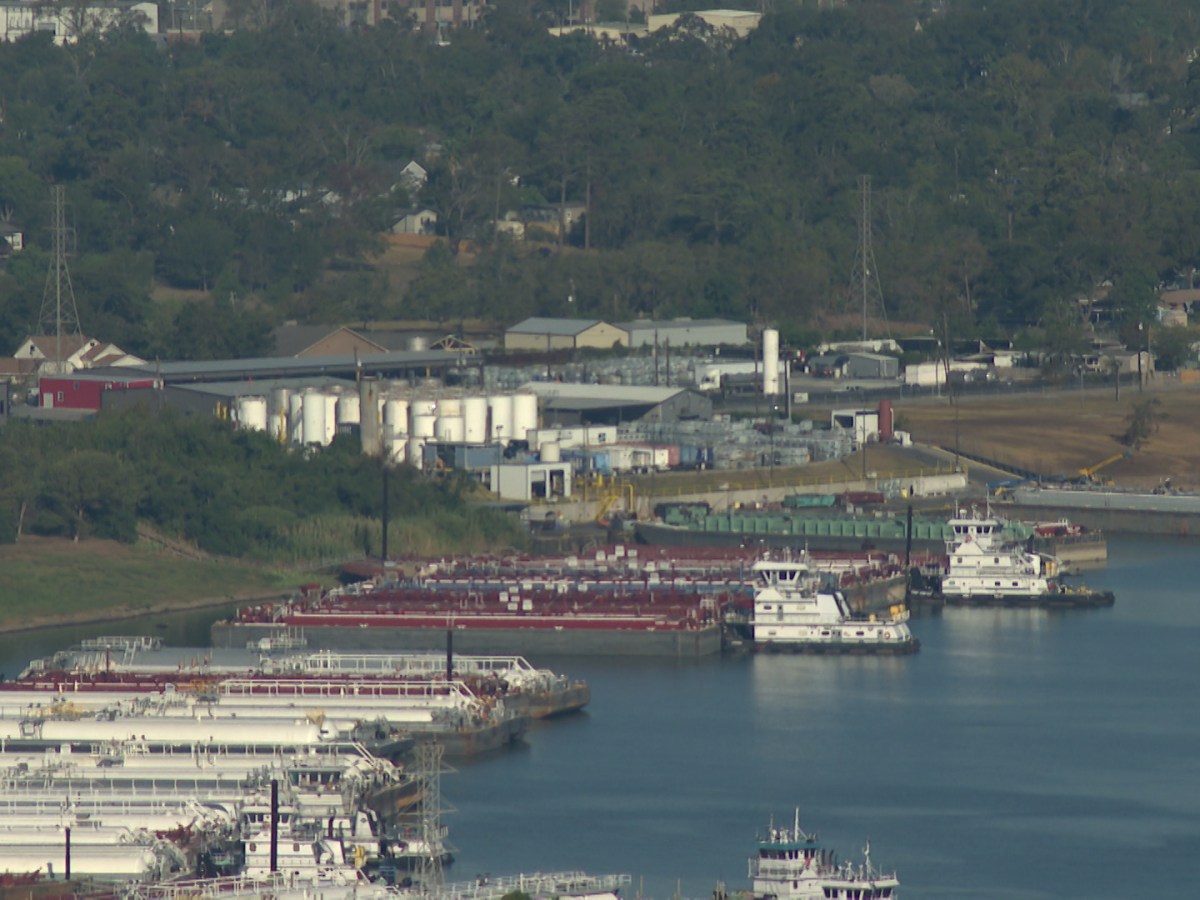
Some of the highest readings the field scientists recorded that day were taken near K-Solv, a chemical distribution and barge-cleaning company that’s less than 600 feet from homes in the southeastern corner of Channelview.
Channelview’s stationary monitor was originally positioned a half-mile downwind of K-Solv and the chemical barges that are moored around its property. But in February 2021, the TCEQ moved the monitor a mile to the west, where it’s no longer downwind of the facility. The TCEQ said it made the switch because the old site was too small to accommodate new equipment.
Before the move, the monitor recorded rolling annual averages that exceeded Texas’ benzene guideline, one of the weakest in the nation. Levels since then have remained below the limit, although they are rising.
The EPA is responsible for approving the placement of stationary monitors, but the agency spokesperson said it doesn’t require states to do extensive testing to determine the position of monitors that measure volatile organic compounds, a class of chemicals that includes benzene.
One benzene sample taken in 2021 on the census block closest to K-Solv — less than 30 feet from its fenceline — had an average of 87 ppb, the second-highest of the TCEQ samples, according to Campos’ and Hopkins’ analysis. That’s 59 times higher than what the stationary monitor recorded over the same hour.
If that average were maintained for a year, the estimated cancer risk for residents of that block would be 1,828 cases in 1 million people. The EPA’s estimate for that block is just 2.31 cases in 1 million.
K-Solv has repeatedly pointed to other sources of benzene in the area, including emissions from chemical barges along the San Jacinto River, which borders Channelview. But K-Solv was the only facility investigated after the TCEQ’s mobile monitoring trips in 2021 and 2022, according to a Public Health Watch review of TCEQ documents. The company paid a $131,997 fine to the TCEQ for 17 violations.
“Our company takes environmental issues seriously and provides access to our facilities when the TCEQ has any questions about our operations,” a K-Solv spokesperson said in a statement to Public Health Watch. “A single reading taken three years ago at an unspecified location does not take into account the multiple sources of benzene in close proximity to our plant and cannot be utilized to accurately predict readings on a year-round basis.”
Hopkins said it’s valid to use a high reading from a single sample as the basis for her and Campos’ cancer analysis, because no unexpected releases of benzene were reported in Channelview on the days the field scientists were there. Companies are required to notify the TCEQ when they release unauthorized amounts of benzene.
“There’s no reason to expect that it (the benzene concentration) would be quite a bit lower,” Hopkins said. “This could very well be routine operations and that needs to be investigated.”
The only way to know with certainty what’s happening on that corner, Hopkins said, would be to conduct consistent monitoring on a long-term basis.
That doesn’t appear likely.
The TCEQ told Public Health Watch that it has no plans to address Channelview’s benzene levels as long as readings on the stationary monitor are within state guidelines.