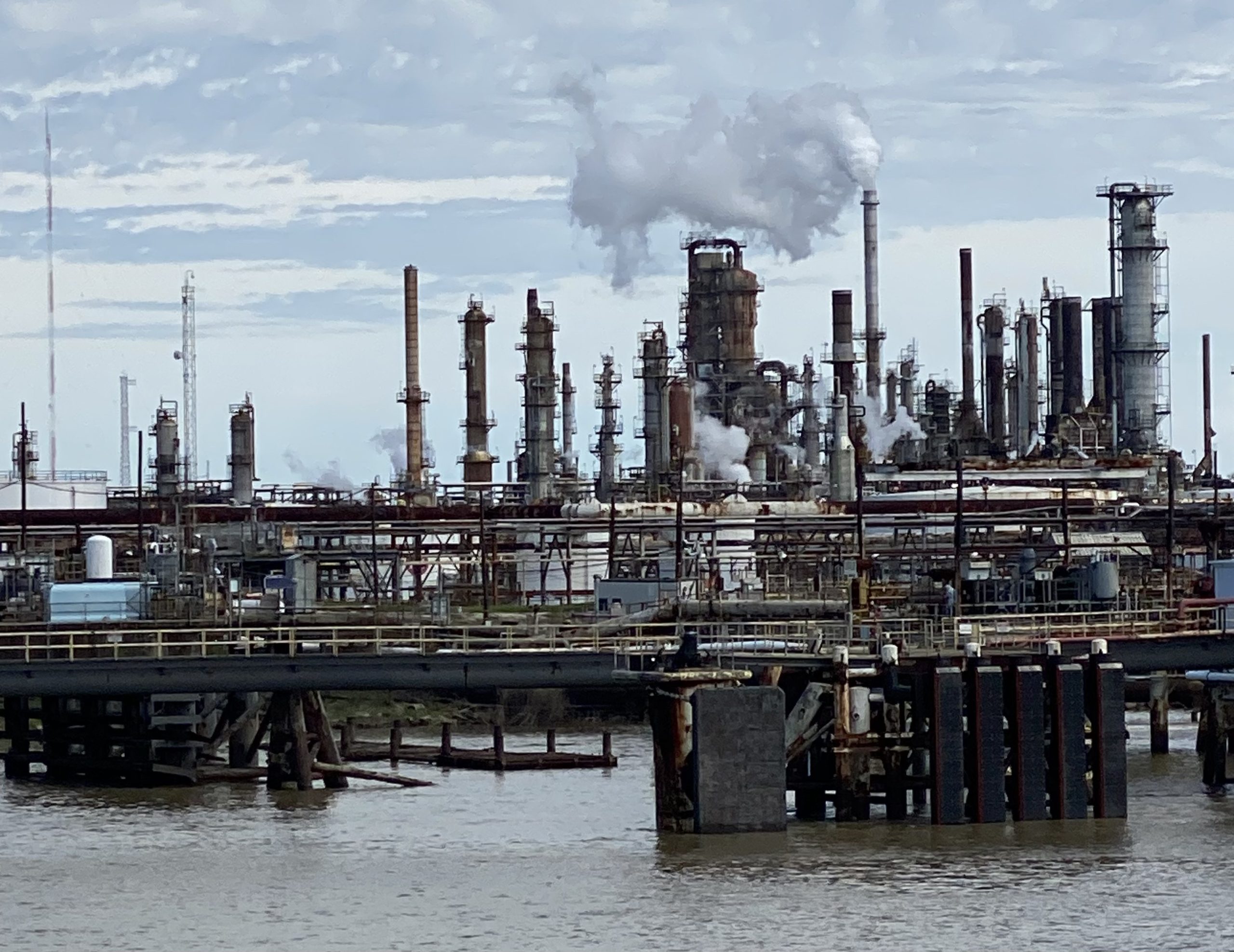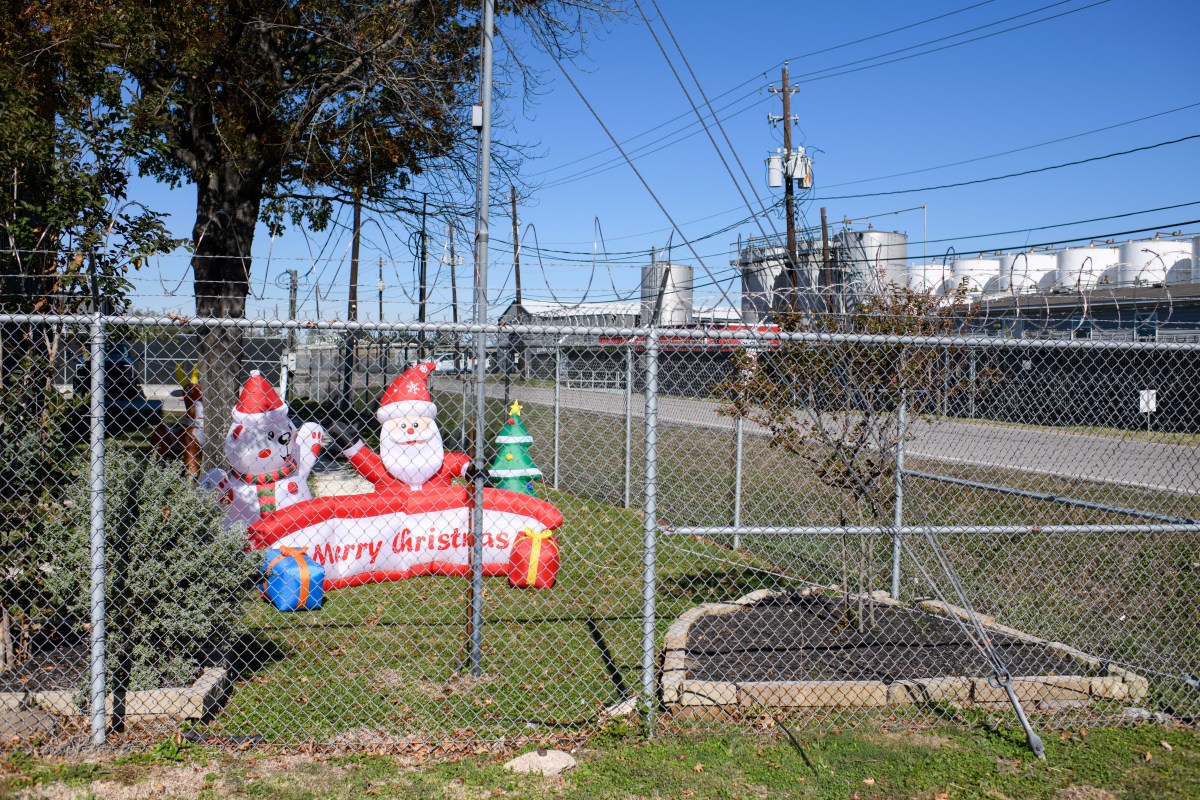
Texas State Sen. Carol Alvarado is exploring new legislation to address the issues uncovered during Public Health Watch’s investigation of chronic benzene pollution in the unincorporated community of Channelview, which has been flooded with the cancer-causing chemical for nearly two decades with little intervention from state regulators.
“I want the people of Channelview to know that we’re here to help them now that these findings have been brought to our attention. We are their voice in Austin and we’re going to do everything we can to bring their concerns forward,” said Alvarado, a Democrat whose district includes Channelview. “We are in a position to have some pretty hefty discussions with the TCEQ. We’re not taking this lightly.”
One option, Alvarado said, could be a law requiring the Texas Commission on Environmental Quality, or TCEQ, to inform lawmakers when there is an extreme benzene polluter in their district — a move that would ensure officials and residents are aware of pollution problems discovered by the state.
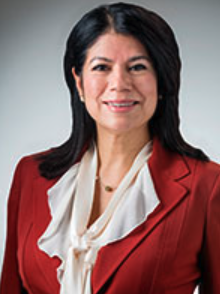
Alvarado’s team said it plans to have a more concrete proposal as early as mid-January — well ahead of the next legislative session in Texas, which begins in 2025. Passing any TCEQ-related legislation will be a challenge in the industry-friendly Texas Legislature, but Alvarado has succeeded before. In 2021, she pushed through a new chemical tank law after a massive fire consumed an ITC storage facility in 2019.
Public Health Watch’s investigation, which was published on Dec. 13, told how the TCEQ had known since 2005 that Channelview residents were routinely breathing dangerous levels of benzene, a chemical linked to leukemia and other blood cancers. But the state agency never told them about the health risks they faced and did little to punish the facility it knew was releasing large amounts of benzene.
Instead, the TCEQ allowed K-Solv, a chemical distribution company located in a residential part of Channelview along the San Jacinto River, to repeatedly expand its operations and increase the amount of chemicals it could legally release into the air. The 18-month investigation — based on thousands of pages of state documents and dozens of interviews with former Texas regulators, independent scientists and residents — found that Channelview’s benzene problem could be worse today than it was in 2005.
Public Health Watch presents…
‘Fumed’
An investigative podcast
Other Houston-area leaders also promised to hold the TCEQ accountable.
Harris County Commissioner Adrian Garcia, a second-term Democrat who represents Channelview on the Harris County Commissioners Court, said “all options are on the table.”
“It doesn’t surprise me that the [TCEQ] knew this and kept it from everybody,” Garcia said. Much of his 560-square-mile district lies in eastern Harris County, a region where residents live side by side with oil refineries and chemical plants.
Garcia was especially disturbed by the number of high-ranking TCEQ officials who failed to act despite knowing about Channelview’s plight. He believes state employees who chose not to intervene and protect residents’ well-being should be prosecuted for gross negligence.
“Someone had information. Someone had the power, the authority to act and chose not to because they wanted to take care of industry over community,” said Garcia, who served as sheriff of Harris County before entering politics. “That is just unconscionable. And they should be held accountable to the highest degrees of the law.”
Harris County Attorney Christian Menefee told Public Health Watch that his office has had its eye on K-Solv since 2021, when a chemical fire broke out at the company’s facility. Menefee’s office said it is exploring potential legal action against K-Solv and the TCEQ for their roles in Channelview’s ongoing benzene problems — though, as a previous Public Health Watch investigation found, the state legislature has passed laws that limit the power of counties to punish polluters.
Public Citizen, a national nonprofit that focuses on curbing the impact of corporate power, highlighted Public Health Watch’s work in an essay on its website titled, “The Startling Report out of Channelview Is What Happens When the State Puts Profits Over People.”
“What is happening in Channelview right now is not OK. The TCEQ knew that people in Channelview were at risk, but the agency refused to protect them,” wrote Adrian Shelley, director of Public Citizen’s office in Texas. “The same thing is happening in other communities across Texas. TCEQ doesn’t act because Texas’ leadership puts corporations over people. Unless we fundamentally change this approach, we will continue to see frightening reports from communities like Channelview.”
Following the release of its investigation, Public Health Watch asked the TCEQ if it planned to review its handling of Channelview’s long-standing benzene problems and its decisions to allow K-Solv to expand over the years. We also asked the agency if it plans to hold a public meeting in Channelview so residents can learn more about the state’s air monitoring efforts in the area. The TCEQ did not respond to these and other questions.
Texas State Rep. Ana Hernandez, whose district includes Channelview, didn’t respond to Public Health Watch’s questions about her reaction to the investigation’s findings or to more than a dozen interview requests over the past five months.
Public Health Watch asked the U.S. Environmental Protection Agency’s Region 6 office, which oversees federal clean-air laws in Texas and five other states, if it bears any responsibility for Channelview’s sustained benzene emissions and if it plans to enhance its monitoring efforts there, as it has done in other parts of Harris County. An agency spokesperson said Region 6 will provide “a substantive response … once staff returns after the new year.”
For the first time in years, Channelview residents are cautiously optimistic that their pollution problems will be addressed. Now they want their leaders’ statements to lead to substantive change.
“The TCEQ needs to answer for this. I can’t begin to imagine seeing someone dying from cancer and saying, ‘I could have done something but I chose not to,’” said Carolyn Stone, a longtime resident who founded the Channelview Health & Improvement Coalition. “We want action. And we want it now.”